











Editor’s note: The views and opinions expressed in this review are solely those of Marlon Wallace and do not necessarily reflect the views and opinions of WBOC.
The same day that this film was released theatrically, a YouTube video was posted about writer and talk show host, Dennis Prager. In the video, Prager said, “I think that the belief that many young women have that if they find a man, that’s a great thing, but the thing that will really bring them joy in life is career has misled massive numbers of women into a less happy life. Career is not as terrific as the feminist’s portrayed it as being. The joy available for most women with a good husband and making a family is incomparably more than from a career.” In the video, talk show host, Ana Kasparian pushed back on the idea of the role of women being homemaker or career-minded as not mutually exclusive. Prager’s view seems to be representative of some, if not a lot of men that a woman should and perhaps only be a homemaker or housewife who only cooks, cleans and raises children, basically subservient to their husbands.
This film, directed by Olivia Wilde, is essentially a critique of that idea from Prager. There’s some reporting that suggests Wilde is critiquing the incel community, and there’s some truth to that here, but her film is more a critique of this Conservative idea that women’s roles should be wife and homemaker and nothing else. Wilde’s critique is that for some women, that Conservative idea can make women feel trapped. For some women, that idea is akin to a bird in a gilded cage. Unfortunately, Wilde’s film fails to show the reasons why women would feel trapped in a marriage, especially women prior to the 1970’s and prior to the 60’s, which is seemingly where this film is set. Until the 60’s, when the Women’s liberation movement went into full force, women had legitimate social and economic reasons to feel trapped. Wilde doesn’t go into any of those reasons. Her team of writers instead concoct a literal way to depict a married woman as being trapped and that’s it. It’s an interesting visualization, but it’s only superficial. There’s no substance to it.

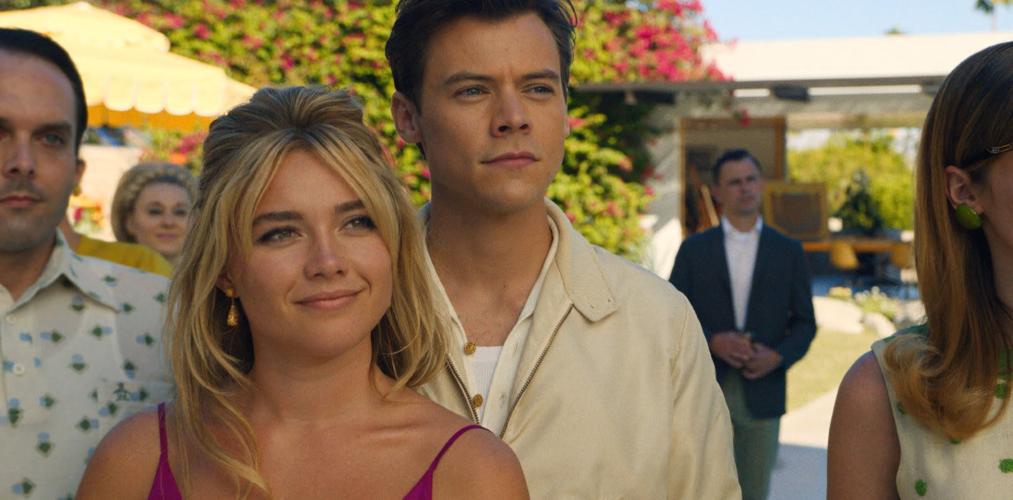
Florence Pugh (Black Widow and Little Women) stars as Alice Chambers, a housewife living in a desert community with her husband. It’s not clear how long they’ve been married, but they behave like newlyweds in terms of the amount of sex they have. They’re constantly all over each other. By the way things are decorated and styled, it appears as though she lives in the 50’s or 60’s. Aside from sex with her husband, we only see her cooking and cleaning the house. We see her repeating that over and over. She seems happy and content. The only inkling of a problem is that she doesn’t want to have children, whereas her husband does.
Harry Styles (Eternals and Dunkirk) co-stars as Jack Chambers, her husband who has a job working at a company in the desert. The company provides housing for its employees and that’s where Jack and Alice live. He certainly seems happy, even though we never see him at work. The film is told almost exclusively from Alice’s point-of-view and he comes across as a loving and good guy. He does seem very loyal to his employer and obviously Jack wants to fit into the community in the desert because he fears if not he’ll lose his job and he and Alice will lose everything.

Chris Pine (Wonder Woman and Star Trek) also co-stars as Frank, the employer of Jack and the man who is the leader of the desert community known as “Victory.” It’s clear from his first speech that Frank is very much akin to a cult leader. He never raises his voice. He’s always calm and sounds reasonable. Yet, there’s always something insidious just lying beneath his surface. He has a charm and an appeal, but he comes across as really sinister, even when he’s not saying anything overtly sinister. He simply has this creepy aura about him.
Things get even creepier when Alice discovers that she’s not allowed to leave or go beyond a certain point in their “Victory” community. She’s also not allowed to know the true nature of what Frank’s company does. When any of the housewives in the Victory community try to leave or go beyond the boundary, something bad happens. When Alice questions this, she becomes the victim of gaslighting. Everyone tries to convince her that everything is fine. It’s in this that we see Wilde’s critique becoming more and more literal.

When the mystery of what Frank is doing and why Alice is the victim of gaslighting is revealed, the film is taken into a new direction that’s there more for the shock value than to be an insightful or interesting critique or even exploration of the issue at hand. It felt more like an ending to a M. Night Shyamalan film, which is ironic given the trailer for Shyamalan’s Knock at the Cabin (2023) played before this film. In other words, the reveal in the third act felt like a twist for a twist’s sake. The implications of what comes in that reveal aren’t given enough time to be explored or even explained before the film comes crashing to a halt.
Spoiler alert! Spoiler alert! Spoiler alert!

What’s revealed is that Alice isn’t a housewife living in California in the 1950’s. She’s actually a medical doctor, a surgeon in fact, living in an apartment in New York. Her life as a 50’s housewife is an illusion that she is being forced to experience due to some machine to which she is connected. We are led to believe that Jack forced her into this situation, most likely against her will, but we don’t see the particulars of that or how he pulled this off. He simply believes that instead of her medical career, she’d rather live the life of a 50’s housewife with him.
It’s like The Matrix (1999) but if the robots were just sexually-frustrated men. It’s also like Total Recall (1990) but instead gender-swapped and purporting some right-wing domesticity fantasy. It could also be like The Truman Show (1998) or Pleasantville (1998) but with more of a feminist screed. It could also be any number of episodes of Black Mirror (2011), including the Emmy-winning “USS Callister.” For fans of Marvel and Disney +, this film is also basically ripping off the Emmy-winning WandaVision (2021). However, the difference between all those properties and this is that this film doesn’t give any time to explore and delve into what is the mind-bending premise. It merely surprises us with this reveal and then drops it, which felt unsatisfying.
Rated R for sexuality, violent content and language.
Running Time: 2 hrs. and 2 mins.
In theaters.