




Editor’s note: The views and opinions expressed in this review are solely those of Marlon Wallace and do not necessarily reflect the views and opinions of WBOC.
Elvis Presley is regarded as one of the most significant, cultural icons of the 20th century. He was nicknamed the “King of Rock and Roll.” He sold over 400 million records worldwide and is considered the best-selling solo music artist of all-time, according to the Guinness World Records. He rose to prominence in the 1950’s and highly influenced teenage culture back then. When it came to older generations, he was seen as controversial, mainly due to his performance style, which was very sexually provocative dance moves. His gyrations were inspired by the moves of African American music artists that he saw. However, he also drew controversy due to the fact that he copied or ripped off African American music or just incorporated Black culture into his work. Presley was from Mississippi and grew up in the Jim Crow south, but he made his fame and fortune prior to the Civil Rights Movement and dealt with people who were very much racist and did not want him popularizing Black culture.
This film, directed and co-written by Baz Luhrmann (Moulin Rouge! and The Great Gatsby), acknowledges that racism. In those moments, the film leans more toward hagiography. The film suggests that despite growing up in the Jim Crow south, Presley didn’t have a racist bone in his body. He grew up in a predominantly Black neighborhood in Tupelo. When his family moved to Memphis, Tennessee, he spent time on Beale Street, which has historically been a predominantly, Black area. The film does show those Black influences for Presley. It also shows his friendship with Black artists like B.B. King. However, filmmaker Eugene Jarecki’s documentary The King (2018) goes into criticism of Presley’s cultural appropriation and limited contribution or lack thereof to the Civil Rights Movement.

Presley was alive during the Civil Rights Movement and this film doesn’t depict any activism or outspoken comments from Presley. This is probably due to the fact that Presley didn’t engage in any activism or make any outspoken comments for Black civil rights. Maybe Presley did, but this film doesn’t depict it. Tom Hanks (Saving Private Ryan and Forrest Gump) stars as Colonel Tom Parker, a music promoter who becomes an agent or kind of manager for Elvis Presley. He becomes a controlling and manipulative force that is working insidiously to exploit Elvis for his talent for selfish purposes.
There is a point where the Colonel tells Elvis that he shouldn’t do any activism or be outspoken about politics. However, there is a whole sequence about the Colonel trying to stop Elvis from expressing himself how Elvis wants to express himself. Yet, the end of that sequence is Elvis expressing himself how he wants in spite of the Colonel. This sequence proves that if Elvis wanted to do any activism or be outspoken about Black civil rights, Elvis could have. The fact that we never see him do so is an indictment. I’m not sure if the real-life man ever did so, but the comments in Jarecki’s film would seem to suggest otherwise. The fact that we never see Elvis’ lack of political activism or outspokenness addressed in this film is an indictment on Luhrmann’s writing and directing.

There have been films that have addressed the struggle for certain music artists to engage in political activism or not because of fears of how it will affect their careers and the business behind them. Regina King’s One Night in Miami (2020) and Matthew Heineman’s The Boy from Medellín (2021) both address this issue directly and better. Arguably, the issue is more of a central focus in those two films. It’s not a central issue here. It didn’t have to be a central issue, but it’s unfortunate that it’s not. This film instead chooses to focus itself on the toxic relationship between Elvis and the Colonel.
Unfortunately, for Luhrmann, that kind of toxic relationship has been present in so many films about famous music artists and their controlling or manipulative managers. From Straight Outta Compton (2015), Rocketman (2019) and Respect (2021), the idea of a famous music artist having a controlling or manipulative manager is at this point cliché or hackneyed. The best example of this kind of toxic relationship played out in the brilliant Love & Mercy (2015) about Brian Wilson of the Beach Boys. I wasn’t as moved by this film’s depiction of that relationship, as I was in Love & Mercy. It’s probably because Hanks’ performance is so over-the-top. It’s cartoon-like in its villainy.

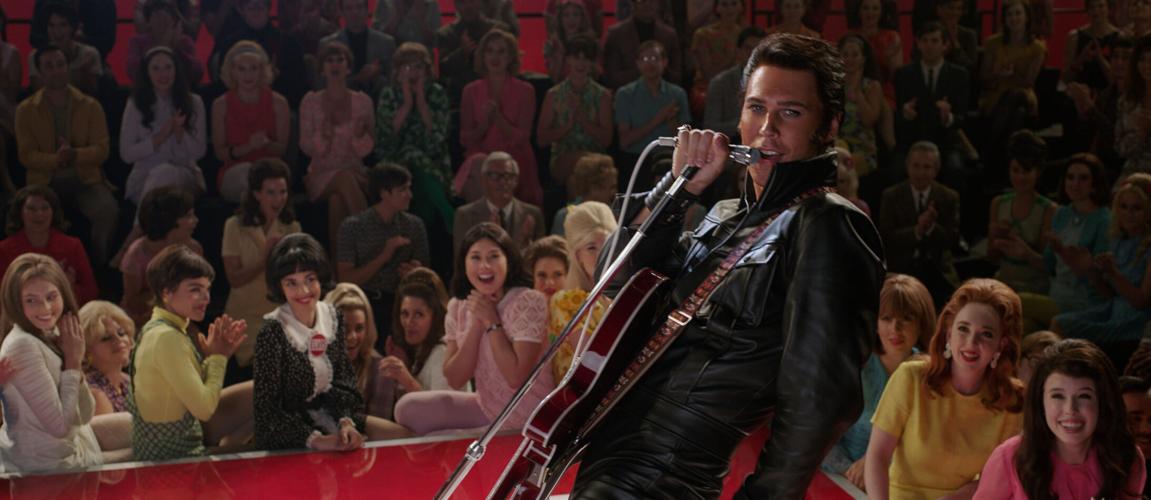
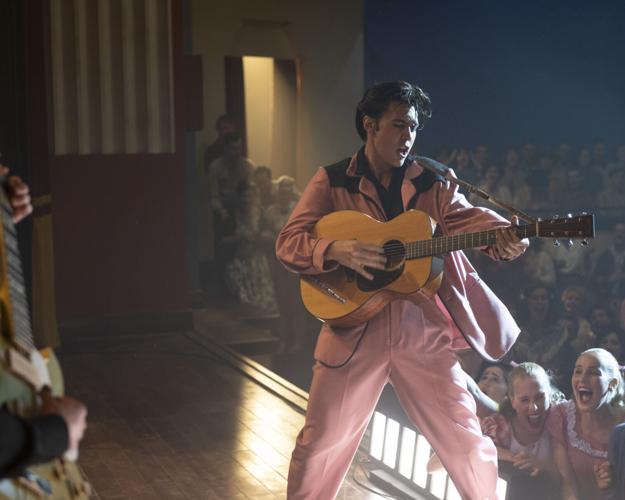
Austin Butler plays Elvis Presley with a kind of sex appeal and verve that works to embody why some would be charmed or attracted to him. Luhrmann’s sequences depicting his sex appeal go way over-the-top as to be eye-rolling, but Butler is still swoon-worthy in Elvis’ blue suede shoes. There are even moments where he bounces off Hanks nicely and even goes toe-to-toe with him in a way that was engaging.
Rated PG-13 for substance abuse, strong language, suggestive and smoking.
Running Time: 2 hrs. and 39 mins.
In theaters.