



Alexander Payne has now eight features as director since his debut in 1996. I've only liked two of those features, that of Election (1999) and Sideways (2004). I don't always jive with the stories Payne writes and chooses to direct. All of Payne's films tend to be comedies, ranging from satire to something sweeter. This film leans more toward his sweeter side. It centers on a kind of character that appears to be a favorite of Payne. Election was about a male history teacher. Sideways was about a male English literature teacher. This film is no surprise about a male teacher who does history and literature. Payne even brings back his actor from Sideways, which won Payne his first Oscar.
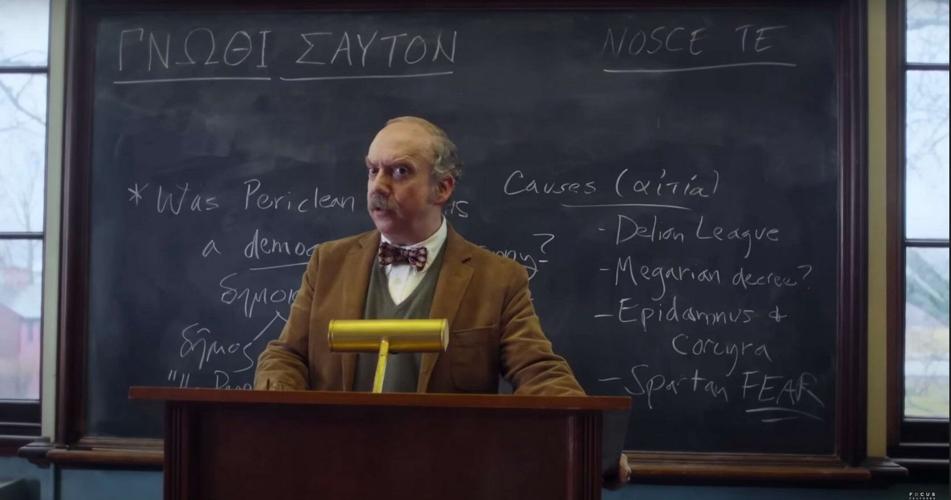
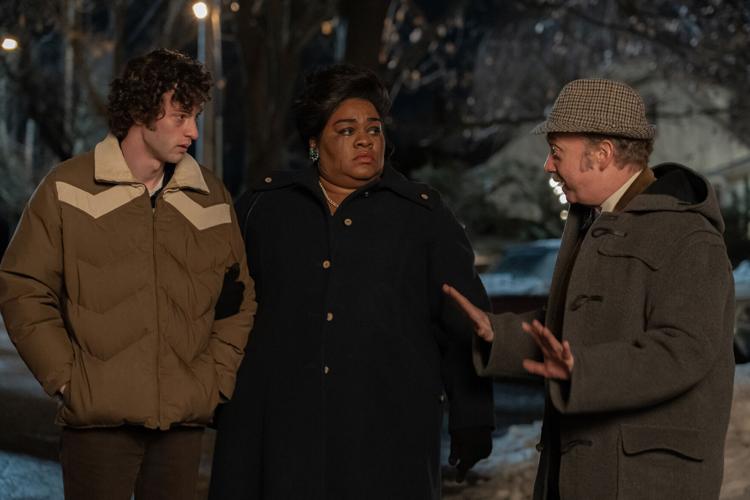
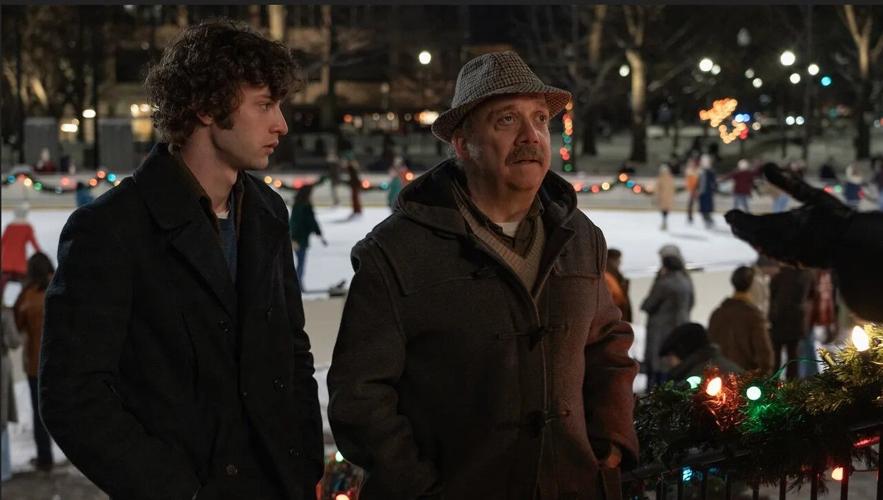
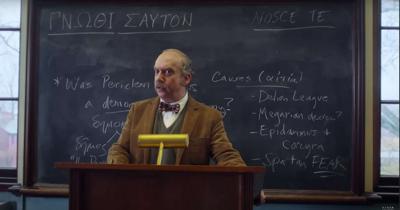
Paul Giamatti (Sideways and American Splendor) stars as Paul Hunham, a teacher at Barton Academy in 1970, a boarding school, somewhere in Massachusetts. He's not very social. He prefers to have his head in a book than attend parties for example. He's in fact very erudite. He specializes in ancient civilizations like the Greeks or Romans. He is very strict about his job and he is very strict about education, how much he values it and how much integrity he has about it. Because the academy is financed largely through wealthy donors who insist their boys attend the school, he's often pressured to give good grades to those boys, known as legacy students. Yet, Hunham doesn't relent. He won't give good grades to someone if they didn't earn it. Because he doesn't relent, this puts him at odds with the dean of the academy.

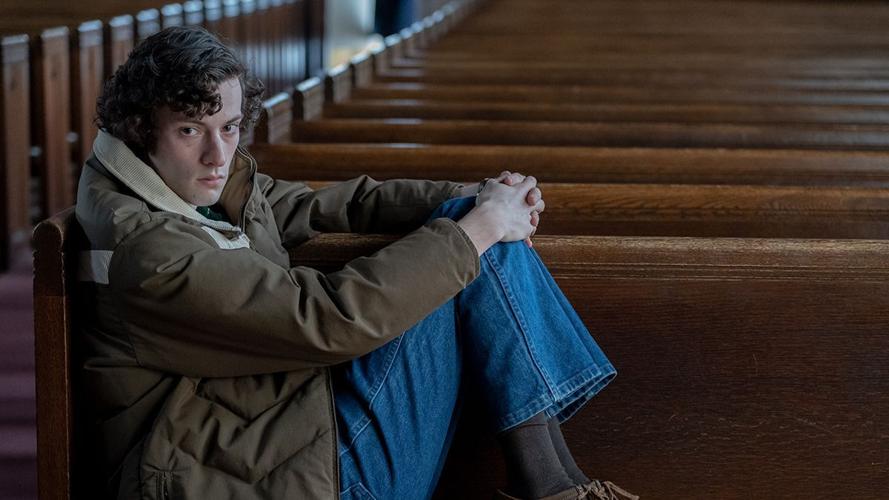
Dominic Sessa, in his feature debut, plays Angus Tully, a brilliant young man who is also a bit smug and is good at wise-cracking. Obviously, it's a defense mechanism for a lot of the things that he's experienced. For starters, he's been kicked out of three other schools. It becomes clear why, as Angus is good at picking fights by way of insulting people, which he can be quick to do. He doesn't want to get kicked out of this school, not because he loves it at Barton but because his parents have threatened to send him to a military academy if he gets into trouble again. Yet, Angus is homesick and knows that being sent to military school will further separate him from his family.
The premise of this film is about that separation that Angus is already feeling. For about two weeks, Barton sends its students home for the Christmas and New Year's holiday. They leave in mid-December and don't return until January, but, for whatever reason, some students can't go home. For those students who can't, the school provides them with accommodations and supervision for those two weeks. In 1970, Hunham is the one chosen to be that supervision. All the other faculty gets a holiday break. Only one is required to stay and be that supervision. Because Hunham has no family or much of a social life, he becomes the obvious choice. Hunham would rather relax and be by himself, but the dean pressures him until Hunham reluctantly takes the assignment.

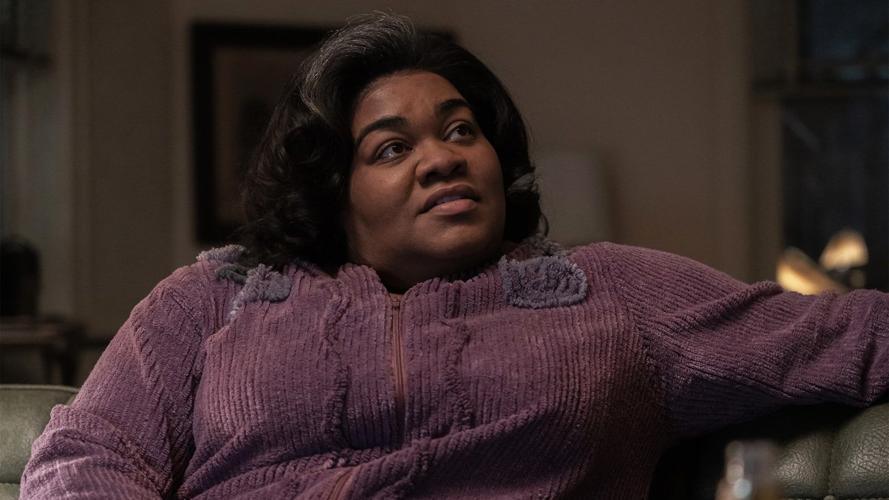
Da'Vine Joy Randolph (The United States vs. Billie Holiday and Dolemite Is My Name) co-stars as Mary Lamb, the woman who runs the kitchen at Barton Academy. Her son was a student at the school. He wanted to go to college, so she got a job at the academy to help pay for his education. When things didn't work out, her son decided to go into the military and had to serve in the Vietnam War. Unfortunately, her son gets killed in action just before the holidays and Mary is in mourning for this season. Yet, she still decides to work during the break, staying at the academy along with Hunham and the five students who are also staying during the holiday.
Mary is dealing with loss in a more literal and visceral sense. It might be stronger than the loss that the other characters experience, but it seems as if the other characters are experiencing loss as well. When it comes to Angus, he is experiencing a loss in that his parents have told him that he can't go home for the holidays because they're on their honeymoon. Angus' mother remarried a man who is now his stepfather and they are the ones on their honeymoon. That's one loss that Angus suffers. The other is his biological father who has been lost in a more mental sense if not physical one. When it comes to Hunham, it's not specifically a person that he's lost but a pathway for his life. It's not that he's not happy with where he is in his current station, but he reveals that he could've gone down a certain path that he didn't get to do.

This is Payne's first period piece. All of his other films are set in the present. His previous film Downsizing (2017) had a quasi-futuristic setting but could be seen as being set in an alternative present. However, this is his first film taking place totally in the past. Obviously, nailing the 70's look and feel was important. Almost immediately, as soon as the film starts and before you even see a single frame, Payne and his production departments are able to achieve that 70's feeling perfectly. His team were able to mimic a sound that feels like it was recorded using audio equipment of the time or played back using vinyl. His team also mimics a sight that feels like this film was actually photographed in 1970, using celluloid, as opposed to the digital tech of today.
Nothing more underlines that feeling of the 1970's than this film's soundtrack. Payne's team, likely his music supervisor, curated a lot of songs, new and old, that immerse us into that time period. The soundtrack also bolsters the film's themes. None is more fitting than the song at the end, right before the end credits. That song is "Crying Laughing Loving Lying" (1972) by Labi Siffre, a Black queer musician. Strangely, that song helps to illustrate how lying isn't always a bad thing. Most media always demonize the idea of lying. This film holds up lying as sometimes being a virtue. Thanks to the performance between Giamatti and Sessa toward the end, as well as the punctuation of this beautiful song, this film's conclusion certainly had me in tears and had me understanding how lying can strangely sometimes be an act of love.

Rated R for language, some drug use and brief sexual material.
Running Time: 2 hrs. and 13 mins.
In theaters.