


This movie has a first act and a second act but no third act. Usually, a movie is divided into three parts or three acts, the beginning, middle and end. This movie has a pretty well-done middle section but then it just stops. Writer-director Anna Muylaert ends her film on a hopeful note. One can infer a lot, but that does not a conclusion make. It’s not that I needed every plot point wrapped up, but with no clear conclusion, it’s difficult to know what the overall purpose was.
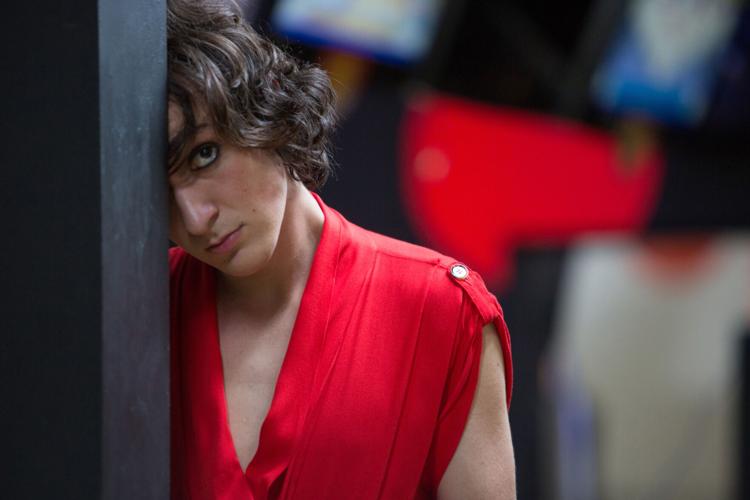
Naomi Nero stars as Pierre, a young person who will kiss any other regardless of sex and will probably have intercourse with any other as well. Pierre is at least gender non-conforming, but most people assume Pierre to be a boy. Whether Pierre is gender non-conforming, a cross-dresser or trans-gendered, we never learn because this film has no conclusion. It leaves everything up in the air essentially, so for simplicity’s sake, I will refer to Pierre with masculine pronouns.
At first, he behaves like a horny teenage boy. He has sex with a girl in a nightclub. He gropes another girl or possibly the same one in poetry class. He plays in a garage band, but he paints his nails, grows his hair long and shaves his body hair. Eventually, he starts to wear what’s traditionally female clothes. Yet, that’s not unusual. David Bowie, Prince, Gene Simmons and Ozzy Osbourne are all male rock stars who dabbled in androgyny or painting their nails and having their hair long. Pierre, however, had a girlfriend but he pulls away from her and gravitates more toward his male band leader.
Questions start to arise about if Pierre is bisexual or just gay, but questions arise that challenge if he identifies as a boy or a girl because his propensity for dresses could just be that or he could be in the process of transitioning. Some might argue that these questions don’t matter and that Pierre is just Pierre who has no need for labels or to be put in boxes.
Except, there is a difference between RuPaul and Caitlyn Jenner. RuPaul is a drag queen and Caitlyn Jenner is trans-gendered. From the outside, it could be seen as both are just boys who like to dress up as girls, but that’s not true. RuPaul identifies as one thing and Jenner identifies as another, and we shouldn’t confuse the two, which is why we shouldn’t confuse Pierre, but this movie is fine with leaving us with the confusion.
Muylaert might instead not care if the confusion exists. The goal is to start the idea of acceptance of a person who might not know what they are. Pierre is only 17. His identity might not be fully formed. He’s probably not sure what he even is, which is fine. There’s no rush, but he has some idea. Yet, he never articulates any of it. Muylaert, like a good filmmaker, is all about showing and not telling, but when it comes to LGBT issues, dialogue is important, but Muylaert keeps the character mostly mute.
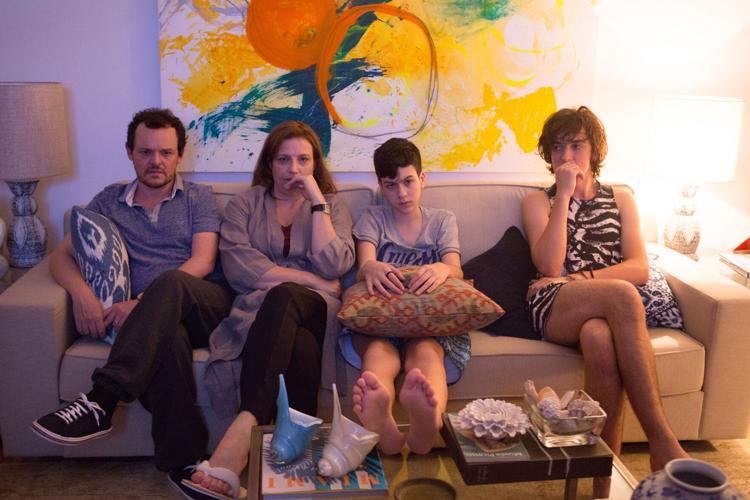
This doesn’t help with the crazy narrative that Muylaert has concocted. What is learned is that Pierre and his sister Jacqueline were stolen as babies and raised by a woman for some reason. Eventually, the biological parents find them and take them back, but this doesn’t change the fact that Pierre still loves the woman who basically kidnapped him.
A lot of questions arise from this narrative. How did the woman steal these babies and get away with it? What was wrong with the security at the hospitals where they were born? How did she forge birth certificates in order to get her stolen children medical care or signed up for school? How did the biological parents realize that it was her?

Sao Paulo/ SP - Dezembro, 2014 STILL Longa ' Mae So Ha Uma ' , de Anna Muylaert Fotos: Aline Arruda *** OBRIGATORIO O USO DE CREDITO EM FOTOS PUBLICADAS NA WEB ou IMPRESSO ***
Muylaert could argue these questions also don’t matter, but these questions go to the point-of-view of the parents of which we only get glances. The whole thing is Pierre’s perspective, but if this is a movie that’s as much about his biological parents accepting him for who he is, then their point-of-view is required. A better example of this is The Deep End of the Ocean (1999), which doesn’t have the gender identity issues here, but it was more balanced in its perspectives.
Muylaert also seems to pad the run time with what Joca, the prepubescent brother to Pierre whom he never knew, does with regard to some relationship he’s supposedly having. I could not have cared less about that brother.
Mãe Só Há Uma
Not Rated but contains language, sexuality and nudity.
Running Time: 1 hr. and 22 mins.
Available on Netflix.