
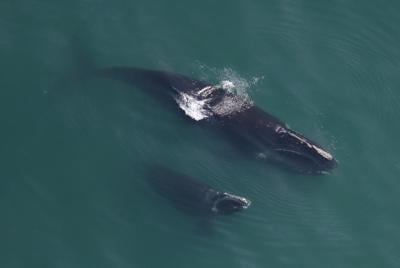

DELMARVA - Federal fisheries officials are beginning a process that could eventually lead to new fishing restrictions along the East Coast designed to protect native whale species.
The National Marine Fisheries Service, part of the National Oceanic and Atmospheric Administration, announced Aug 14 that it intends to conduct an environmental review of potential changes to the Atlantic Large Whale Take Reduction Plan. The plan is intended to reduce deaths and serious injuries of North Atlantic right whales, humpback whales, and fin whales caused by entanglements in commercial trap/pot and gillnet fishing gear along the East Coast.
NMFS stresses that Friday’s publication merely begins a public comment process and is not a proposed federal rule.
Potential impact on Mid-Atlantic fisheries
Several fisheries included in the federal review are found in the Mid-Atlantic.
The list includes gillnet fisheries for species such as striped bass, menhaden, spot, croaker, bluefish, weakfish, black drum, American shad, Spanish mackerel, sharks, and white and yellow perch.
Atlantic mixed-species trap/pot fisheries for black sea bass, conch and whelk, tautog, spot, and other species are also included, along with the Atlantic blue crab trap/pot fishery and Mid-Atlantic lobster and Jonah crab fisheries.
NMFS has not determined what changes, if any, would ultimately apply to those fisheries or specific areas of Delmarva.
Among the measures the agency is seeking public input on are limits intended to reduce the number of vertical fishing lines, changes to gillnet configurations, shorter lengths of time for fishing gear to be in the water, seasonal fishing restrictions, and changes to existing closure areas.
Other possibilities include ropes and nets designed to break more easily if a whale becomes entangled, changes to gear-marking requirements, and the use of ropeless or on-demand fishing gear. NMFS says any use of ropeless retrieval devices would be subject to testing for safety, affordability, and operational feasibility.
The agency is also considering dynamic management areas that could allow restrictions to be implemented in response to real-time right whale aggregations.
Balancing whale protection and fishing industry impacts
NMFS says the environmental review will examine both the potential benefits to whales and the economic consequences for commercial fishermen. The agency acknowledges possible restrictions could cause "severe economic strain" on family-owned fishing businesses and threaten the cultural heritage of coastal fishing communities.
Potential impacts identified by NMFS include the cost of purchasing or modifying gear, additional labor, safety concerns, reduced catches, and lost access to fishing grounds during seasonal restrictions.
At the same time, the agency says additional measures may be necessary to reduce the number of North Atlantic right whales killed or seriously injured by fishing gear. NOAA estimates approximately 380 North Atlantic right whales were alive in 2024. That's an increase from an estimated 359 in 2020, but still below the population's recovery goals.
Since an unusual mortality event was declared in 2017, 176 right whales have suffered documented impacts in U.S. and Canadian waters, according to NMFS. Those include 43 deaths, 41 serious injuries, and 92 whales suffering other injuries or illnesses.
NMFS says 111 of those incidents, or 63 percent, were attributed to fishing-gear entanglements.
What happens next
The process is expected to take several years, according to federal officials. NMFS plans to convene its Atlantic Large Whale Take Reduction Team in 2026 and 2027 to consider possible changes. The agency expects to complete an Environmental Assessment or draft Environmental Impact Statement, if required, by late 2027.
A final federal decision is expected in late 2028. Congress has directed NMFS to have new regulations for American lobster and Jonah crab fisheries take effect by the end of 2028.
For now, federal officials are asking fishermen, coastal communities, state and local governments, and members of the public to weigh in on what potential measures should be studied and their possible environmental and economic effects.
The notice is scheduled for formal publication in the Federal Register on Monday, Aug. 17. Digital public comments can be made by visiting regulations.gov and searching "NOAA-NMFS-2025-0041."