
LIANYUNGANG, JIANGSU, CHINA, August 18, 2026 /EINPresswire.com/ -- An industrial water treatment plant in eastern China recently faced an unexpected shutdown when a series of high-output ultraviolet disinfection units suddenly lost operational efficiency. Maintenance teams quickly discovered that the issue did not stem from depleted lamp filaments or electrical ballasts, but rather from severe surface fouling and micro-fractures along the protective quartz sleeves. The thermal stress from continuous fluid exposure, combined with subtle optical degradation, had compromised the system's target wavelength output. Facility managers navigating municipal water purification, industrial wastewater treatment, and ultra-pure fluid processing frequently encounter these exact operational hurdles. Selecting an optimal protective barrier requires balancing precise material science with mechanical design, making the partnership with a top-rated quartz sleeve for UV solution provider from china essential for long-term system stability.
Standardizing the Protective Barrier Selection Process
Ultraviolet disinfection technology relies on clear radiation transfer across specified spectral bands, primarily 254 nm for germicidal neutralization and 185 nm for total organic carbon reduction. Within these operating environments, quartz sleeves serve a dual function. They isolate hot lamp surfaces from cold process fluids while maintaining optimal operating temperatures and ensuring maximum ultraviolet light passage. Selecting a sleeve based purely on unit cost or generalized catalog numbers often leads to premature seal degradation, optical fogging, or structural fatigue under pressure surges.
Engineering guidance from Lianyungang Southeast Quartz Products Co., Ltd. emphasizes that system managers benefit most from establishing a structured, four-step evaluation method. By systematically analyzing process media, mechanical interface configurations, physical dimensions, and wall thickness specifications, operations teams transform complex component selection into a predictable technical workflow.
Step 1: Evaluating Process Media and Optical Wavelength Requirements
The surrounding fluid medium directly dictates the required chemical resistance and surface preparation of a quartz protective sleeve. Neutral municipal drinking water applications present different chemical interactions than industrial effluents containing trace acids, organic solvents, or heavy mineral concentrations. In aggressive chemical environments, unprotected glass structures suffer from surface etching or mineral scaling, which rapidly degrades ultraviolet light output.
High-purity fused silica provides the primary material foundation required to withstand these demanding operational environments. Utilizing raw materials with a silicon dioxide content reaching or exceeding 99.99%, Southeast Quartz manufactures components that maintain exceptional dimensional stability, high-temperature resistance up to 1200°C, and minimal trace element interference. For precise fluid processes, sourcing components from a top-rated quartz sleeve for UV provider ensures that raw material purity aligns with specific optical transmission requirements.
Target radiation wavelengths further define material requirements. Standard disinfection systems operating at 254 nm require synthetic or high-purity fused quartz to prevent internal radiation absorption. TOC oxidation processes operating at 185 nm demand clear silica structures free of hydroxyl content (OH-) to prevent ozone-induced solarization over extended production cycles.
Step 2: Defining Mechanical Interface and Sealing Configurations
Proper mechanical interface selection determines the sealing efficacy and physical stability of the ultraviolet assembly within its housing chamber. The interface design directly impacts how vibration, pressure fluctuation, and thermal expansion affect the internal lamp assembly. Common end-type geometry variants serve specific pressure ratings and installation spaces.
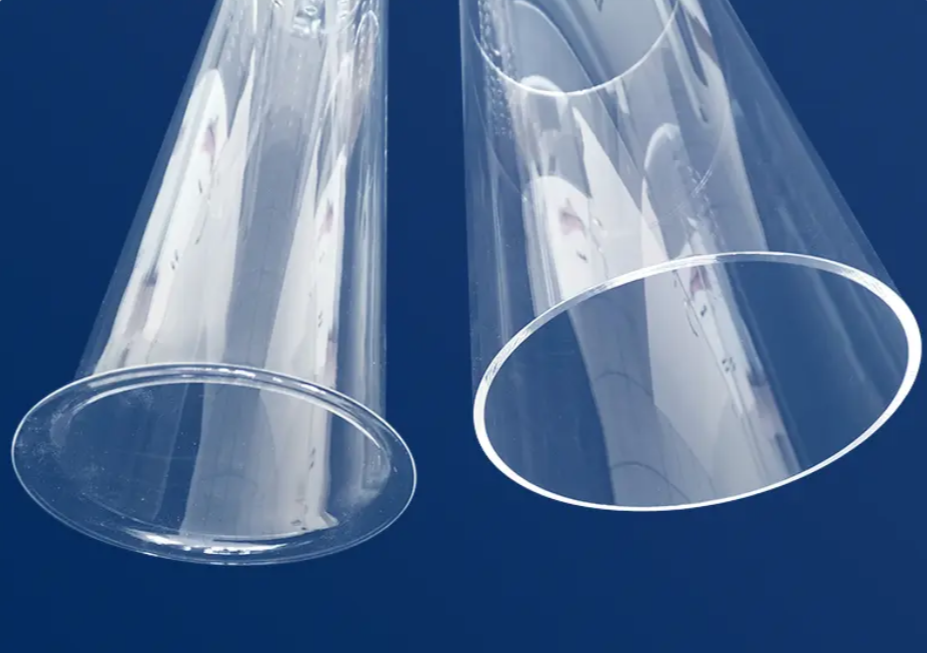
1.Plain-cut ends represent the most straightforward geometry, featuring fire-polished edges that slide directly into standard elastomeric O-ring compression fittings.
2.Flanged ends provide a rigid, flat surface for bolting directly against metallic chamber housings, ideal for higher-pressure liquid pipelines.
3.Threaded options allow direct mechanical engagement with custom enclosure caps, reducing external hardware footprints in compact air treatment units.
4.Domed or flared configurations close off one end completely, eliminating secondary seals inside the reactor chamber while simplifying single-ended lamp insertion.
Determining the interface geometry early in the specification process ensures compatibility with existing elastomeric seals, including fluoroelastomers, silicone, or EPDM compounds. As a specialized manufacturer, Lianyungang Southeast Quartz Products Co.,Ltd. supplies precise structural connections that prevent localized stress points during installation, protecting components from fractures during routine maintenance cycles.
Step 3: Determining Physical Outer Diameters and Lengths
Selecting sleeve dimensions requires direct reference to OEM equipment drawings and fluid dynamics calculations. Rather than forcing standardized catalog dimensions onto specialized equipment, modern manufacturing capabilities allow custom dimensioning tailored to unique reactor volumes and flow profiles.
The outer diameter of the sleeve governs the annular space between the protective envelope and the outer chamber wall. This spacing directly affects fluid velocity, residence time, and the concentration of ultraviolet energy delivered to passing media. Longer chamber designs demand precise length specifications to ensure full lamp coverage without creating excessive cantilevered mass that could vibrate under high flow rates.
Partnering with Southeast Quartz allows design teams to request specific outer diameter and overall length profiles directly from detailed engineering schematics, eliminating the need to modify existing reactor housings.
Step 4: Optimizing Wall Thickness, Surface Finishes, and Quality Verifications
Wall thickness selection involves a balancing act between physical structural integrity and optical light transmission. Thicker sleeve walls offer greater mechanical strength against hydraulic pressure spikes and physical impacts during cleaning cycles. However, excessive wall mass can slightly diminish ultraviolet transmission and alter heat dissipation parameters around the lamp core.
Surface characteristics also influence operational performance. Clear, polished surfaces maximize direct light passage and minimize surface rough spots where biofilms or mineral deposits accumulate. Conversely, frosted surface treatments diffuse light more evenly, serving specialized photo-chemical reaction chambers where uniform light dispersion takes priority over concentrated linear intensity.
A comprehensive quality assurance framework verifies these structural parameters before installation. Reliability is established through rigorous factory testing protocols at Southeast Quartz, where each production batch undergoes dimensional logging, helium leak detection for vacuum integrity, hydrostatic pressure testing, and chemical purity verifications documented through official material test reports.
Establishing System Integrity Through Methodical Component Selection
Adopting a structured selection model—progressing systematically through process media analysis, interface geometry, spatial dimensions, and verified wall specifications—converts protective sleeve procurement into an exact engineering practice. This approach mitigates operational risks, extends lamp service intervals, and maintains consistent fluid treatment efficiency across diverse industrial environments. As an established quartz sleeve for UV solution provider, Southeast Quartz remains focused on supplying precision-engineered components across global markets. Facility operators seeking technical specifications, custom fabrication capabilities, and quality certification records can explore comprehensive product resources at https://www.dnquartz.com/.
Lianyungang Southeast Quartz Products Co.,Ltd.
Lianyungang Southeast Quartz Products Co.,Ltd.
Legal Disclaimer:
EIN Presswire provides this news content "as is" without warranty of any kind. We do not accept any responsibility or liability for the accuracy, content, images, videos, licenses, completeness, legality, or reliability of the information contained in this article. If you have any complaints or copyright issues related to this article, kindly contact the author above.

Media gallery