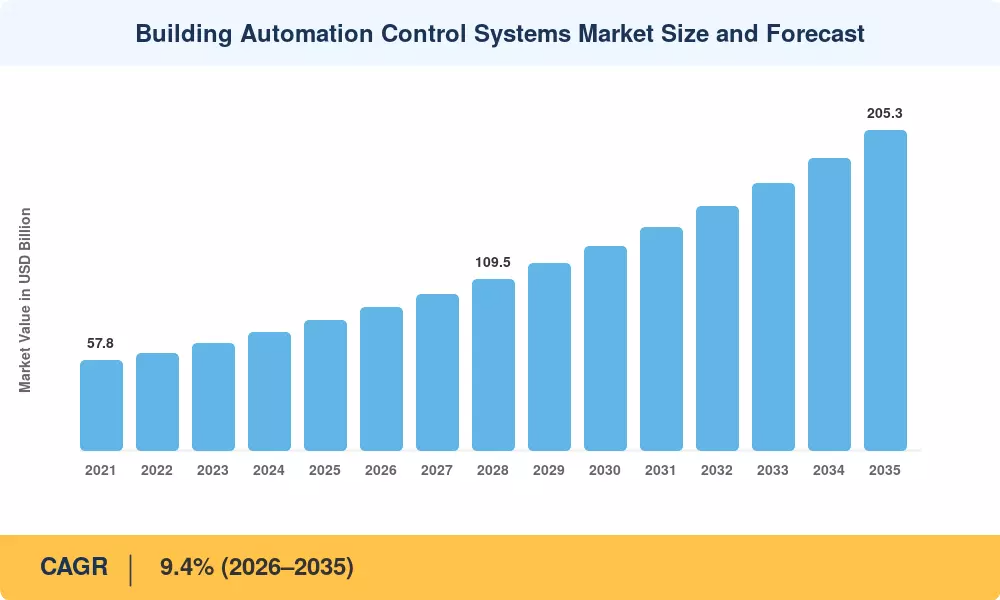

The Building Automation Control Systems Market reached an estimated USD 83.6 billion in 2025 and is projected to grow from USD 91.5 billion in 2026
NEW YORK, NY, UNITED STATES, July 29, 2026 /EINPresswire.com/ -- The Building Automation Control Systems Market reached an estimated USD 83.6 billion in 2025 and is projected to grow from USD 91.5 billion in 2026 to USD 205.3 billion by 2035, registering a CAGR of 9.4% during the forecast period (2026–2035).
Market Overview
Building Automation Control Systems (BACS) represent the integrated digital infrastructure that centralizes, monitors, and optimizes a building's mechanical, electrical, and electromechanical systems . These systems form the "intelligent nervous system" of modern structures, controlling everything from heating, ventilation, and air conditioning (HVAC) to lighting, security, fire safety, and energy management. By leveraging sensors, controllers, actuators, and sophisticated software, BACS ensures operational efficiency, occupant comfort, and safety while significantly reducing energy consumption and carbon footprint. The market serves a broad spectrum of applications, from commercial offices, retail spaces, and hospitality venues to industrial facilities, multi-family residences, and government institutions.
The market's exceptional growth is driven by the convergence of several powerful catalysts. The accelerating push for energy efficiency and net-zero carbon targets is a primary driver, as buildings are the single largest energy-consuming sector, accounting for approximately 75% of electricity use in the U.S. economy . According to the International Energy Agency, to meet global climate goals, all new buildings and 20% of existing buildings must be zero-carbon as soon as 2030. The steady migration of building operations onto digital platforms, combined with the exponential growth of IoT-connected devices, is creating a rich ecosystem for data-driven building management . Furthermore, the rising demand for integrated, centralized management of security, fire, and HVAC systems is compelling building owners to invest in automation.
Industry trends indicate a decisive shift toward software-defined, cloud-based, and analytics-driven solutions. Software is forecast to be the fastest-growing category, driven largely by the emergence of Building Operational Platform (BOP) software, which is projected to grow at a 16.7% CAGR . Buyers are increasingly paying for performance—analytics, continuous monitoring, and real-time insights—not just hardware panels and sensors . Cloud-based software is now common to the BACS proposition, though take-up is uneven across regions, influenced by data sovereignty concerns and cultural factors . The integration of AI is being actively explored, with the market looking for product-market fit and commercial models that deliver on long-standing promises around energy efficiency and indoor environment quality .
Technological developments are rapidly expanding the market's capabilities and service models. Hardware is forecast to grow at around half the rate of software as the sector shifts from analogue to digital devices across an already substantial installed base . The adoption of IoT and AI in building automation enables real-time monitoring, predictive analytics, and system interoperability . AI algorithms support predictive maintenance, enabling systems to automatically adjust ventilation, lighting, and temperature based on occupancy patterns, which reduces energy waste and ensures personalized comfort . Smart building automation is also becoming a key enabler for green certifications like LEED and BREEAM .
Policy and regulatory influence is a major growth catalyst. Climate policy and exposure to imported fossil fuels in Europe have reinforced regulation around building energy efficiency, while in the US, environmental policy is shaped more at state and city levels . Government incentives for green building initiatives and stringent building codes are driving investment in BACS . The EU's Corporate Sustainability Reporting Directive and other ESG frameworks are compelling building owners to demonstrate lower carbon footprints, further accelerating the demand for automation.
The demand outlook remains exceptionally strong, with the market poised for sustained double-digit growth. The total installed BACS market (including products, labor, and margin) is forecast to reach USD 41.1 billion by 2030 . Key regions show distinct dynamics: Europe and the Americas are driven by the push to improve energy performance and indoor comfort, while in developing markets, new construction remains the principal driver of demand . India is currently the fastest-growing BACS market worldwide, expanding at a 10% CAGR, driven largely by new construction .
📍 Get Free Sample Report for Detailed Market Insights:
https://www.marketresearchfuture.com/sample_request/22593
Market Segmentation
By System Type
The market is segmented by system type into HVAC Controls, Lighting Controls, Security & Access Control, Fire & Life Safety, and Others (Elevator, Shade, EV Charging). HVAC controls represent the largest segment, driven by the imperative to reduce energy consumption and comply with stringent efficiency regulations. The surge in demand for HVAC is linked to rapid population growth and urbanization, with the IEA estimating that up to 2.5 billion individuals in hot countries are expected to own an air conditioner by 2050 . Security and access control systems are gaining significant market traction due to rising cases of theft and burglary, with vendors expanding their security portfolios through product innovations and acquisitions . Lighting controls are growing steadily, driven by the transition to LED technology and the need for intelligent lighting management.
By Component
Component segmentation includes Hardware (Controllers, Sensors, Actuators), Software & Analytics, and Services (Integration, Maintenance). While field devices and controllers currently represent the largest product segments by revenue, software is forecast to be the fastest-growing category . Building operators are increasingly seeking continuous monitoring and real-time performance data, pulling investment towards software and services . The market is moving from a product sale to an operating relationship, where services and software provide recurring revenue streams .
By Application
Application segmentation covers Commercial (Office, Retail, Hospitality), Industrial (Manufacturing, Warehousing), Residential (Multi-Family, Luxury), and Government & Institutional. The commercial sector is a major adopter of BACS, driven by the need to optimize energy use in large office, retail, and hospitality spaces. The residential segment is rapidly expanding, particularly in multi-family and luxury housing, as smart home automation becomes more accessible. Government and institutional buildings, including schools and hospitals, are also significant markets, influenced by public sector energy mandates and green building initiatives.
By Region
Regional segmentation includes North America, Europe, Asia Pacific, South America, and the Middle East and Africa. North America holds a significant share due to stringent energy efficiency regulations and the widespread adoption of smart building technologies in commercial buildings. Asia-Pacific is the fastest-growing region, driven by rapid urbanization, infrastructure development, and rising disposable income in countries like China and India.
🛒 You can buy this market report at:
https://www.marketresearchfuture.com/checkout?currency=one_user-USD&report_id=22593
Regional Analysis
North America
North America holds a significant share of the building automation control systems market, with the U.S. being a major contributor. The region's growth is driven by stringent energy efficiency regulations, such as those from the Department of Energy and state-level building codes . The market benefits from a mature commercial real estate sector and a high rate of technology adoption. In the United States, close to half of BACS deployments used cloud-based software in 2025, reflecting a strong trend toward digitalization . Government initiatives promoting smart cities and building decarbonization are further bolstering market growth.
Europe
Europe is a key market, shaped by the push to improve energy performance and reduce exposure to imported fossil fuels . The EU's regulatory framework, including the Energy Performance of Buildings Directive and the Fit-for-55 package, mandates ambitious energy efficiency and carbon reduction targets, directly driving investment in BACS. The region is focused on sustainable building practices and the adoption of advanced automation systems. However, cloud adoption in parts of Europe, such as Spain, is lower due to cultural factors and data sovereignty concerns, despite the technology being available .
Asia-Pacific
Asia-Pacific is the fastest-growing region in the BACS market, fueled by rapid urbanization, increasing infrastructure development, and rising disposable income . India is currently the fastest-growing BACS market worldwide, expanding at a 10% CAGR, although its market size is still relatively small. New construction dominates demand in the region, as developing economies build new commercial and residential spaces . In Poland, for example, the market grew by 5.3% in 2025, with refurbishment and replacement work as the main drivers in larger regional cities .
Rest of the World
The Rest of the World segment, including South America and the Middle East and Africa, is experiencing growth driven by commercial and residential construction sectors and government initiatives for smart city development. The Middle East, in particular, is seeing growth in commercial construction, which is driving demand for building automation solutions.
Competitive Landscape / Key Players
The building automation control systems market is fragmented, with major global players competing alongside regional specialists . Key companies operating in this market include Siemens AG, Schneider Electric, Honeywell International Inc., Johnson Controls, ABB, Trane Technologies, Lutron Electronics, and Robert Bosch GmbH.
Strategic developments in the market are characterized by product innovations, acquisitions, and partnerships. Companies are increasingly focusing on integrating AI capabilities into their building management systems to enhance predictive maintenance and operational efficiency . For instance, Honeywell announced a collaboration with Microsoft aimed at integrating AI capabilities into its building management systems . Market leaders are deploying data-driven solutions, such as Siemens' extension of its Desigo CC building management platform to include IoT and AI capabilities, which helps optimize energy use and predict maintenance needs . These strategic moves are aimed at expanding portfolios and strengthening global footprints.
Latest Industry News & Developments
Recent developments highlight the market's focus on digitalization, software, and analytics. The shift from product sales to operating relationships is a defining theme, with buyers paying for performance and data-driven insights . The emergence of Building Operational Platform (BOP) software is a key trend, with this category projected to grow at 16.7% CAGR . The integration of AI is another prominent focus, as suppliers and integrators work to connect existing estates, prove savings, and take the largest share of future growth .
Market Challenges & Opportunities
Key restraints facing the building automation control systems market include high initial investment costs and the complexity of retrofitting existing buildings with advanced automation solutions . The initial capital requirement for sensors, software, and integration can be a significant barrier for cost-sensitive building owners. Compatibility issues when integrating new automation technologies with older HVAC or lighting systems can extend project timelines and increase costs . Additionally, interoperability issues among different systems and devices, cybersecurity threats, and a lack of skilled professionals to design, install, and maintain these complex systems pose challenges .
Emerging opportunities in the market are substantial and diverse. The growth of software and analytics presents the most significant opportunity, as building operators seek continuous monitoring and real-time performance data . The potential of AI and machine learning to deliver on long-standing promises around energy efficiency and indoor environmental quality is creating a new competitive battleground . The global push for net-zero buildings and stringent energy regulations will continue to drive demand for advanced automation. The expansion of smart home automation and the growing emphasis on cybersecurity in building automation systems also present new opportunities . Furthermore, the move to cloud-based solutions and the development of advanced analytics to optimize building performance are key growth areas .
To explore more market insights, visit us at:
https://www.marketresearchfuture.com/reports/building-automation-control-systems-market-22593
Final Market Summary
The building automation control systems market is positioned for exceptional growth through 2035, driven by the convergence of energy efficiency mandates, digital transformation, and the demand for intelligent, integrated building management. The projected valuation of USD 205.3 billion reflects a market undergoing a fundamental shift from hardware-centric product sales to software-defined, analytics-driven service relationships. The growth is underpinned by the critical need to decarbonize the built environment and optimize building performance.
The medium-term growth outlook remains exceptionally strong, with the market registering a robust CAGR of 9.4% during the forecast period. North America and Europe will continue to be major markets, driven by regulatory and sustainability goals, while Asia-Pacific emerges as the fastest-growing region fueled by urbanization and new construction. The ongoing development of AI-powered analytics, cloud-based platforms, and predictive maintenance capabilities will continue to expand market possibilities and applications.
Long-term industry potential extends significantly beyond the current forecast horizon. The integration of AI is expected to move from talk to deployment, delivering on promises of energy efficiency and indoor environment quality. The market will be decided in existing buildings, with the winners being those who can connect existing estates, work across protocols, and prove the savings . The convergence of IoT, AI, and cloud computing will create a new generation of self-optimizing buildings. Manufacturers that successfully develop scalable, interoperable platforms, invest in advanced analytics, and adapt to the evolving needs of building operators will capture substantial value in this rapidly evolving market. The transformation of buildings from static structures to intelligent, responsive, and sustainable ecosystems represents a fundamental advancement in how we design, construct, and manage the spaces where we live and work.
More Related Reports from MRFR Library:
Commercial Refrigerators Market: https://www.marketresearchfuture.com/reports/commercial-refrigerators-market-38930
Vacuum Casting Machine Market: https://www.marketresearchfuture.com/reports/vacuum-casting-machine-market-39090
Cordless Vacuum Cleaners Market: https://www.marketresearchfuture.com/reports/cordless-vacuum-cleaners-market-39094
Water Quality Monitoring Instrument Market: https://www.marketresearchfuture.com/reports/water-quality-monitoring-instrument-market-39106
3D Automated Optical Inspection Equipment Market: https://www.marketresearchfuture.com/reports/3d-automated-optical-inspection-equipment-market-
39386
Dry Coolers Market: https://www.marketresearchfuture.com/reports/dry-coolers-market-39953
Steel Ingots Market: https://www.marketresearchfuture.com/reports/steel-ingots-market-40095
Tank Trailers Market: https://www.marketresearchfuture.com/reports/tank-trailers-market-40098
Touchpad Market: https://www.marketresearchfuture.com/reports/touchpad-market-40100
Fabric Cutting Machine Market: https://www.marketresearchfuture.com/reports/fabric-cutting-machine-market-40609
Larry Wilson
WantStats Research And Media Pvt. Ltd.
+1 855-661-4441
Legal Disclaimer:
EIN Presswire provides this news content "as is" without warranty of any kind. We do not accept any responsibility or liability for the accuracy, content, images, videos, licenses, completeness, legality, or reliability of the information contained in this article. If you have any complaints or copyright issues related to this article, kindly contact the author above.

Media gallery