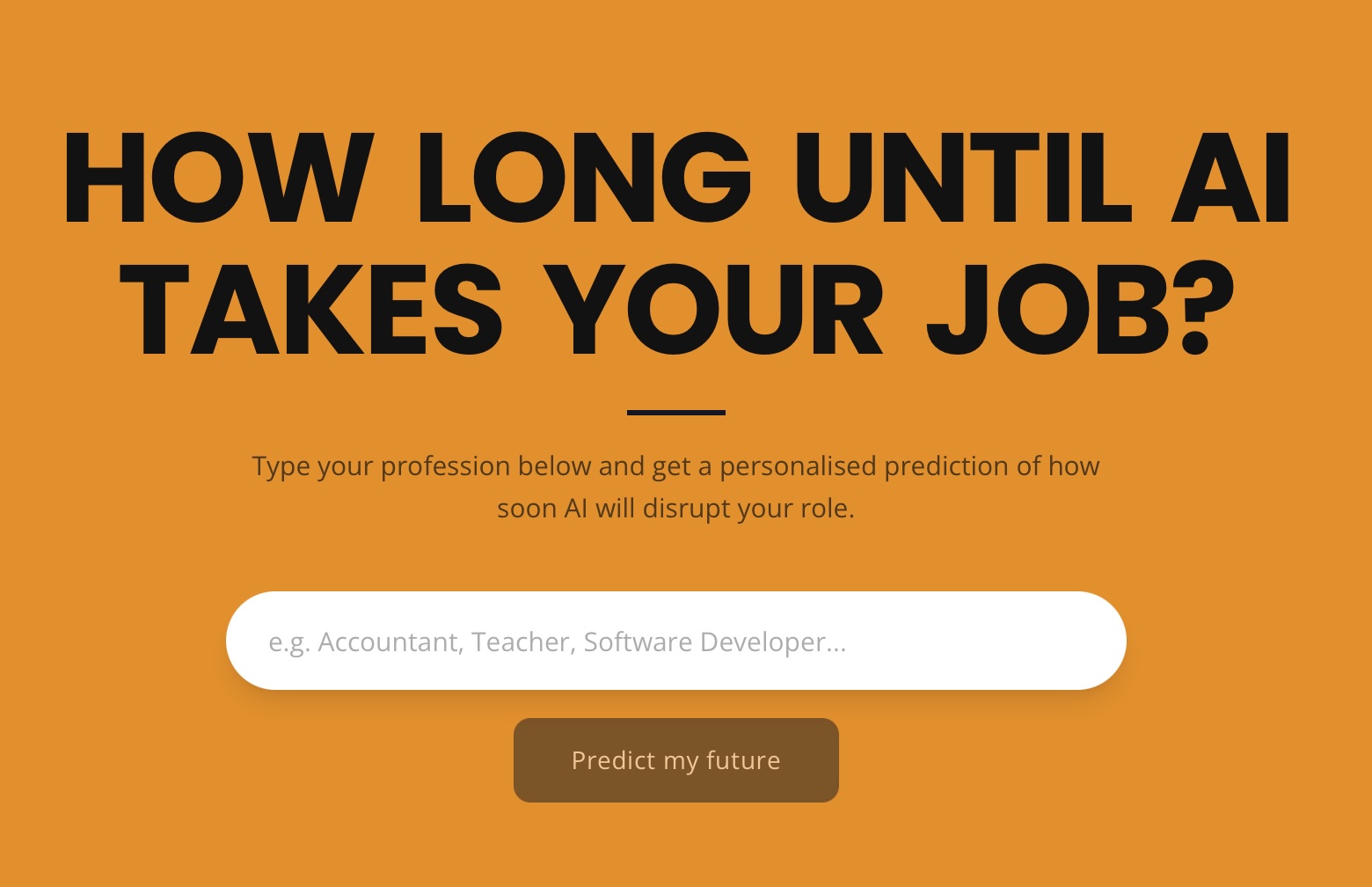
Enter any job title to see how many days remain before AI materially disrupts it, with a plain English explanation and citations from both sides.
EDINBURGH, CITY OF EDINBURGH, SCOTLAND, May 22, 2026 /EINPresswire.com/ -- How long until AI takes your job? There is widespread confusion about what artificial intelligence is genuinely good at and where it will be most disruptive, and the gap between public anxiety and credible evidence keeps growing. A new tool on roneehulk.com aims to close that gap by giving any worker a personalised, citation backed estimate of how many days remain before their job, as it is currently performed, is materially disrupted by AI.
The tool, How Long Until AI Takes Your Job?, sits on the homepage of roneehulk.com. It is the work of Edinburgh based author Ronee Hulk, writer of Dear Future: You Can Keep The Change. A user enters a job title in plain English, such as primary school teacher, barrister or lorry driver, and within seconds receives a specific countdown in days, a short structured explanation, and two pieces of supporting evidence alongside two pieces of contrarian evidence, each with a clickable citation.
The tool works because every estimate rests on three layers of grounding. The first is a structured catalogue of occupations whose anchored target dates only move when the underlying evidence base moves. The second is a regional adjustment based on observable differences in adoption, regulation and labour market structure. The third is a citation layer that forces every response to display real, named sources on both sides of the question, including ones that disagree with the headline number. The narrative layer writes the prose, but the score, the date, the region and the citations are all set before it ever runs.
The tool is transparent about its assumptions. It judges each job as currently performed, not against a hypothetical future redesign. It treats the target date as the point of material disruption rather than full elimination, recognising that most occupations will continue to exist in some form well beyond it. It uses O*NET as the canonical reference for what each occupation actually involves, and it applies regional context because adoption, regulation, capital intensity and language coverage vary materially between markets.
The target dates themselves are arrived at by combining three inputs. The first is occupation level exposure scoring published by Goldman Sachs, OpenAI, the OECD, and academic groups at Oxford, Princeton and Stanford. The second is observed deployment data, including enterprise adoption surveys, model capability benchmarks, and labour market indicators from official statistical offices. The third is a small set of accelerator and decelerator factors that the platform applies consistently, such as regulatory friction, union density, physical embodiment requirements and consumer trust thresholds. Where the underlying evidence is weaker, the tool defaults to longer time horizons rather than shorter ones.
About Ronee Hulk
Ronee Hulk is an Edinburgh based author and the writer of Dear Future: You Can Keep The Change. He is the creator of roneehulk.com and the political inference platform LikelyStance.com.
Media Contact
Ronee Hulk
Email: ronee@roneehulk.com
Phone: +44 7512 333 333
Website: www.roneehulk.com
Ronee Hulk
+44 7512 333 333
Visit us on social media:
Dear Future: You Can Keep The Change by Ronee Hulk
Legal Disclaimer:
EIN Presswire provides this news content "as is" without warranty of any kind. We do not accept any responsibility or liability for the accuracy, content, images, videos, licenses, completeness, legality, or reliability of the information contained in this article. If you have any complaints or copyright issues related to this article, kindly contact the author above.

Media gallery