
FENGYANG, ANHUI, CHINA, October 12, 2026 /EINPresswire.com/ -- Industrial manufacturing facilities rely heavily on large-scale compressed air networks and high-capacity ventilation ducts to maintain continuous production operations. Generating and distributing compressed air ranks among the most energy-intensive activities in modern industrial plants, often accounting for a major portion of total electricity expenditure. Consequently, plant managers prioritize comprehensive airflow audits to uncover systemic energy waste, detect hidden distribution leaks, and optimize compressor efficiency. Auditing large-diameter piping systems exceeding two hundred millimeters presents unique operational and technical challenges that standard inline instrumentation cannot easily resolve. Selecting a trusted Custom Insertion Thermal Gas Mass Flowmeter Solutions Provider enables facility engineering teams to obtain precise mass flow data across expansive header pipes without incurring severe financial or operational penalties.
Traditional inline flow meters require full pipe section cutting, heavy mounting flanges, and extensive structural modifications that drive up installation overhead. Moreover, interrupting primary utility lines forces complete facility shutdowns, resulting in lost production volume and expensive downtime. Lacking continuous flow measurement across main headers, energy engineers struggle to establish reliable baseline consumption figures or verify the performance of individual compressor banks. Systematic airflow audits bridge this operational gap by delivering actionable volumetric and mass flow insights across key distribution zones. Continuous, accurate measurement allows facility teams to implement data-driven energy conservation programs, eliminate baseline air losses, and optimize long-term capital investments in utility infrastructure.
Economic and Operational Imperatives of Insertion Thermal Technology
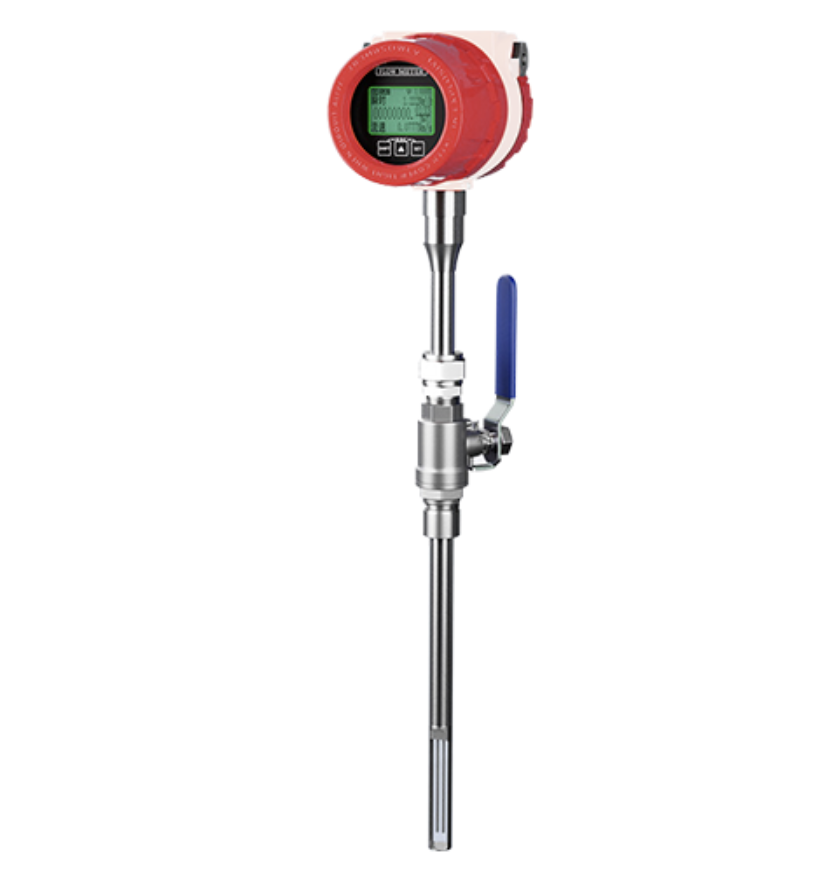
Transitioning from traditional inline devices to insertion thermal gas mass flow meters fundamentally changes the economics of monitoring large-diameter process lines. The manufacturing cost and physical weight of full-bore inline flow meters increase exponentially as pipe diameters expand. For large ventilation ducts or compressed air mains, the cost of full-bore inline equipment often becomes prohibitive for facility-wide monitoring projects. Conversely, an insertion-style flow meter uses a slim, specialized sensor probe mounted on a customizable support rod that extends directly into the process stream. This design ensures that instrument hardware costs remain independent of pipe diameter, delivering substantial savings when outfitting large industrial pipes.
Operational flexibility represents another key advantage of insertion thermal flow technology during facility energy audits. Engineering technicians frequently utilize hot-tap ball valve assemblies to install insertion probes into existing pipelines under full line pressure. Maintenance personnel drill a small insertion hole into the pipe wall, weld a threadlet coupling, attach the isolation valve, and extend the probe to its designated depth. This installation technique eliminates the need for pipe cutting, line depressurization, or factory production stoppages. Furthermore, the slender probe geometry introduces virtually zero physical obstruction into the pipe cross-section, maintaining full fluid velocity and eliminating permanent pressure drops. When executing facility-wide energy audits, thermal gas mass flowmeters are used for compressed air measurement to deliver continuous operational insight while preventing unnecessary pressure losses across supply networks.
Overcoming Fluid Dynamic Complexities: Insertion Depth and Velocity Profiles
Obtaining accurate flow measurements with an insertion probe requires a detailed understanding of internal pipe fluid dynamics. Gases moving through long, straight conduits do not exhibit a uniform velocity profile across the pipe cross-section. Viscous drag against the internal pipe wall creates a slow-moving boundary layer, while velocity reaches its maximum along the center axis of the pipe. In fully developed turbulent flow, fluid velocity transitions from zero at the wall to maximum velocity at the center. Mathematical flow models indicate that the average fluid velocity point typically resides at approximately twenty-five percent of the internal diameter from the inside pipe wall, or roughly twelve percent past the centerline under specific Reynolds numbers.
Because an insertion probe measures gas velocity at a single localized point, sensor placement directly dictates measurement accuracy. Positioning the sensor tip even slightly away from the calculated average velocity point introduces systematic reading errors. Upstream piping configurations such as elbows, reducers, tees, and control valves distort symmetrical flow profiles, generating secondary swirl and localized turbulence. Field engineers mitigate these fluid dynamic distortions by selecting mounting locations with sufficient straight pipe runs upstream and downstream of the sensor. In applications with limited straight piping, technicians apply flow straighteners or implement electronic profile correction factors within the transmitter software to compensate for distorted velocity distributions.
Tailored Precision: HHD Custom Insertion Thermal Mass Flowmeter Engineering
Overcoming difficult installation environments demands high-precision instrument manufacturing and specialized design customization. As a prominent instrument manufacturer in China, HHD (Huaibei Huadian Automation Technology Co., Ltd) engineers robust insertion thermal mass flow meters specifically designed for demanding industrial applications. The company builds probe assemblies using high-grade stainless steel materials and precise platinum Resistance Temperature Detectors (RTDs). The operating mechanism relies on thermal dispersion principles, where one RTD measures the ambient gas temperature and a second heated RTD maintains a constant temperature differential. Moving gas molecules carry heat away from the active sensor element at a rate proportional to the gas mass flow rate.
This direct mass flow measurement capability allows industrial users to record precise flow rates without installing auxiliary pressure sensors or temperature transmitters. To support varied field requirements, Huaibei Huadian Automation Technology Co., Ltd provides custom probe lengths tailored to specific pipe diameters and duct configurations. The engineering team at HHD equips insertion instruments with adjustable compression fittings, hot-tap ball valve assemblies, and rugged terminal housings to withstand vibration, moisture, and outdoor conditions. Digital signal processing transmitters from HHD convert thermal sensor readings into standardized output signals, enabling straightforward integration with building management systems and enterprise data historians.
Partnering with HHD: From Audit Diagnosis to Enterprise Energy Optimization
Executing a successful airflow audit across large-diameter industrial piping requires reliable hardware supported by comprehensive engineering support. HHD collaborates directly with plant energy managers, consulting engineers, and system integrators to evaluate site conditions prior to meter selection. Technical specialists review pipe geometry, line pressures, gas temperature ranges, and expected velocity profiles to determine optimal probe specifications. This thorough engineering review ensures that every installed flow meter operates within its optimal accuracy range while providing dependable long-term measurement performance.
Accurate mass flow data collected from key distribution headers gives facility engineers the visibility required to make informed operational decisions. Energy teams can easily isolate baseline air leaks during non-production shifts, evaluate compressor efficiency, and balance air delivery across different operational departments. Eliminating unregistered compressed air leaks and optimizing system operating pressures directly reduce utility power consumption, generating significant cost savings over time. Through tailored instrumentation, precise thermal sensing technology, and dedicated customer support, HHD remains a trusted partner for industrial enterprises striving for operational excellence and energy sustainability.
For more technical specifications and enterprise solutions, visit https://www.hd-a.cn/.
HHD
HHD
Legal Disclaimer:
EIN Presswire provides this news content "as is" without warranty of any kind. We do not accept any responsibility or liability for the accuracy, content, images, videos, licenses, completeness, legality, or reliability of the information contained in this article. If you have any complaints or copyright issues related to this article, kindly contact the author above.

Media gallery