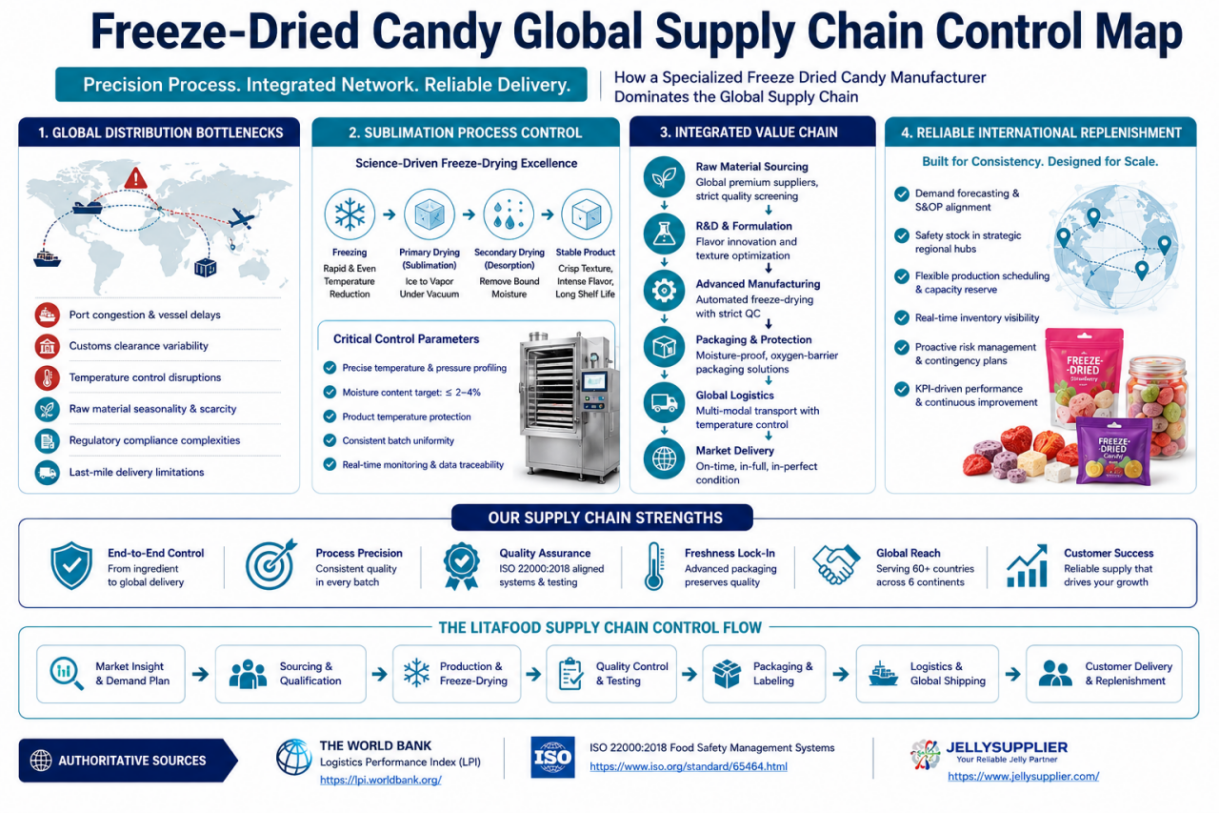

NANTONG, CHINA, July 9, 2026 /EINPresswire.com/ -- LITAFOOD (operating as a pioneering confectionery brand and manufacturing partner) has established an expansive international footprint. With over two decades of technical expertise in advanced moisture-elimination protocols, the entity stands out as the first enterprise in China to scale industrial production within this specialty field. However, sustaining a highly efficient distribution model across disparate geographical jurisdictions requires navigating multifaceted technical and operational challenges.
This analysis addresses a central question: How does a Specialized Freeze-Dried Candy Manufacturer dominate the global supply chain despite the rigorous variables inherent to international food logistics?
I. The Complexities and Operational Bottlenecks of Global Distribution
Distributing freeze-dried confectionery on a global scale involves significantly more structural complexity than managing conventional sugar-based commodities. The primary challenge lies in the physical nature of the finished goods. The sublimation process removes approximately 98% of the native moisture content from the confectionery matrix, leaving behind a highly porous, delicate micro-structure. This high level of porosity makes the product extremely hygroscopic and fragile. Exposure to ambient humidity can cause rapid moisture reabsorption, leading to structural collapse, stickiness, and product spoilage. Consequently, standard global freight systems—often subject to uncontrolled humidity fluctuations inside shipping containers—are fundamentally unsuited for bulk transport without specialized protective frameworks.
Furthermore, structural fragility introduces severe risks during physical transit. Conventional logistics pipelines subject packages to mechanical stress, including vibration, drops, and stacking pressure. For conventional confectionery, these forces are easily absorbed. However, for a rigid, dehydrated crystalline structure, unchecked kinetic energy results in severe product fracturing, turning high-value candy into unsellable dust. To overcome this, manufacturers must redesign the entire supply chain, utilizing advanced primary barrier films, specific gas-flushing protocols, and optimized structural outer cartons. This balance between weight minimization and mechanical protection represents a significant operational challenge for international suppliers.
Beyond physical preservation, compliance with international food safety standards adds another layer of complexity. Food distribution across jurisdictions like North America, the European Union, and the Asia-Pacific region requires adherence to strict biochemical and sanitary regulations. Exporting entities must maintain rigorous operational certifications, such as BRCGS, IFS, FSSC 22000, and comprehensive HACCP frameworks. Variations in allowable additives, regional labeling mandates, and strict auditing processes can stall supply chains at international borders. Achieving dominance in the global market therefore requires an infrastructure capable of handling high structural fragility, extreme ambient sensitivity, and diverse regulatory requirements simultaneously.
II. Technical Hurdles, Sublimation Processing, and Structural Evolution
Overcoming these global supply chain barriers requires deep technical control over the thermodynamic stabilization of sugar matrices. Standard freeze-drying, or lyophilization, was originally designed for pharmaceuticals and basic agricultural products like fruits or coffee. Adapting this technology to complex confections requires shifting from simple water sublimation to managing complex multi-component sugar solutions that include sucrose, glucose, gelatin, and various starches.
The core technical challenge involves defining precise eutectic points—the exact temperature threshold where a specific confectionary mixture coexists in a completely solid state. If a manufacturer applies thermal energy too quickly during the primary drying phase, the core temperature of the candy rises above its structural collapse point. This triggers an internal melt-back effect, destroying the desired light texture and turning the product into a dense, unmarketable mass. Achieving consistent results requires a highly calibrated multi-stage thermal profile, maintaining chamber vacuum pressures between 0.05 and 0.1 millibars while carefully modulating shelf temperatures over processing cycles that can exceed 20 hours. This precise control ensures complete ice crystal sublimation without altering the delicate geometry of the candy.
This technical rigor creates a clear distinction between specialized freeze-dried products and conventional confections. Standard candies rely on high moisture retention or artificial binders to maintain flexibility and shelf life. In contrast, specialized freeze-dried confections rely entirely on their low water activity level—typically below 0.2 AW—to halt microbial growth and enzymatic degradation naturally, without chemical preservatives. This low water activity level extends the product's shelf life to several years under proper sealing, making it highly resilient during extended maritime transit. Additionally, the structural transformation completely alters the sensory experience. The dense, chewy texture of standard candy becomes an airy, crisp crunch that rapidly dissolves upon consumption, releasing flavor profiles more intensely. This combination of natural preservation and enhanced sensory appeal changes the product's positioning from a basic commodity to a premium global export.
III. Value Chain Integration, Case Study, and Institutional Customization
To understand the practical application of these technical principles, we can examine the production parameters of a representative product, such as the Freeze-Dried Mango Fruit Candy (Case Reference: Freeze-Dried Mango Fruit). This product bridges the gap between natural agricultural inputs and structured confections, making it an excellent example of supply chain integration. Raw mango pulp contains a complex mix of fructose and fibrous structures, which are prone to uneven freezing and structural collapse during sublimation. Processing requires pre-freezing the raw material to below minus 40 degrees Celsius to ensure rapid, uniform ice crystal nucleation. During the subsequent primary and secondary sublimation phases, the internal moisture is systematically reduced to less than 2.5%, locking in the fruit's natural vitamins, carotenoids, and volatile flavor compounds without using sulfur dioxide or artificial stabilizing agents. The final product delivers a crisp texture and a concentrated flavor profile, while remaining highly stable for global transport and storage.
This technical capability forms the foundation for large-scale institutional integration. Because the manufacturing process is highly standardized, the industrial infrastructure can easily support comprehensive OEM (Original Equipment Manufacturer) and ODM (Original Design Manufacturer) customization models. Global brands, high-volume retail chains, and specialized distributors require specific product adaptations, including custom flavor profiles, tailored shapes, unique moisture-barrier packaging, and regional compliance labeling. A specialized manufacturer meets these needs by integrating flexible production lines that can quickly switch between different product runs without losing thermal efficiency or vacuum integrity.
This operational adaptability allows the manufacturer to seamlessly integrate into the procurement systems of the world’s largest retail networks, such as Walmart and Costco. These global retailers demand absolute volume reliability, strict price predictability, and flawless quality control across thousands of delivery windows. By combining large-scale vacuum chamber capacity with automated packaging lines and robust quality management systems, the specialized manufacturer moves beyond a basic supplier role. Instead, they become a strategic partner embedded directly within the global food value chain, helping top-tier brands expand their market share across multiple continents.
Corporate Website:https://www.jellysupplier.com/
Nantong Litai Jianlong Food Co., Ltd.
Nantong Litai Jianlong Food Co., Ltd.
Legal Disclaimer:
EIN Presswire provides this news content "as is" without warranty of any kind. We do not accept any responsibility or liability for the accuracy, content, images, videos, licenses, completeness, legality, or reliability of the information contained in this article. If you have any complaints or copyright issues related to this article, kindly contact the author above.

Media gallery