
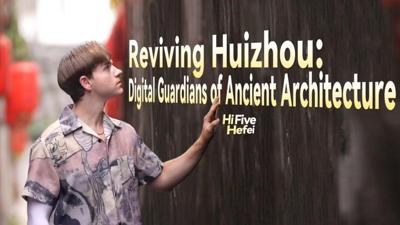

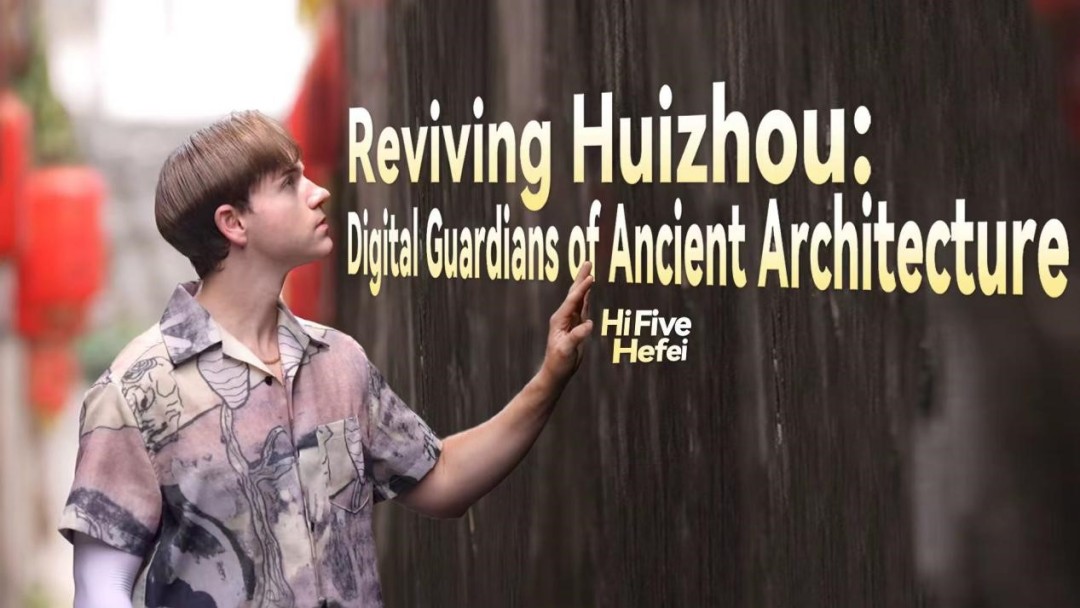
Video link: https://youtu.be/eeNhImeIkIg?si=9NVuOFmMehT8eGt6
HUIZHOU, Anhui - Gavin Cooley expected to find dusty relics and crumbling wood. The American youth had traveled to this remote corner of China to understand the philosophy behind its ancient architecture. Why save these old houses? What value do they hold?
Instead, inside a centuries-old residence in Xucun Village, he found a high-tech lab.
“I thought the answers were buried in history books,” Cooley said, watching students from Hefei University of Technology (HFUT) wave handheld laser scanners across intricate wooden beams. “But here, I’m hearing echoes of the future.”
The team, led by Professor Chen Gang, is essentially giving the building an “X-ray.” Using 3D laser scanning, they capture every joint and structural detail, transforming them into a 360-degree visible point cloud model on a computer screen.
Centuries of wind and rain inevitably take their toll, causing structural deformation. “While we deeply respect the wisdom of ancient builders, modern technology gives us the foresight to protect history,” said Associate Professor Chen Xin of HFUT. Postdoctoral researcher Wang Hanqin added that establishing a digital archive is just the first step. His team runs mechanical analyses on the data to evaluate structural safety, providing scientific support for the adaptive reuse of these ancient buildings.
Huizhou’s mountainous terrain made for a harsh living environment. Yet, as doctoral candidate Zhang Yueting pointed out, this very hardship forced ancient locals to maximize every inch of land and stone. “Limitations can inspire the greatest creativity,” Zhang noted, referencing the distinctive “horse-head walls” that define Huizhou architecture. Her words highlight not only a survival strategy but also a modern breakthrough in heritage conservation.
Through 3D scanning and digital modeling, HFUT students are creating comprehensive digital archives for numerous ancient structures. The “genes” of these buildings are extracted and aggregated into a full-coverage database. Under this digital convergence, ancient spaces are finding new life—sometimes integrated into modern cafes and boutique guesthouses. No longer trapped in yesterday, they now flow toward tomorrow.
Hundreds of years ago, teenage boys from Huizhou would set sail from Yuliang Dam down the Xin’an River, leaving the mountains to seek their fortunes. Today, a new generation of youth, represented by HFUT students, brings advanced digital technology back to these villages for inheritance and protection. Departure and return—history completes its most touching loop at this moment.
From the Colosseum in Rome to the Pyramids of Egypt, every piece of world heritage is in a race against time. In this race, technology from Hefei offers a hopeful answer. These digital models, crossing mountains and seas, not only preserve every brick and tile but also showcase China’s innovative approach to cultural heritage protection to the world.
This encounter is more than just a dialogue between an American youth and ancient architecture. It serves as a microcosm of how young people from different cultural backgrounds can find common ground through shared passion. As they discuss mortise and tenon joints and marvel at digital models together, cultural differences transform into a uniquely attractive charm.
When ancient Eastern wisdom meets today’s technology, history finds its way to the future.
About us
Established and operated under Hefei Broadcasting and Television Station, Hefei International Communication Center tells the city's stories to the world. It spotlights Hefei's strengths in quantum information, fusion energy, new energy vehicles and the low-altitude economy, alongside its rich Hui-style heritage, presenting to global audiences a Hefei that is innovative, open and livable.
Media Contact
Company Name: Hefei International Communication Center
Contact Person: Chuhan Xu
Email:
Send EmailCountry: China
Website:
https://youtu.be/eeNhImeIkIg?si=9NVuOFmMehT8eGt6