
The Business Research Company’s Rigid Exoskeleton Global Market Report 2026 – Market Size, Trends, And Forecast 2026-2035
LONDON, GREATER LONDON, UNITED KINGDOM, September 14, 2026 /EINPresswire.com/ -- The rigid exoskeleton industry is rapidly expanding as advances in technology and rising healthcare needs drive demand. This market is set for significant growth over the coming years due to various factors including healthcare innovation, industrial safety concerns, and military applications. Let’s explore the current market size, key drivers, regional outlook, and the future potential of rigid exoskeletons.
Rigid Exoskeleton Market Size and Projected Growth Through 2026
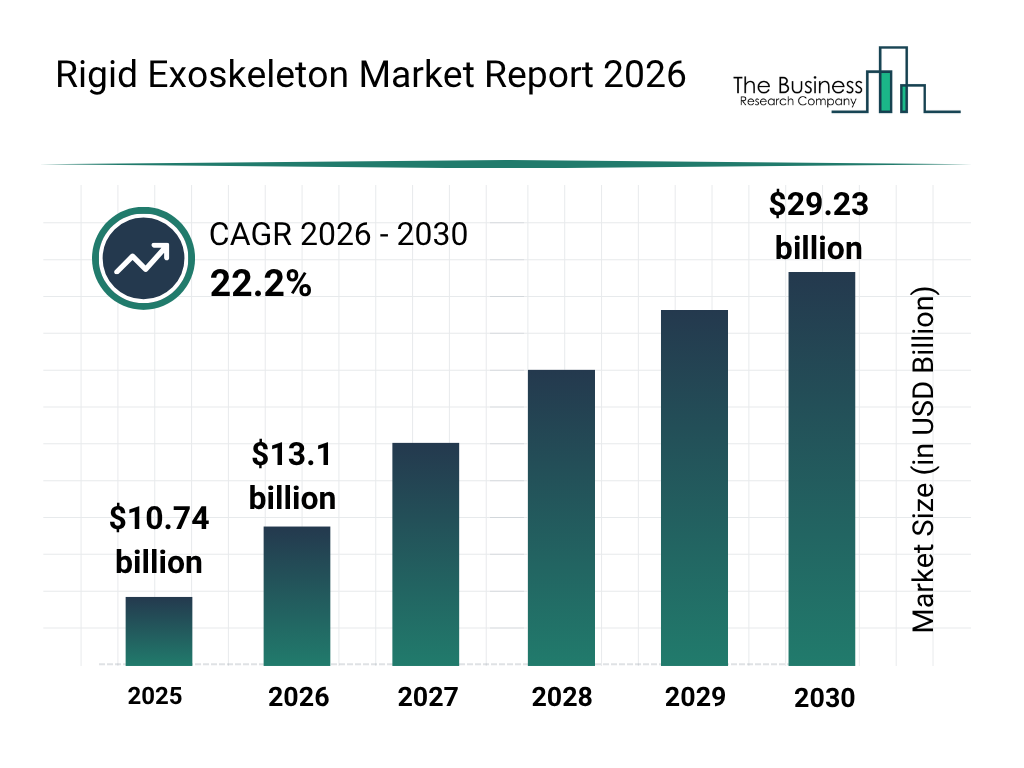
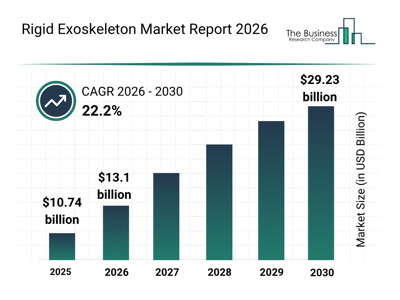
The rigid exoskeleton market has experienced strong growth recently, with its value expected to increase from $10.74 billion in 2025 to $13.1 billion by 2026. This corresponds to an impressive compound annual growth rate (CAGR) of 22.0%. The expansion during this period is largely driven by factors such as a rise in industrial workplace injuries, greater adoption of assistive rehabilitation tools in hospitals, increased defense spending aimed at enhancing soldier performance, advancements in powered orthotic systems, and a growing focus on reducing physical strain in manual labor sectors.
Download a free sample of the rigid exoskeleton market report:
Future Market Outlook for Rigid Exoskeletons Through 2030
Looking beyond 2026, the market is projected to expand significantly, reaching $29.23 billion by 2030 with a CAGR of 22.2%. This robust growth is expected to be fueled by the aging population’s increasing need for mobility support, rising demand for human augmentation technologies in logistics and manufacturing industries, integration of cutting-edge biomechanical materials into wearable systems, and broader adoption of exoskeletons in emerging healthcare rehabilitation programs. Additionally, energy-efficient portable power systems for wearable robotics are anticipated to be a key area of focus. Notable trends in the coming years include the use of lightweight composite frames to improve comfort and endurance, increased military-grade load-bearing assist systems, ergonomic injury prevention in industrial settings, and miniaturization of high-torque actuators for enhanced human motion assistance.
What Defines a Rigid Exoskeleton?
A rigid exoskeleton is a wearable mechanical device composed of solid structural components designed to support, augment, or enhance human movement and physical capabilities. These systems incorporate sophisticated technologies such as sensors, actuators, robotics, and control mechanisms to boost strength, stability, mobility, and endurance during physical tasks. Their primary purpose is to alleviate physical strain, provide motion assistance, and enhance operational efficiency by offering structured biomechanical support.
View the full rigid exoskeleton market report:
Neurological Disorders as a Key Growth Driver for the Rigid Exoskeleton Market
One of the main factors propelling the rigid exoskeleton market is the increasing prevalence of neurological disorders. These conditions affect the brain, spinal cord, nerves, and the nervous system’s normal function. The aging population is particularly vulnerable to disorders like Alzheimer’s disease, Parkinson’s disease, and stroke, which contribute to this rise. Rigid exoskeletons assist patients suffering from such neurological conditions by offering powered mobility support and rehabilitation, improving their ability to move, maintain balance, and walk. For example, in October 2023, the World Federation of Neurology, a UK-based association of national neurological societies, reported that over 40% of the global population currently experiences some form of neurological condition, with this figure expected to nearly double by 2050. This growing healthcare burden clearly supports the increasing demand for rigid exoskeletons.
Additional Factors Encouraging Market Expansion
Beyond neurological applications, the growth of the rigid exoskeleton market is also supported by rising awareness about reducing physical strain in manual labor industries, advancements in military technology focused on soldier performance enhancement, and the early adoption of powered orthotic systems in clinical settings. Together, these factors create a favorable environment for market growth.
Regional Leadership and Growth Prospects in the Rigid Exoskeleton Market
In terms of geography, North America held the largest share of the rigid exoskeleton market in 2025. However, Asia-Pacific is forecasted to be the fastest-growing region during the upcoming years. The market report encompasses key regions including Asia-Pacific, South East Asia, Western Europe, Eastern Europe, North America, South America, Middle East, and Africa, providing a comprehensive perspective on global market trends and regional developments.
Our 2026 market reports now offer broader strategic coverage through market attractiveness scoring and analysis, total addressable market (TAM) analysis, company scoring matrix graphics and tables, Excel-based forecasting dashboards, market hotspots infographics, key technologies and future trend analysis, along with updated graphics and tables.
Speak With Our Expert:
Saumya Sahay
Americas +1 310-496-7795
Asia +44 7882 955267 & +91 8897263534
Europe +44 7882 955267
Email: marketing@tbrc.info
The Business Research Company - www.thebusinessresearchcompany.com
Follow Us On:
• LinkedIn: https://in.linkedin.com/company/the-business-research-company
Oliver Guirdham
The Business Research Company
Visit us on social media:
Legal Disclaimer:
EIN Presswire provides this news content "as is" without warranty of any kind. We do not accept any responsibility or liability for the accuracy, content, images, videos, licenses, completeness, legality, or reliability of the information contained in this article. If you have any complaints or copyright issues related to this article, kindly contact the author above.

Media gallery