
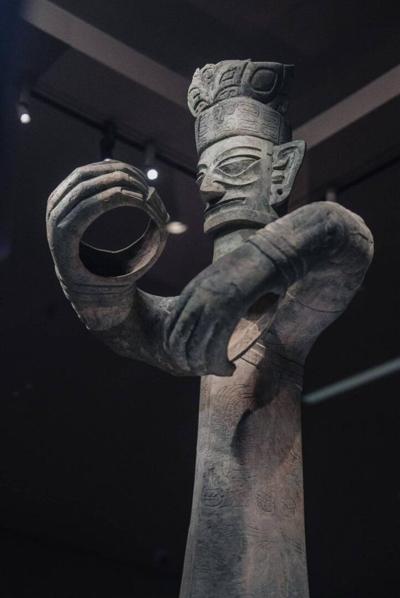
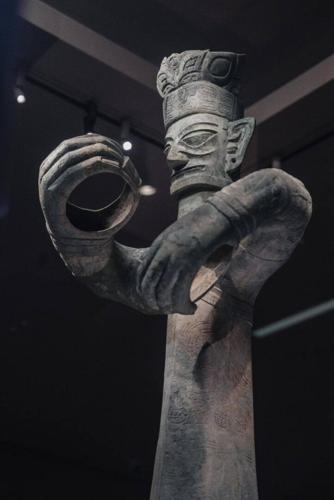

Recently, Sanxingdui Museum in Sichuan and Jinsha Site Museum in Chengdu held events marking the 40th anniversary of the discovery of Sanxingdui’s sacrificial pits and the 25th anniversary of the archaeological discovery of Jinsha respectively. About 40 kilometers apart with each other —one to the north and the other to the south—the two sites jointly trace the development of the Bronze Age civilization in the upper Yangtze River region.
— Forty Years since a World-Astonishing Discovery
In 1986, two sacrificial pits were discovered at Sanxingdui. The large bronze standing figure, the bronze sacred tree, and other artifacts had astonished the world and reshaped the understanding of China’s Bronze Age civilizations. Since 2019, more than 10,000 artifacts have been unearthed from six newly discovered sacrificial pits.
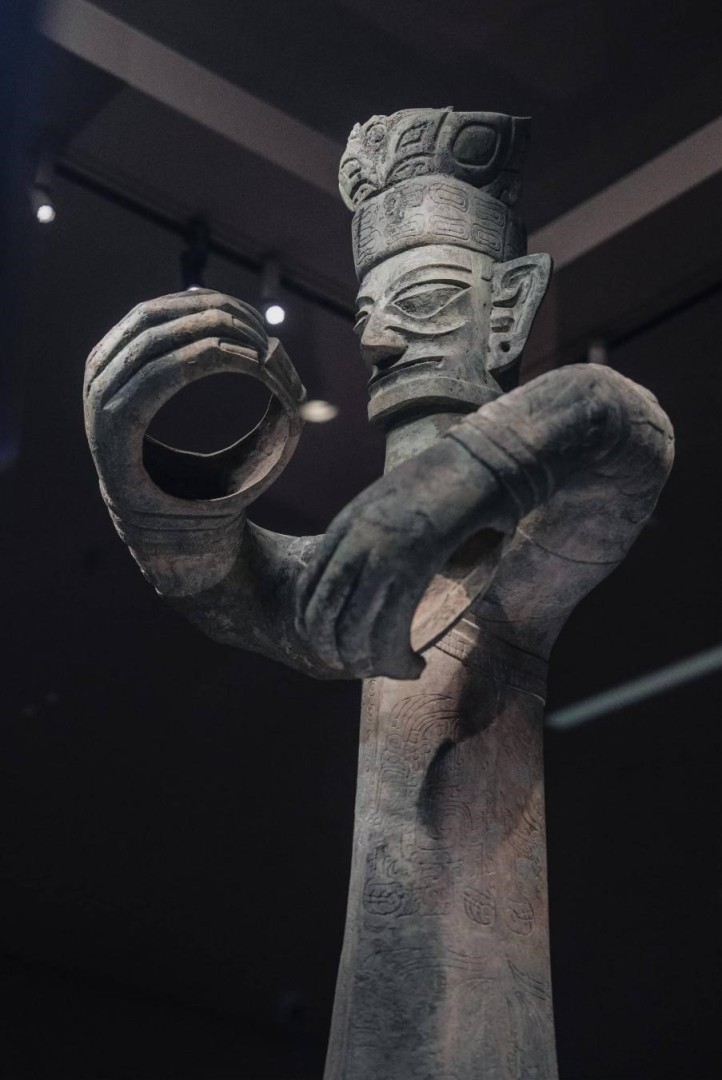
Bronze grand standing figure. (Collection of the Sanxingdui Museum)
At the international symposium held in Guanghan from July 24 to 26, scholars discussed the Sanxingdu ancient city’s layout, its sacrificial system, and the conservation of ancient ivory. Sanxingdui is now a key site for understanding early cultural interactions linking the upper Yangtze River region with the Central Plains and Eurasia. Its discoveries demonstrate that the Yangtze River basin, like the Yellow River basin, was an important cradle of Chinese civilization.
— Twenty-Five Years of Continuous Exploration
Discovered in 2001, Jinsha is regarded as a political, economic, and cultural center that emerged after the decline of the Sanxingdui culture. Artifacts such as the Sun and Immortal Birds Gold Ornament and jade cong tubes show its continuity with Sanxingdui as well as distinctive local features. More than 20 fragments of Shang- and Zhou-period oracle turtle plastrons provide important evidence of links between ancient Shu and the Central Plains.
At the symposium on July 22 in Chengdu, scholars reported that the Jinsha plastrons retained local characteristics while showing strong influence from Shang and Zhou ritual systems. The findings confirm deep interaction between the two regions more than 3,000 years ago.
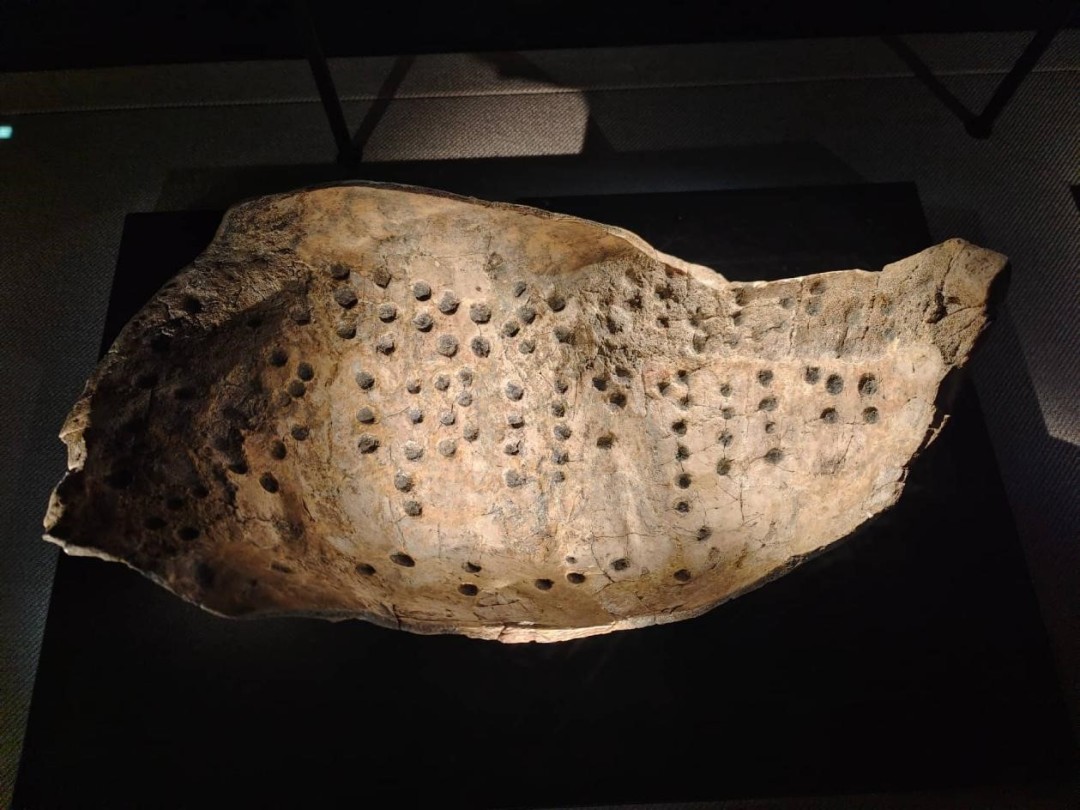
Jinsha Oracle Turtle Plastron. (Collection of the Jinsha Site Museum)
Joint research on Sanxingdui and Jinsha sites challenges the traditional Central-Plains-centered view and recognizes both the Yangtze and Yellow River basins as cradles of Chinese civilization. Unearthed cowries, ivory, and jade materials reveal extensive early trade networks and attest to the long history of the “Southern Silk Road”. Technological advances in artifact conservation are also contributing expertise shared internationally.
Media Contact
Company Name: JINSHA SITE MUSEUM
Contact Person: Jean Wong
Email:
Send EmailCountry: China
Website:
http://www.visitancientshu.com/