
Conventional steam-cycle units contribute an estimated USD 6.3 billion in 2025 revenue, supported by coal-fired fleet maintenance in Asia.
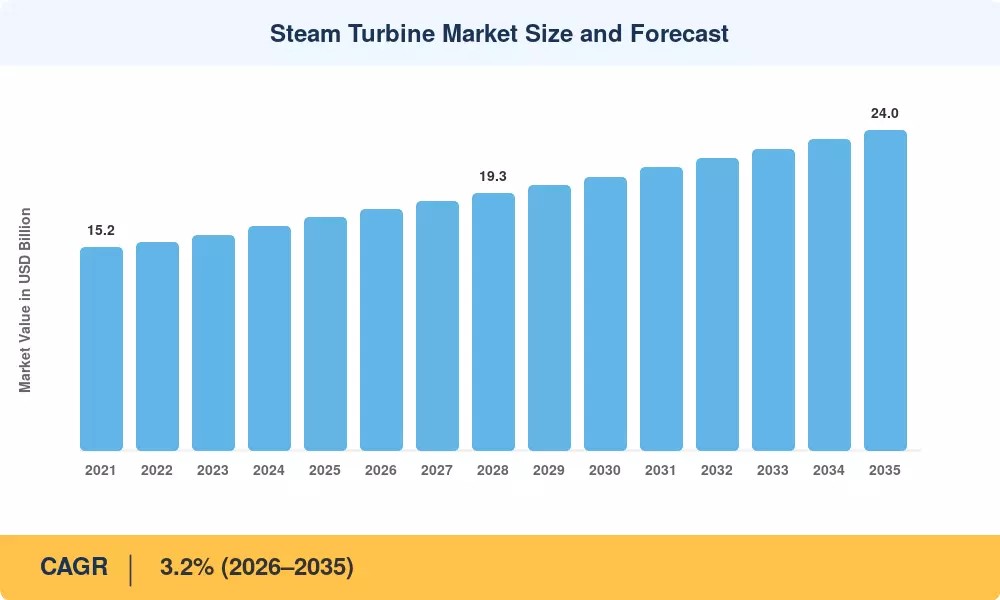
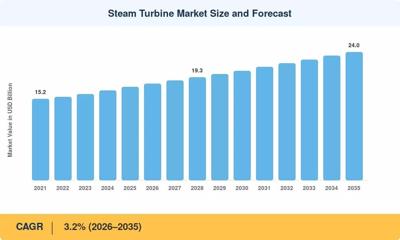
NEW YORK, NY, UNITED STATES, July 29, 2026 /EINPresswire.com/ -- The global Steam Turbines Market reached an estimated USD 17.5 billion in 2025 and is projected to grow from USD 18.1 billion in 2026 to USD 24.0 billion by 2035, registering a CAGR of 3.2% during the forecast period (2026–2035).
Market Overview
Steam Turbines Market are critical rotating machinery that convert thermal energy from pressurized steam into mechanical rotational energy, which then drives electrical generators or industrial equipment. These systems form the backbone of thermal power generation across coal, nuclear, gas-fired combined-cycle, and biomass plants, while also serving industrial applications in petrochemical, steel, and pulp-and-paper facilities for on-site power and process heat. The market spans a wide capacity range from small units under 120 MW for industrial cogeneration to giant 1,000+ MW nuclear-island turbines, with technology configurations including condensing, extraction-condensing, and backpressure designs optimized for specific operating conditions.
The market's steady growth trajectory reflects the dual pull of coal-to-gas fleet transitions in mature economies and accelerating thermal capacity additions across emerging Asia. The IEA's World Energy Outlook 2024 flagged over 680 GW of planned coal retirements by 2040, each requiring replacement dispatchable capacity — a pipeline that feeds directly into steam turbine demand. Technologically, the market is transitioning through a generational shift as the backbone of 20th-century power generation – subcritical units – is being replaced by ultra-supercritical and advanced ultra-supercritical designs running at steam temperatures exceeding 600°C and boosting net plant efficiency above 47%. GE Vernova and Siemens Energy have committed more than USD 2.8 billion for enhanced steam-path R&D through 2030. Close to 60% of all new orders for gas-fired capacity globally are now for combined-cycle gas turbine (CCGT) plants, which use exhaust heat to drive a steam turbine.
Asia-Pacific accounts for approximately 42% of the steam turbine market, led by coal fleet upgrades in China and India and LNG-based expansions in Southeast Asia, while also anticipated to witness the highest CAGR of 4.1% through 2035. Europe holds roughly 24% share backed by fleet life-extension programs and cogeneration obligations under the EU Energy Efficiency Directive. North America is at approximately 22% share and benefits from clean-energy tax incentives from the Inflation Reduction Act that stimulate CCGT conversions. The market's modest but steady growth reflects its essential role in providing dispatchable, grid-stabilizing power capacity alongside increasingly intermittent renewable sources.
Get Free Sample Report for Detailed Market Insights:
https://www.marketresearchfuture.com/sample_request/4618
Market Segmentation
The Steam Turbine Market is comprehensively segmented across technology, capacity, and end-user categories to capture diverse application requirements and regional dynamics. By technology, combined-cycle configurations represent the largest revenue segment capturing roughly 48% share in 2025, as utilities pair gas turbines with heat-recovery steam generators to achieve plant efficiencies above 62%. This segment benefits from every new CCGT installation worldwide, with an estimated pipeline of 250+ GW through 2035. Cogeneration/CHP installations are the fastest-growing technology segment, expanding at an estimated CAGR of 4.5% through 2035, driven by European district-heating mandates and Japanese industrial-efficiency regulations that deliver total system efficiencies above 80%. Conventional steam-cycle units contribute an estimated USD 6.3 billion in 2025 revenue, supported by coal-fired fleet maintenance in Asia and base-load biomass plants.
By capacity, the 351–750 MW bracket represents the core of utility-scale procurement, driven by the global push toward larger, more efficient CCGT plants, with Siemens Energy and GE Vernova dominating this segment through turbine-generator packages optimized for F- and H-class gas turbine bottoming cycles. The sub-120 MW segment is the fastest-growing on a percentage basis at 3.8% CAGR, fueled by distributed-generation projects, geothermal installations, and waste-to-energy plants requiring compact, modular designs. The above-750 MW segment grows at a more modest 2.6% CAGR, serving large nuclear and supercritical coal applications. By end-user, the power-and-utility sector dominates with approximately 68% share, reflecting base-load and peaking plant demand, while industrial end-users are growing at roughly 3.8% CAGR, driven by on-site power and process-heat requirements across petrochemical, pulp-and-paper, and steel industries.
You can buy this market report at:
https://www.marketresearchfuture.com/checkout?currency=one_user-USD&report_id=4618
Regional Analysis
Asia-Pacific leads all regions with an estimated USD 7.35 billion in 2025 revenue, driven by China's ongoing USC plant construction and a 100+ GW pipeline of CCGT projects approved under the dual-carbon strategy. India's National Electricity Plan 2023 mandates that all new coal units meet supercritical efficiency standards, pushing average turbine order values upward by 20–25%. Japan's nuclear restart program sustains domestic demand for replacement components and life-extension outages. Southeast Asian nations, particularly Vietnam and the Philippines, are advancing LNG-to-power projects that require combined-cycle steam turbines, contributing to the region's 4.1% CAGR.
North America's steam turbine market is projected to grow at 2.8% CAGR as CCGT conversions accelerate under federal incentives. The United States dominates the regional market with 85% share, driven by the Inflation Reduction Act's Section 45Y clean-electricity production tax credit incentivizing high-efficiency CCGT plants. FERC data shows over 38 GW of proposed gas-fired capacity in interconnection queues as of Q4 2024, each requiring a heat-recovery steam turbine. Canada's Pacific NorthWest LNG and LNG Canada projects include cogeneration steam turbines for plant self-supply, while Mexico's CFE continues to procure mid-range combined-cycle units.
Europe holds approximately 24% share, shaped by decarbonization mandates that constrain new coal builds and energy-security imperatives that sustain gas and nuclear investments. Germany's Kohleausstieg (coal exit) law drives replacement CCGT demand, while the EU Cogeneration Directive promotes district-heating steam turbines across Scandinavia and the Baltics. France's Grand Carénage program — a EUR 50 billion nuclear fleet refurbishment initiative — generates substantial steam turbine component orders through 2035. The Middle East & Africa region, driven by Saudi Arabia's Vision 2030 gas-fired generation, UAE's Barakah nuclear plant, and Sub-Saharan Africa's gas monetization initiatives, and South America, anchored by Brazil's sugarcane bagasse CHP and Argentina's Vaca Muerta gas development, represent smaller but growing markets with distinct application profiles.
Competitive Landscape
The Steam Turbine Market is moderately concentrated, with the top five players holding an estimated 55–60% combined revenue share. The Herfindahl-Hirschman Index sits in the 1,200–1,500 range, indicating moderate concentration with meaningful competition from regional and specialty manufacturers. Barriers to entry remain high due to metallurgical expertise, reference-fleet requirements, and long qualification cycles with utility buyers.
GE Vernova commands 14–17% market share with its D-series and STF-D100 advanced reheat designs, leveraging the broadest installed base and digital Predix platform for predictive maintenance. Siemens Energy holds 13–16% share through its SST-5000 and SST-6000 series, offering integrated CCGT packages and a hydrogen-ready roadmap. Mitsubishi Power captures 10–13% share with HART series USC and A-USC turbines, positioning as a technology leader in ultra-supercritical and ammonia co-firing applications. Toshiba Energy Systems holds 6–8% share, dominating geothermal and nuclear steam turbine segments with strong presence in Japan and Southeast Asia. Doosan Enerbility and Shanghai Electric each hold 5–7% share, with Doosan leveraging cost-competitive Korean manufacturing and Shanghai Electric serving as China's domestic market leader. Other significant players include BHEL, Harbin Electric, Ansaldo Energia, and MAN Energy Solutions.
Key players are investing heavily in advanced steam-path technologies, digital twin platforms, and hydrogen-ready designs to maintain competitive differentiation. Long-term service agreements (LTSAs) locking in aftermarket revenue for 10–20 years represent a critical competitive battleground, accounting for 30–40% of OEM lifetime revenue per unit and creating high switching costs for plant operators.
Latest Industry News & Developments
In January 2026, Siemens Energy secured a contract to supply steam turbine generator sets for Babcock & Wilcox's one-gigawatt power project supporting AI data center infrastructure, highlighting the growing intersection of thermal power and digital infrastructure. Also in January 2026, Mitsubishi Power completed a major gas-to-combined-cycle reliability upgrade at VPI's Damhead Creek Power Station in the UK, enhancing operational efficiency and long-term asset availability. In March 2026, GE Vernova signed a Memorandum of Understanding with Vietnam Electricity (EVN) to explore High Voltage Direct Current (HVDC) technology, aiming to strengthen grid reliability in Southeast Asia.
Market Challenges & Opportunities
Renewable energy substitution represents the most significant challenge, as the cost competitiveness of renewables accelerates with over 90% of new utility-scale renewable capacity added globally in 2025 producing electricity more cheaply than fossil fuel alternatives. Carbon pricing mechanisms, including the EU's Carbon Border Adjustment Mechanism certificate price set at €75.28 per tonne of CO₂ for Q2 2026, create direct economic pressure on thermal plant operations. Supply-chain constraints, with many critical industrial supply chains containing single-point dependencies where less than 25% of demand could be met if the largest supplier were disrupted, continue to drive extended lead times for large-scale energy infrastructure projects.
However, significant opportunities are emerging across multiple dimensions. Ultra-supercritical and advanced USC technology adoption is becoming the standard for new capacity, with 90% of new coal-fired power capacity expected online in 2026 utilizing supercritical or ultra-supercritical technology to significantly reduce fuel consumption and carbon intensity. Hydrogen and ammonia co-firing retrofits are enabling operators to decarbonize existing assets, with international initiatives funding demonstration projects to adapt steam turbine components for cleaner fuel blends. Geothermal and waste-to-energy expansion is creating demand for specialized turbines, with the IEA estimating total global investment in geothermal could reach USD 1 trillion by 2035. Digital twin and predictive-maintenance platforms are transforming plant operations, reducing unplanned downtime by 20–50% and decreasing total maintenance costs by 15–25%. Emerging-market capacity build-out across Sub-Saharan Africa, where 563 million people lack power access, and Southeast Asia's rapid industrialization represent substantial growth frontiers.
To explore more market insights, visit us at:
https://www.marketresearchfuture.com/reports/steam-turbine-market-4618
Final Market Summary
The Steam Turbine Market is positioned for steady, moderate growth, with projections indicating an increase from USD 17.5 billion in 2025 to USD 24.0 billion by 2035, at a CAGR of 3.2%. This growth is underpinned by the global coal-to-gas fleet transition, CCGT capacity expansion, industrial cogeneration mandates, and sustained grid reliability requirements for dispatchable thermal capacity alongside growing renewable penetration. While challenges including renewable energy substitution, carbon pricing pressures, and supply-chain constraints persist, emerging opportunities in ultra-supercritical technology adoption, hydrogen and ammonia co-firing retrofits, geothermal expansion, and digital plant management platforms offer significant potential for industry participants. The future market landscape will be defined by companies that successfully navigate the dual transition toward higher efficiency and lower emissions, invest in fuel-flexible designs, and leverage digital services to capture lifecycle value, with Asia-Pacific continuing to lead global growth through coal fleet modernization and LNG-based capacity expansion.
More Related Reports from MRFR Library:
Oil & Gas Waste Heat Recovery Market: https://www.marketresearchfuture.com/reports/oil-gas-waste-heat-recovery-market-5903
Hydrogen Fuel Cells Market: https://www.marketresearchfuture.com/reports/hydrogen-fuel-cells-market-5947
Pad Mounted Transformers Market: https://www.marketresearchfuture.com/reports/pad-mounted-transformer-market-5974
Onshore Wind Energy Market: https://www.marketresearchfuture.com/reports/onshore-wind-energy-market-5996
Paralleling Switchgear Market: https://www.marketresearchfuture.com/reports/paralleling-switchgear-market-6010
Drilling Waste Management Market: https://www.marketresearchfuture.com/reports/drilling-waste-management-market-6012
Smart Transformers Market: https://www.marketresearchfuture.com/reports/smart-transformers-market-6014
Screw Compressor Rental Market: https://www.marketresearchfuture.com/reports/screw-compressor-rental-market-6269
Submarine Power Cable Market: https://www.marketresearchfuture.com/reports/submarine-power-cable-market-6442
Distributed Generation Market: https://www.marketresearchfuture.com/reports/distributed-generation-market-6454
Larry Wilson
WantStats Research And Media Pvt. Ltd.
+ +1 855-661-4441
Visit us on social media:
Legal Disclaimer:
EIN Presswire provides this news content "as is" without warranty of any kind. We do not accept any responsibility or liability for the accuracy, content, images, videos, licenses, completeness, legality, or reliability of the information contained in this article. If you have any complaints or copyright issues related to this article, kindly contact the author above.

Media gallery