
Not just a deposit - But Clearly a District!
ESTES PARK, CO / ACCESS Newswire / August 5, 2026 / Taranis Resources Inc. ("Taranis" or the "Company") (TSXV:TRO)(OTCQB:TNREF) is providing some initial findings from the expanded exploration program currently underway on the company's 6,400 Ha exploration project located in Southeast British Columbia. Taranis has located an intrusive body in outcrop on its newly acquired Mineral Tenures, which were appended to Taranis' mineral property in January 2025. This new, definitive identification of an intrusive body is of major significance to the company's ongoing investigations of the Silver Cup mineral district for linked porphyry-epithermal systems potential.
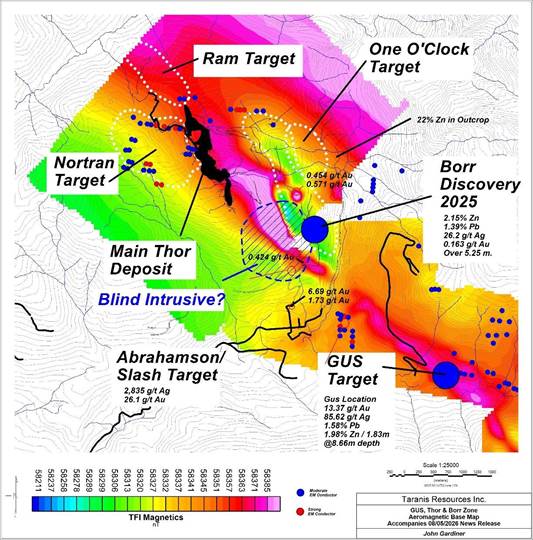
The intrusive stock ("GUS") is located 3.7 km southeast of the Borr epithermal zone discovered in 2025, which is itself located 1.3 kilometers to the southeast of Taranis' NI 43-101 Thor Mineral Resource. All three of these features are connected by the Thor Lamprophyre Dyke, a conspicuous aeromagnetic feature that can be traced throughout Taranis' property and upwards of 16 km in total length where it is closely affiliated to historical past-producing mines.
Geological Significance of GUS
Phaneritic intrusive rocks have not previously been identified at Thor, but airborne geophysics identified a large, circular resistive anomaly (I-1) that has been interpreted as a deep-seated, blind intrusive target. Deep drilling aimed at this feature in 2025 intersected the Thor Lamprophyre intrusive beneath Thor, and it is believed the lamprophyre is located directly on top of the postulated I-1 intrusive body.
Approximately 6.4 km southeast of Thor is the GUS prospect. At GUS, an intrusive body (syenite) and associated skarn alteration bears remarkable similarity to the alteration found in deep drilling near the Thor deposit. The metasedimentary rocks on the west side of GUS are grossular-andradite skarn, exhibiting intense white-blue/green bleaching. Contact alteration extends for approximately 340m to the west of the GUS intrusive, and currently it is unclear if the alteration is due to contact metamorphism from the GUS intrusive body itself, or if it comes from the Thor Lamprophyre Dyke. In 1984, Moly Gold Resources drilled one shallow drill hole (dip -450, strike 0300 - TD 31.39m) in the metasedimentary skarn 126 m to the west of the GUS intrusive, intersecting 13.37 g/t Gold, 1.98% Zinc, 1.58% Lead, and 85.62 Oz/ton Silver over 1.83m*. Intrusive rocks at GUS contain both unaltered syenite, and endoskarn that consists of irregular iron-oxide quartz veinlets with 3-4% pyrrhotite, and green-coloured alteration. Numerous lamprophyre rocks were identified in float in the area, although the source of the lamprophyre has not been identified.
*Note: The Company has not independently verified the historical drill hole sampling, assay results, or QA/QC protocols associated with this drill hole. While the Company considers these historical results relevant for guiding future exploration work, readers are cautioned not to place undue reliance on them. There can be no assurance that historical grades or mineralization widths will be replicated in future diamond drilling or exploration programs.
Discussion
This is the first time phaneritic intrusive rocks have been identified on the Thor Property, and they appear to be directly associated with alteration identical to what has been documented in the main Thor NI 43-101 Mineral Resource area. Review of the recently compiled aeromagnetic maps of the expanded Thor property show at least five circular magnetic highs that are prospective intrusive stocks. These geophysical anomalies are currently being ground proofed to see if they are in fact important intrusive stocks.
GUS is connected to Thor by a lamprophyre dyke that forms a north-west trending linear feature on aeromagnetic maps. Numerous airborne electromagnetic anomalies are associated with the margins of the lamprophyre dyke and satellite mapping (iron alteration indices) can be correlated with the lamprophyre. These are highly prospective targets for gold mineralization and additional field work is ongoing to evaluate these important anomalies.
The intrusive rocks found at GUS will be analyzed in detail, as they are probably representative of the ‘engine' to the widespread mineralization in the Silver Cup mining district. Based on what has been found at GUS, it is highly probable that there is an undiscovered deep intrusive at Thor, and that the intrusive rocks are intimately related to the Thor lamprophyre dyke. The deepest hole drilled in the Thor Lamprophyre dyke at Thor showed shallow iron-sulphide transitioning to pyrrhotite at depth, and this, viewed in conjunction with other drill holes, shows that there is an important mineral zonation at Thor where pyrite dominates near surface, and that mineralization changes to high-temperature pyrrhotite 400m below the Thor deposit. There is also a zonation in the Thor deposit itself, where the upper parts of the deposit are silver, gold and base metal-rich, but, transition into pyrite and copper at depth. All of this evidence viewed collectively is indicative of a large intrusive stock (similar to GUS) underlying Thor.
Qualified Person
Exploration activities at Thor were overseen by John Gardiner (P. Geo.), who is a Qualified Person under the meaning of Canadian National Instrument 43-101. John Gardiner is the principal of John J. Gardiner & Associates, LLC which operates in British Columbia under Firm Permit Number 1002256. Mr. Gardiner is the President and CEO of Taranis Resources inc. and has reviewed and approved the comments contained within this News Release.
About Taranis Resources Inc.
Taranis Resources (TSXV:TRO)(OTCQB:TNREF) has evolved beyond the profile of a traditional junior explorer. After 15 years of methodical exploration and compiling a massive database from over 250 drill holes to define a 43-101 Mineral Resource at Thor and recently completing a 100% consolidation of the historic Silver Cup Mining District, the company is transitioning from "understanding the Thor deposit" to "unlocking district-scale" discovery potential.
Taranis' core values include scientific rigor, highlighting exploration driven by state of art predictive targeting, 3-D geophysical inversions, and carefully controlled use of AI, as opposed to traditional surfacelevel prospecting. The Company prioritizes methodological, high-quality exploration over promotional shortcuts, and allocates funds "into the ground". Taranis' leadership has unmatched shareholder alignment, and our Management Team has been intact for 20 years with substantial insider ownership. Taranis exercises responsible stewardship and is committed to defining legitimate ownership through active labour, stringent reclamation programs, and transparent First Nations and local community engagement.
Taranis currently has 104,452,053 shares issued and outstanding (122,608,613 shares on a fully-diluted basis).
TARANIS RESOURCES INC.
Per: John J. Gardiner (P. Geo.),
President and CEO
For further information contact:
John J. Gardiner
681 Conifer Lane
Estes Park, Colorado 80517
Phone: (720) 209-3049
NEITHER THE TSX VENTURE EXCHANGE NOR ITS REGULATION SERVICES PROVIDER (AS THAT TERM IS DEFINED IN THE POLICIES OF THE TSX VENTURE EXCHANGE) ACCEPTS RESPONSIBILITY FOR THE ADEQUACY OR ACCURACY OF THIS NEWS RELEASE.
This News Release may contain forward looking statements based on assumptions and judgments of management regarding future events or results that may prove to be inaccurate as a result of factors beyond its control, and actual results may differ materially from expected results.
SOURCE: Taranis Resources, Inc.
View the original
press releaseon ACCESS Newswire
Media gallery