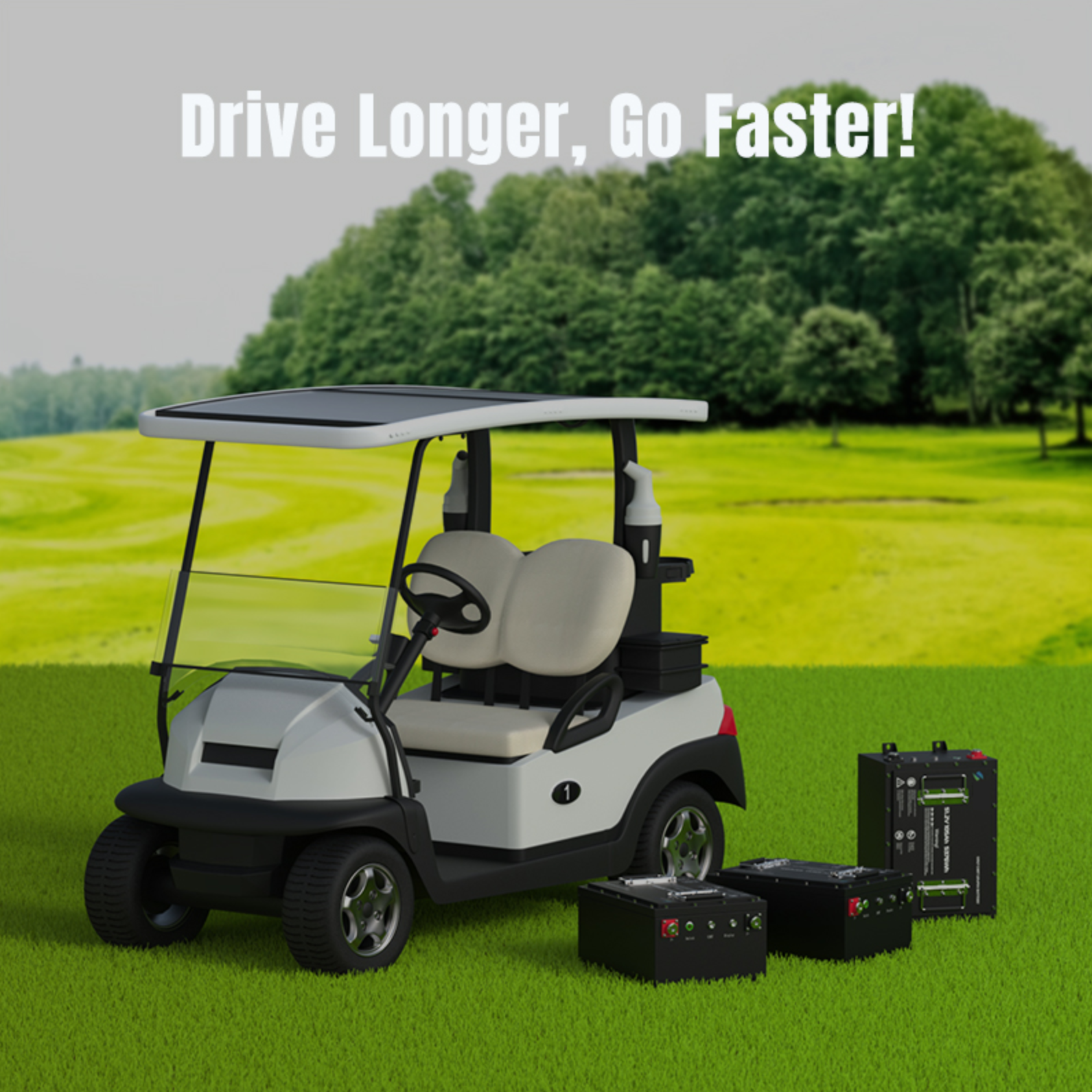


HUIZHOU, GUANGDONG, CHINA, August 21, 2026 /EINPresswire.com/ -- Golf cart fleet operations demand persistent power delivery, structural durability, and rapid recharge turnarounds across demanding course terrains. Traditional lead-acid battery packs frequently exhibit voltage sag during steep climbs, rapid capacity degradation under mechanical vibration, and severe charging limits in cold temperatures. Modern electric fleet management requires high-density motive power solutions capable of maintaining stable voltage curves while resisting severe physical vibration. To solve these critical field-level challenges, Propow provides high-performance LiFePO4 golf cart batteries engineered to deliver over 4000 deep discharge cycles with zero daily maintenance. Built with advanced lithium iron phosphate chemistry and intelligent battery management architectures, these systems provide a 10-year design life for commercial resort fleets and utility vehicles.
Drawing from Propow Energy's 20+ years of manufacturing experience, the following 5 dimensions provide a structured framework for fleet managers and OEMs to evaluate golf cart lithium battery suppliers:
High-Discharge BMS Architecture: Integrates continuous 300A discharge ratings to eliminate voltage sag during heavy vehicle acceleration and steep incline navigation.
Cell-Level Vibration and Thermal Isolation: Utilizes internal structural dampening and thermal containment to endure continuous rough terrain vibration without mechanical failure.
Integrated Low-Temperature Self-Heating Infrastructure: Features optional automated internal heating elements to enable full charging capability in freezing environments below 0°C.
Plug-and-Play OEM Compatibility & Complete Retrofit Kits: Delivers turnkey conversion packages customized for major chassis brands including Club Car, Yamaha, and EZGO.
Scalable Parallel Expansion and Real-Time IoT Telematics: Supports unrestricted parallel battery clustering with Bluetooth App monitoring for live state-of-charge, voltage, and cycle tracking.
Evaluating BMS Discharge Capacity and Acceleration Power
Commercial golf carts encounter severe electrical stress when accelerating under full loads or climbing steep gradients. Standard battery systems with low-current protection circuits often trip during sudden current spikes. A robust lithium battery design relies heavily on its Battery Management System (BMS). Proprietary BMS designs equipped with high-power MOSFET arrays support continuous discharge currents up to 300A, ensuring instantaneous torque delivery without over-current shutoffs.
In addition, nominal system configurations must match diverse golf cart drive platforms. Manufacturing capabilities covering 36V (38.4V), 48V (51.2V), and 72V (73.6V) platforms with capacities like 50Ah, 60Ah, 72Ah, 80Ah, 105Ah, 150Ah, 168Ah and 210Ah allow operators to select exact energy storage profiles. High-capacity models like the CP48105 (51.2V 105Ah) and CP48150 (48V 150Ah) provide heavy-duty 48V cart fleets with sustained energy reserves, while the CP72105G (73.6V 105Ah) powers high-speed 72V vehicles.
Verifying Structural Durability and Thermal Resilience
Off-road golf cart operation exposes battery enclosures to mechanical shock, multidirectional vibration, and atmospheric humidity. Evaluating supplier quality requires scrutinizing environmental testing protocols and cell containment engineering. Leading facilities utilize specialized cell-level physical isolation structures with ruggedized outer casings. Internal testing laboratories perform drop testing, vibration testing, waterproof testing, and thermal shock assessments to confirm structural integrity prior to mass deployment.
Compliance with international safety benchmarks validates quality control execution. Facilities certified under ISO 9001 and ISO 14001 standards ensure strict process quality control from initial cell screening to pack assembly. Certifications such as CE, UN38.3, IEC, MSDS, UL, IEC62619, and RoHS demonstrate that battery assemblies meet global regulatory standards. Operating across -20°C to 65°C (-4°F to 149°F), long-term reliability is backed by 7-year manufacturer warranty terms for golf cart product lines.
Assessing Low-Temperature Charging Capabilities and Smart Heating
Operating golf cart fleets in cold climates introduces operational hurdles for standard lithium batteries. Conventional LiFePO4 cells cannot accept charge current below 0°C without risking lithium plating and cell damage. To overcome ice-bound constraints, advanced battery packs incorporate intelligent self-heating technology powered directly by the charger or internal reserve.
When an external charger is connected in sub-zero conditions, the smart BMS directs electrical current to internal heating elements within the cell module. The BMS monitors temperature sensors until the core cell temperature reaches a safe charging threshold above freezing. Once thermal equilibrium is established, the BMS routes full charging current to the cells, enabling reliable fleet replenishment during freezing winter mornings without heated storage.
Analyzing One-Stop Retrofit Compatibility for Major Golf Cart Brands
Replacing lead-acid battery banks with modern LiFePO4 systems often presents mechanical mounting and electrical compatibility hurdles. Evaluating top manufacturers involves reviewing their ability to provide turnkey conversion kits designed for direct drop-in replacement across major cart brands like Club Car, Yamaha, EZGO, and STAR EV.
A complete conversion kit includes custom-fit mounting brackets, a dedicated high-efficiency lithium charger, a voltage reducer, a custom charging receptacle, an AC extension cord, and a dash-mounted SOC display screen. Matching battery housing dimensions to original battery trays allows quick mechanical installation without chassis modification, while integrated 48V to 12V voltage reducers ensure auxiliary electronics receive stable power.
Examining IoT Telematics and Parallel Battery Scalability
Modern fleet management requires real-time visibility into battery health metrics to prevent downtime and streamline preventive maintenance. Advanced golf cart lithium batteries feature integrated Bluetooth modules paired with mobile applications—supporting both neutral BT apps and custom-branded apps. Technicians and operators can scan battery packs in real time to monitor exact State of Charge (SOC), voltage, current, cell temperature, individual cell balance, and complete historical problem logs.
For enhanced on-board interaction and fleet tracking, manufacturers offer optional hardware integrations, including an interactive touchable LCD display screen (providing instant touch navigation for SOC, voltage, current, and cell balance), an audible SOC low-power buzzer alarm (triggering when SOC reaches 10% or a custom threshold), and an integrated GPS positioning module for real-time asset tracking. Additionally, BMS architectures support remote diagnostics—allowing historical data transmission for troubleshooting—and wireless firmware updates over the air (OTA). In commercial facilities where vehicle range requirements vary, engineering designs supporting parallel battery expansion allow operators to connect additional battery modules to multiply total vehicle capacity without complex wiring overhauls.
Factory-Direct Lithium Systems Versus Component Sourcing
Integrated LiFePO4 battery systems streamline fleet conversion and ensure exact mechanical alignment compared to sourcing individual cells, chargers, and BMS units from separate suppliers.
Single-source manufacturer solutions integrate pre-calibrated BMS algorithms with matched battery cell configurations, delivering optimized energy efficiency and instant installation readiness compared to assembling disparate aftermarket components.
Factory-direct engineering support backed by over 100 technical patents and national high-tech enterprise recognition ensures long-term spare parts availability and dedicated technical consultation throughout the vehicle lifecycle.
Conclusion
Selecting a top golf cart lithium battery manufacturer in China requires evaluating high-current BMS discharge ratings, internal mechanical vibration resistance, sub-zero self-heating infrastructure, OEM drop-in compatibility, and scalable IoT telematics. Partnering with an established manufacturer backed by 15GWh annual production capacity, national research center credentials, and ISO quality certifications guarantees robust motive power systems tailored for demanding fleet applications. By adopting pre-configured LiFePO4 technology, fleet operators maximize vehicle uptime, eliminate daily battery maintenance expenses, and achieve long-term operational efficiency.
For custom golf cart battery specifications, OEM conversion kits, and wholesale procurement inquiries, visit https://www.propowenergy.com/ to consult with senior battery engineering specialists.
Propow Energy Co., Ltd.
Propow Energy Co., Ltd.
Visit us on social media:
Legal Disclaimer:
EIN Presswire provides this news content "as is" without warranty of any kind. We do not accept any responsibility or liability for the accuracy, content, images, videos, licenses, completeness, legality, or reliability of the information contained in this article. If you have any complaints or copyright issues related to this article, kindly contact the author above.

Media gallery