
Vadzo Imaging releases a design guide for low power industrial WIFI camera systems using optimized camera designs and advanced sensor architectures. The guide highlights the Wave camera series built on Sony IMX678, Sony IMX662, onsemi AR0821 and onsemi AR0234 sensors for robotics, AGV, UAV and surveillance applications. Vadzo Imaging explains how dual-band WiFi, HDR imaging, ultra-low light sensitivity and global shutter technology improve power efficiency in embedded vision deployments. The company also demonstrates how the Wave camera portfolio helps OEMs achieve reliable imaging performance across battery-powered platforms.
FORT WORTH, TX / ACCESS Newswire / May 29, 2026 / Vadzo Imaging, a designer and manufacturer of embedded vision camera products, today released a design guide for low-power industrial WIFI camera systems. The guide covers four purpose-built camera products based on the Sony IMX678, onsemi AR0821, Sony IMX662, and onsemi AR0234 sensors, and addresses the growing demand for energy-efficient, dual-band wireless, and high-resolution imaging in mobile robots, AGV, UAV, drone camera, patient monitoring, and smart surveillance applications, where interface selection and sensor architecture directly determine system power performance.
Why Power Efficiency Is Now a Critical Constraint in Embedded Vision Design
In environments where camera products operate on battery power or draw from limited onboard energy sources, power budget is no longer secondary to resolution or frame rate. Mobile robot camera platforms, AGV camera systems, UAV camera rigs, drone camera payloads, kiosk camera deployments, and medical device camera modules all share one constraint: they must perform reliably within the thermal and power limits of their host platform.
System designers frequently underestimate how much the camera interface contributes to overall consumption. MIPI CSI-2, USB 3.0, GMSL, and LVDS each carry different overheads in terms of active power and idle draw. The design guide details how selecting the correct interface for a given deployment topology directly impacts the energy budget across the full operational cycle. For battery-powered industrial camera designs in particular, this interface decision can make the difference between a four-hour and an eight-hour operational window.
Rolling Shutter vs Global Shutter: How Sensor Architecture Shapes Power Consumption in Low-Power Camera Designs
Rolling shutter and global shutter sensors behave differently under real-world power conditions. A rolling shutter WiFi camera built around a well-optimized sensor pipeline can achieve lower idle consumption than a global shutter alternative running at equivalent resolution. For applications involving fast motion capture in robotic camera and drone camera platforms, however, a 2MP global shutter WiFi camera may reduce the computational overhead required to correct motion artifacts downstream and thus lower total system power when the full processing chain is considered.
Sensor generation technology from Sony STARVIS2 and onsemi directly affects pixel sensitivity and dynamic range in ways that reduce the dependence on external illumination. In low-light deployments, a low-consumption vision camera with higher quantum efficiency requires less artificial lighting and therefore lowers the total energy footprint of the entire vision node. This effect is especially pronounced in patient monitoring camera and pathology device camera installations, where continuous illumination would otherwise add significant steady-state power draw.
How Dual-Band WiFi Improves Performance in Low-Power Camera Systems
WiFi industrial camera designs introduce power considerations that wired camera products do not face. The choice between the 2.4 GHz and 5 GHz bands affects both throughput and power behavior depending on the deployment environment. A dual-band wireless camera can intelligently switch between bands based on environmental interference patterns and proximity to the access point. This adaptability reduces retransmission overhead and lowers the average power consumed during video streaming sessions.
For applications like smart surveillance camera installations, medical device camera systems, and video streaming camera deployments where continuous output is required, an 8MP dual-band WiFi camera can maintain high-resolution streaming without the power penalties associated with poor link quality. The design guide examines scheduling strategies, sleep mode configurations, and buffer management techniques that further reduce energy use in always-on vision deployments. For VGA camera devices and lower-resolution nodes where bandwidth is less demanding, 2.4 GHz operation. Aggressive duty cycling offers the most efficient path to long runtime.
Wave Series Camera Portfolio for OEM Vision Integration:
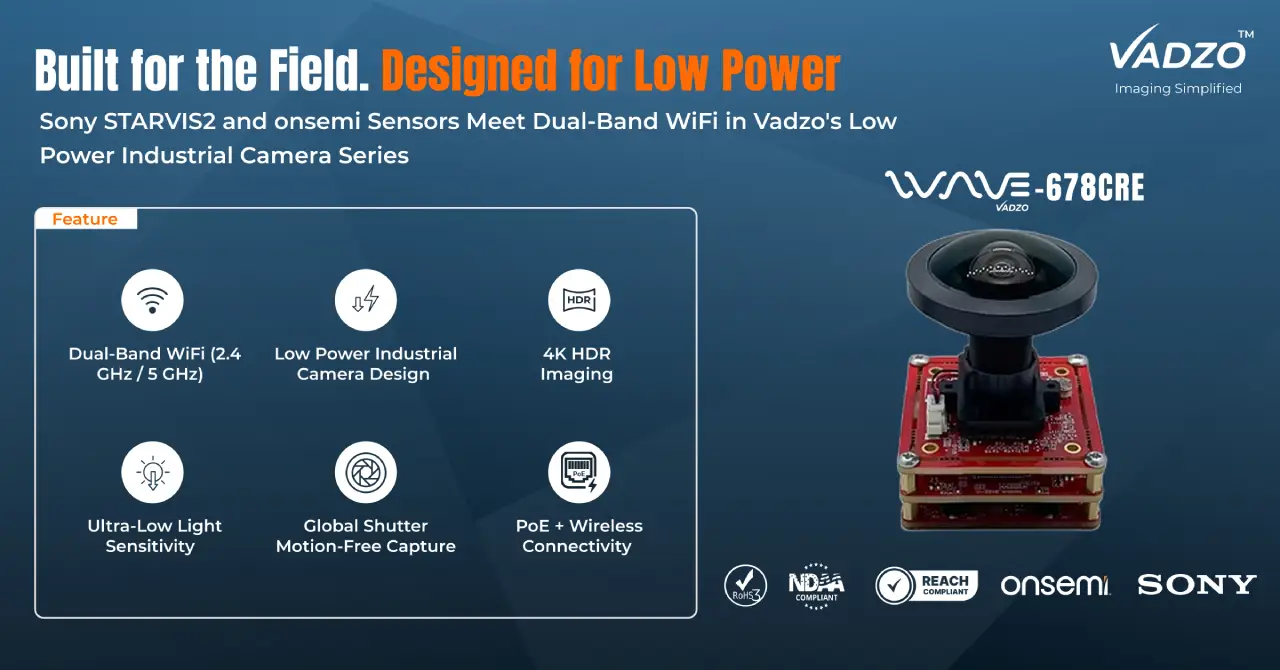
Wave-678CRE IMX678 WiFi Camera: 8MP 4K STARVIS2 HDR for Robotic and UAV Applications
The Wave-678CRE IMX678 WiFi Camera targets robotic camera, UAV camera, and mobile inspection platforms where dynamic range requirements shift rapidly between bright outdoor environments and shadowed interior spaces within a single deployment cycle. Delivering 4K HDR output on the Sony STARVIS2 IMX678 BSI CMOS with rolling shutter readout, it maintains clean signal integrity across high-contrast scenes without requiring aggressive ISP compensation or artificial illumination to close the exposure gap. This 8MP rolling shutter WiFi camera transmits over dual-band WiFi at 2.4 GHz and 5 GHz, making it a validated wireless solution for battery-powered industrial camera systems that demand high-resolution streaming without a wired tether.
Key specs: 8MP (3840x2160) | Sony IMX678 STARVIS2 BSI CMOS | Rolling Shutter | Dual-Band WiFi (2.4 GHz / 5 GHz) | 4K HDR + High Dynamic Range | Low Power Design
Wave-821CRE AR0821 WiFi Camera: 8MP 4K HDR for AGV and Mobile Robot Deployments
The Wave-821CRE AR0821 8MP 4K HDR WiFi Camera targets AGV camera, mobile robot camera, and outdoor industrial inspection platforms where reliable high-resolution imaging must coexist with flexible power delivery options across varying site infrastructure. Delivering 4K HDR output on the onsemi AR0821 BSI CMOS with rolling shutter readout, it sustains image quality across variable outdoor lighting conditions without performance degradation at scene boundaries. This AR0821 rolling shutter WiFi camera supports dual-band WiFi and Power over Ethernet over a single cable, making it a versatile deployment option for energy-efficient embedded camera systems that operate across both wired and wireless infrastructure without separate power runs.
Key specs:8MP (3840x2160) | onsemi AR0821 BSI CMOS | Rolling Shutter | Dual-Band WiFi + PoE | 4K HDR | Low Power Dual-Mode Connectivity
Wave-662CRE IMX662 WiFi Camera: 2MP 1080P Ultra Low Light for Patient Monitoring and Surveillance
The Wave-662CRE IMX662 WiFi Camera targets patient monitoring camera devices, smart surveillance cameras, and security installations where ambient light is minimal, and artificial illumination must be kept to an absolute minimum to avoid disrupting the monitored environment. Delivering 1080P output on the Sony STARVIS IMX662 BSI CMOS with rolling shutter readout, it sustains clean signal performance in near-darkness conditions that would push a frontside illuminated sensor beyond its usable operating range. This IMX662 rolling shutter WiFi camera transmits over dual-band WiFi, making it a low consumption vision camera solution for continuous monitoring deployments that run unattended for extended periods without a power source tethered at the installation point.
Key specs: 2MP (1920x1080) | Sony IMX662 STARVIS BSI CMOS | Rolling Shutter | Dual-Band WiFi (2.4 GHz / 5 GHz) | Ultra Low Light Sensitivity | Low Power Continuous Streaming
Wave-234CGS AR0234 Global Shutter WiFi Camera: 2MP 1080P for Drone and Kiosk Applications
The Wave-234CGSAR0234 Global Shutter WiFi Camera targets drone camera, kiosk camera, and pathology device camera deployments where motion-induced distortion from rolling shutter readout would compromise the integrity of the captured frame. Delivering 1080P output on the onsemi AR0234 BSI CMOS with simultaneous pixel capture across the full array, it eliminates the skew and wobble artifacts that affect rolling shutter designs in fast-motion or vibration-prone environments. This 2MP global shutter WiFi camera transmits over dual-band WiFi, making it a reliable low-power industrial camera solution for airborne and interactive platforms where motion clarity and color accuracy are operationally non-negotiable.
Key specs:2MP (1920x1080) | onsemi AR0234 BSI CMOS | Global Shutter | Dual-Band WiFi (2.4 GHz / 5 GHz) | Motion-Free Capture | Low Power Wireless Design
"Power efficiency in embedded vision is not just about the sensor. It is a systems problem that requires aligning the interface, the sensor architecture, the wireless stack, and the application pipeline. Our Wave camera series gives engineers a starting point that is already optimized across all of these layers, so they can focus on building the product rather than debugging power budgets."- Alwin Vincent, Product Manager, Vadzo Imaging.
Applications for the Vadzo Wave Camera Series Across Industries
Mobile Robotics and AGV Camera Systems: AGV and mobile robot platforms demand 4K HDR imaging within a strict shared power budget across warehouse and outdoor yard environments. The Wave-678CRE delivers dual-band WiFi streaming on the Sony STARVIS 2 IMX678 sensor, and the Wave-821CRE adds PoE support for fixed-route AGV deployments over standard Ethernet infrastructure.
UAV, Drone Camera, and Aerial Vision Platforms: Airborne platforms cannot absorb the computational overhead of rolling shutter correction on a vibrating or yawing airframe. The Wave-234CGS captures distortion-free 2MP frames simultaneously across the full array on the onsemi AR0234 global shutter sensor, eliminating post-processing load and lowering total system power over dual-band WiFi.
Smart Surveillance Camera and Perimeter Security: Outdoor perimeter nodes must cover full sun to complete darkness without supplemental lighting or manual exposure adjustment. The Wave-678CRE handles high-contrast outdoor scenes as a 4K HDR WiFi camera, and the Wave-662CRE covers indoor and low ambient light monitoring with Sony STARVIS ultra-low light sensitivity at 1080P.
Patient Monitoring Camera and Medical Device Integration: Clinical and ward environments require wireless camera products that sustain reliable output under low ambient illumination without active cooling or supplemental lighting. The Wave-662CRE covers continuous patient monitoring, and the Wave-234CGS serves pathology device camera integrations requiring motion-free global shutter capture with full OEM customization available across both products.
Kiosk Camera and Interactive Platform Deployments: Self-service kiosks and ticketing terminals capture fast-moving subjects at close range inside thermally sealed enclosures with no active cooling headroom. The Wave-234CGS delivers global shutter clarity over dual-band WiFi, and the Wave-662CRE covers dim retail and hospitality environments where Sony STARVIS low light sensitivity is the deciding factor.
Frequently Asked Questions (FAQs)
1) What is the best WiFi industrial camera for battery-powered AGV and mobile robot deployments?
For AGV and mobile robot platforms, the best WiFi industrial camera is one that delivers 4K HDR output over dual-band wireless connectivity within a shared power envelope that also serves drive motors and onboard compute. Vadzo Imaging offers two purpose-built options from the Wave camera series for this use case. The Wave-678CRE delivers 4K HDR on the Sony STARVIS2 IMX678 sensor over dual-band WiFi for wireless-only platforms. The Wave-821CRE adds Power over Ethernet to the onsemi AR0821 sensor for fixed-route AGV deployments where a single cable handles both power and data. Both are available with full OEM customization for housing, connector type, and firmware configuration.
2) How does dual-band WiFi reduce power consumption in industrial embedded vision systems?
A dual-band wireless camera reduces power consumption by switching intelligently between 2.4 GHz and 5 GHz bands based on environmental interference and distance from the access point. When the 5 GHz band is available and the link is clean, the camera transmits higher throughput with fewer retransmissions. Fewer retransmissions mean the radio stays in active state for shorter periods per frame, which directly lowers average power draw during continuous video streaming sessions. For always-on deployments like smart surveillance camera and patient monitoring camera nodes, this band-switching behavior, combined with sleep mode scheduling and buffer management, can meaningfully extend battery runtime without reducing resolution or frame rate.
3) Which type of industrial WiFi camera is best for drone and UAV applications where motion distortion is a concern?
A global shutter WiFi camera is the correct choice for drone camera and UAV camera platforms where vibration, yaw, and forward motion are present during capture. Rolling shutter sensors read pixel rows sequentially, which produces skew and wobble artifacts on a moving airframe. Correcting these artifacts requires a downstream compute that adds total system power on an already energy-constrained platform. Vadzo Imaging addresses this directly with the Wave-234CGS, which uses the onsemi AR0234 global shutter camera to capture all 2MP pixels simultaneously. The result is distortion-free output over dual-band WiFi with no post-processing overhead, making it the lowest total system power path for airborne embedded vision deployments.
4) What should I look for in a low-power camera for patient monitoring and medical device integration?
A low-power camera for patient monitoring and medical device integration must sustain reliable wireless output under minimal ambient illumination without active cooling, supplemental lighting, or a wired video tether at the installation point. The key specifications to evaluate are BSI sensor sensitivity for low light performance, dual-band WiFi for cable-free deployment, and a power-optimized firmware stack that supports continuous streaming without thermal accumulation. For pathology device camera integrations that involve fast-moving specimens, a global shutter architecture eliminates motion distortion at the sensor level, removing the need for computational correction. The Wave-662CRE covers continuous low-light patient monitoring on the Sony STARVIS IMX662 sensor, and the Wave-234CGS serves precision pathology imaging on the onsemi AR0234 global shutter sensor.
5) How do I select an energy-efficient camera for smart surveillance and perimeter security without supplemental lighting?
Selecting an energy-efficient camera for smart surveillance without supplemental lighting requires a BSI sensor architecture with high quantum efficiency so the camera product can maintain usable image quality across the full illuminance cycle from direct midday sun to complete darkness. For outdoor perimeter security, the key requirement is HDR capability to handle high-contrast scenes at scene boundaries without manual exposure intervention. For indoor and low ambient light monitoring, the key requirement is ultra-low light BSI sensitivity at the sensor level. Vadzo Imaging covers both scenarios within the Wave camera series. The Wave-678CRE handles outdoor high-contrast surveillance at IMX678 4K HDR WiFi camera on the Sony STARVIS2 IMX678 sensor, and the Wave-662CRE covers indoor and perimeter low light monitoring at 1080P on the Sony STARVIS IMX662 sensor. Both transmit over dual-band WiFi and support OEM customization for infrastructure-integrated deployments.
Availability
The Wave camera series is available now for evaluation and production orders through Vadzo Imaging. The Wave-678CRE, Wave-821CRE, Wave-662CRE, and Wave-234CGS are all stocked for immediate shipment with OEM customization and volume pricing available on request. Visit vadzoimaging.com to explore the full camera portfolio or reach out to the Vadzo team for application-specific guidance on interface selection, sensor choice, and power optimization for your deployment.
About Vadzo Imaging
Vadzo Imaging designs and manufactures custom OEM camera products for industrial, medical, and embedded vision applications. With deep expertise in sensor selection, ISP tuning, wireless integration, and mechanical customization, Vadzo serves engineering teams that need production-ready camera solutions with application-specific performance. The company's camera portfolio spans resolutions from VGA to 4K and supports interfaces including USB, MIPI, WiFi, and PoE. Vadzo works with clients across smart surveillance, patient monitoring, robotics, AGV, UAV, kiosk, and pathology markets.
Media Contact
Alwin Vincent
Vadzo Imaging
Email: alwin@vadzoimaging.com
LinkedIn: Vadzo Imaging
YouTube: Vadzo Imaging
SOURCE: Vadzo Imaging
View the original
press releaseon ACCESS Newswire