

A federal judge in Washington, D.C. has issued a new order freezing President Donald Trump's attempt to limit mail voting for the midterm elections. A previous order from another judge is already before the U.S. Supreme Court. Election officials say they could not implement Trump's new requirements before November. The decision issued late Sunday by U.S. District Judge Carl Nichols is significant because he was nominated by Trump and earlier declined to freeze the president's executive order, saying at the time it was premature. In issuing a preliminary injunction, he wrote that it's now clear many people could lose their ability to vote if it goes into effect.
From
To

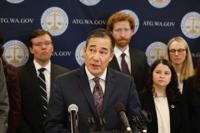
FILE - Washington Secretary of State Steve Hobbs speaks during a news conference at which the state attorney general announced a federal lawsuit challenging President Donald Trump's executive order attempting to overhaul elections in the U.S., in Seattle, April 4, 2025. (AP Photo/Manuel Valdes, File)

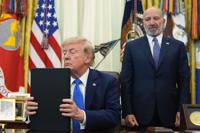
A federal judge has blocked President Donald Trump's latest attempt to prohibit automatic U.S. citizenship at birth. Judge Deborah L. Boardman in Maryland granted a preliminary injunction on Wednesday, stopping the executive order until a class-action lawsuit by immigrant families and advocacy groups is resolved. Birthright citizenship is guaranteed under the 14th Amendment, ratified in 1868. Trump's order aimed to restrict citizenship for children born to certain foreign nationals. The judge said the U.S. Supreme Court already ruled on the issue in June, finding that children in the class action case are citizens at birth. Boardman said Trump's new executive order, issued in August, violated the high court's earlier ruling.

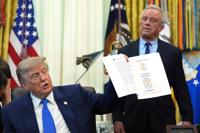
FILE - President Donald Trump holds up an image taken from his Truth Social account as Health and Human Services Secretary Robert F. Kennedy Jr. watches during a meeting to sign an executive order about vaccines, Monday, Aug. 10, 2026, in the Oval Office of the White House in Washington. (AP Photo/Jacquelyn Martin, File)

Postal Service work to comply with Trump's executive order is rushed, sloppy, whistleblower contends
A whistleblower for the U.S. Postal Service is warning that a new mail ballot system being hastily built to comply with President Donald Trump's executive order restricting that method of voting could lead to the rejection of huge numbers of mail ballots. The whistleblower made the allegation anonymously in documents submitted by Democratic Sen. Richard Blumenthal to the Postal Service. Blumenthal says the disclosure shows Trump is trying to sabotage mail voting. A federal judge has barred the Postal Service from making the changes for the midterms, but that case is being appealed, possibly to the Supreme Court.

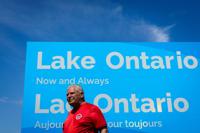
TORONTO (AP) — Ontario Premier Doug Ford answered President Donald Trump’s “Lake America” decree Saturday with a billboard-sized message on th…
The leader of the Seneca Nation in upstate New York is criticizing President Donald Trump's decision to rename Lake Ontario as “Lake America,”…

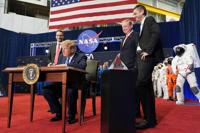
President Donald Trump signs an executive order creating the U.S. Space Academy as Michael Kratsios, White House Science and Technology advisor, from left, Kevin Hassett, director of the National Economic Council, and NASA Administrator Jared Isaacman look on during an event to present the Congressional Space Medal of Honor to Artemis II crew members, Friday, Aug. 28, 2026, at Johnson Space Center in Houston. (AP Photo/Mark Schiefelbein)

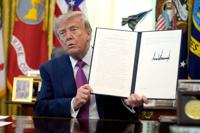
President Donald Trump holds up a signed executive order in the Oval Office of the White House, Thursday, Aug. 27, 2026, in Washington. (AP Photo/Manuel Balce Ceneta)

WASHINGTON (AP) — President Donald Trump said Thursday he is renaming Lake Ontario to be known as “Lake America” in the United States as he ex…