
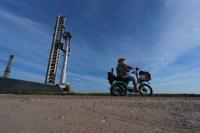
SpaceX launched its enormous Starship toward orbit for the first time Monday, aiming for six full laps around Earth to prove its readiness for…
From
To

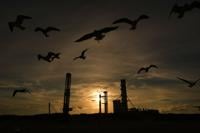
Seagulls fly near the site of SpaceX's mega rocket Starship as it is prepared for a test flight from Starbase, Texas, Sunday, Sept. 27, 2026. (AP Photo/Eric Gay)
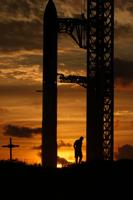
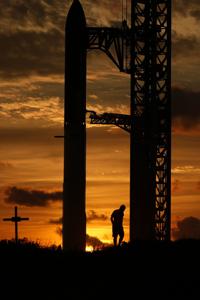
A man watches at sunset as SpaceX's mega rocket Starship is prepared for a test flight from Starbase, Texas, Sunday, Sept. 27, 2026. (AP Photo/Eric Gay)

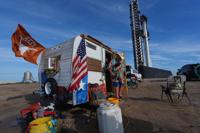
David Orr camps out near the site where SpaceX's mega rocket Starship, behind right, is preparing for a test flight from Starbase, Texas, Sunday, Sept. 27, 2026. (AP Photo/Eric Gay)

David Orr rides his bike past SpaceX's mega rocket Starship as it is prepared for a test flight from Starbase, Texas, Sunday, Sept. 27, 2026. (AP Photo/Eric Gay)

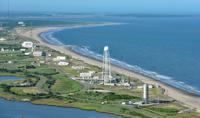
NASA is exploring a potential expansion of orbital launch operations at Wallops Flight Facility that could open roughly 150 acres of the facility to new launch infrastructure.

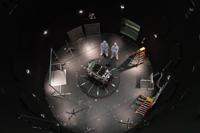
CAPE CANAVERAL, Fla. (AP) — A private spacecraft that was supposed to supply a lifeline to NASA’s Swift Observatory managed to get close to th…
FILE - This photo provided by NASA shows Kieran Wilson, LINK's principal investigator, and Hunter Robertson, a space systems engineer, both at Katalyst Space, standing next to their spacecraft inside the SES (Space Environment Simulator) at NASA's Goddard Space Flight Center in Greenbelt, Md., April 17, 2026, ahead of thermal vacuum testing. (Sophia Roberts/NASA via AP, File)
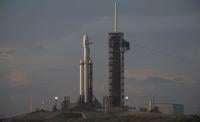
NASA’s newest space telescope has blasted off on a quest to find planets around other stars and explore the hidden universe. SpaceX launched the $4 billion Roman Space Telescope on Sunday from Florida’s Kennedy Space Center. Roman blazed toward an observation point 1 million miles away that’s home to the Webb Space Telescope, one of NASA’s other crown jewels in the sky. Roman will take three months to reach its destination. Once there, it will survey the cosmos like never before. The telescope is named after the late Nancy Grace Roman, NASA’s first chief astronomer.

NASA's Nancy Grace Roman Space Telescope, encapsulated in a protective payload fairing atop a SpaceX Falcon Heavy rocket, is seen at sunrise, Saturday, Aug. 29, 2026, at Launch Complex 39A at NASA's Kennedy Space Center in Florida. (Joel Kowsky/NASA via AP)