
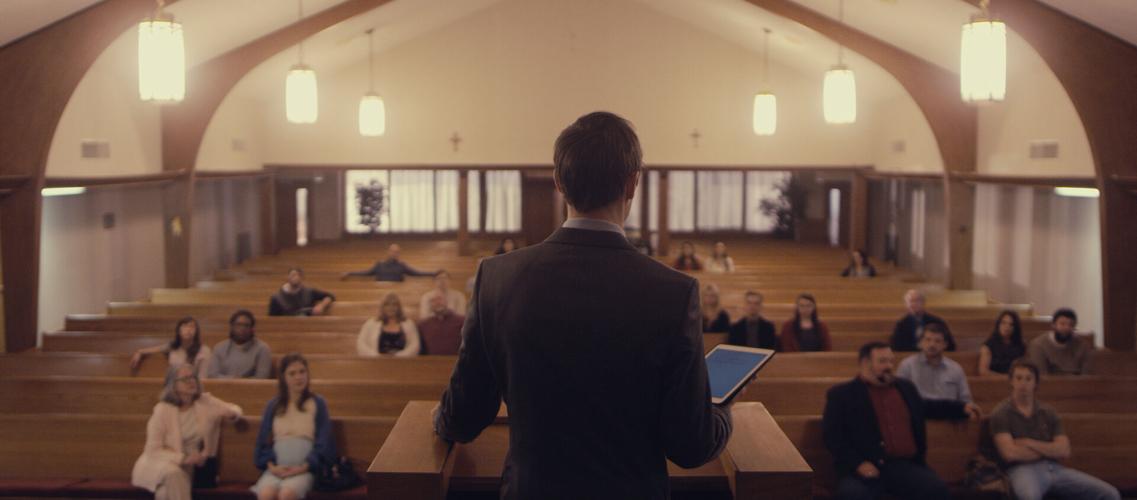



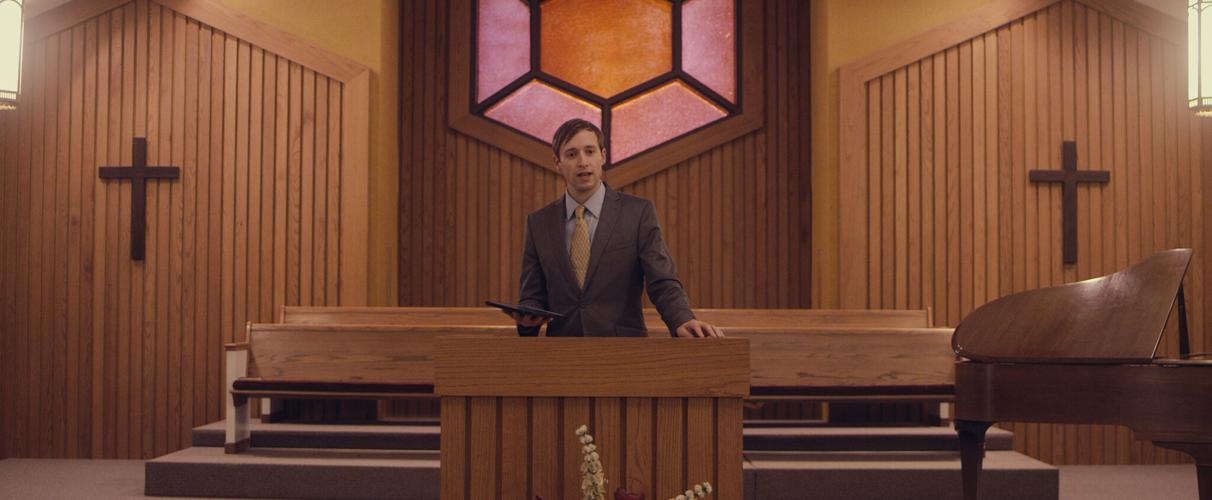
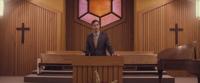
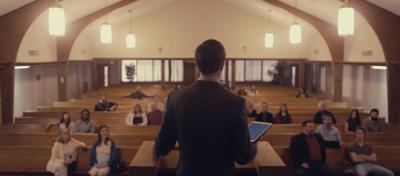
A young pastor at a Southern Baptist church in Arkansas gives a sermon at the beginning of this film where he says Christianity, Judaism and Islam define God differently, which might not be technically true. All three are collectively known as the Abrahamic religions, meaning all three derive their understanding of faith about God from the same source. What isn’t mentioned is why the three religions split into each’s own. Yes, Christianity and Islam had differences in whom they thought the Messiah was, but, a lot of the reasons for diverging were mainly political. Even today, differences are mainly political ones. The Southern Baptists, for example, are Protestants who separated from the regular Baptist denomination, mainly due to political reasons during the American Civil War. Mainly, Southern Baptists supported slavery and even advocated for it.
The young pastor here continues by arguing that we shouldn’t label or try to define God because that would limit God to one’s own perspective. The film then cuts to a shot of people listening and looking at him in dead silence, as if to think that the point of religion, in actuality, is trying to define or label God, and if this pastor is arguing the opposite, then there is no point of even sitting in the church, which is probably why the pastor’s congregation is lacking. That film cut is clearly a moment of quiet comedy for director Jennifer Gerber in her directorial debut.

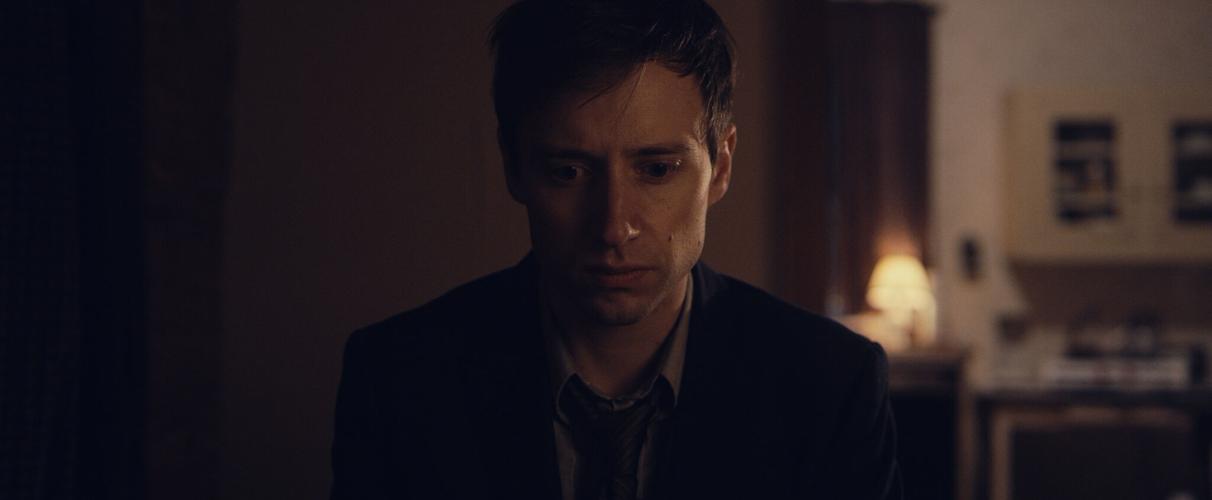
David Rysdahl (That’s Not Us) stars as Eli, the young pastor in question who has inherited his father’s church. He’s married with no children. His church is struggling financially. Attendance is low and he’s under pressure to change things. It’s not clear how long he’s been doing this, but it feels like his job as pastor is a recent one but perhaps not. His sermons, challenging the status quo of how people think about religion, could have been the reason for his congregation’s erosion. He just seems awkward, nervous and not good at public speaking.
Yet, Eli’s awkwardness and nervousness are another source of humor in this movie. Adapting the 2010 play by Samuel Brett Williams, Eli’s foil is Trevor, played by Raymond McAnnally. If Eli is awkward and nervous, Trevor is the opposite. Even his body-type is opposite. Trevor is a burly, hirsute, aggressively jolly, literal, deer hunter, whereas Eli is a mild-mannered and meek, skinny vegetarian. Eli and Trevor’s scenes together are initially funny in a quasi-Neil Simon, The Odd Couple kind of way.
Eli and Trevor also could have worked in a Norman Lear, All in the Family kind of way with Trevor as Archie Bunker and Eli as Michael Stivic. The film, however, has no interest to bandy the issues, particularly the main issue on this movie’s mind, that of homosexuality in the church. The movie is more concerned with the business of running a church. In that, this movie is not unlike the TV series Greenleaf on OWN. The business of running a church, as Williams has said in interviews about his play, is similar to the business of putting on a play itself, or particularly a one-man-show, where the pastor or priest is the star on stage. Yet, this movie isn’t really about the substance of what that pastor says. It’s more about the presentation and whether Eli gives his sermons emotionally or intellectually, whether he should entertain or educate, or whether he should lecture or instead just give pep rallies for Jesus.
Yet, Eli’s presentation is less of a conflict, as the titular, church revival and the business surrounding it feel more like a pretense or a backdrop for Eli entering into a same-sex romantic relationship while acting like he’s straight. As most movies about a closeted man with a girlfriend or wife, this one plays out rather predictably. The exception is the role of Eli’s wife, June, played by Lucy Faust (Mudbound). June isn’t necessarily predictable in her actions here, but the times this movie is really interesting is when it’s almost satirizing Eli’s religious beliefs. The gutting of a deer is one time and another more comedic time is when Jimmy, played by Stephen Ellis, a parishioner, reveals taboo feelings that might be worse than homosexual feelings but somehow are condoned textually in the Bible.

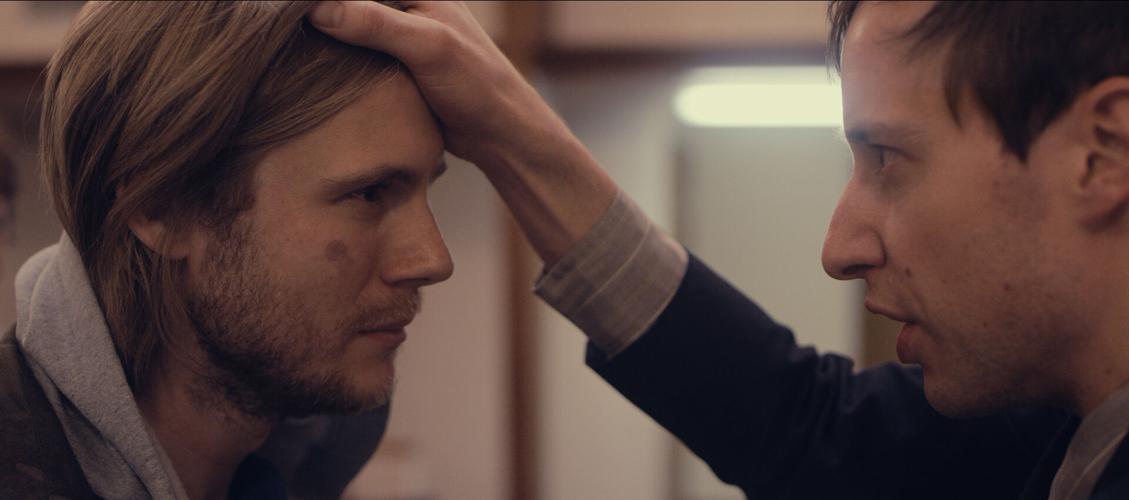
In fact, the first 30 minutes of the movie is mostly comedic, a sly comedy that is buoyed by the performances of Rysdahl and McAnnally. However, immediately after, the final two-thirds lose that comedic tone and the movie becomes a more sobering romance that really becomes fueled by the passion of Daniel, played by Zachary Booth (pictured above on left), a drifter who arrives homeless and at the door of the church whom Eli shelters and with whom Eli has sex.
I would have preferred if that satiric bent were maintained, but the romance does generate steamy moments. The chemistry between Eli and Daniel is definitely intense, and it’s interesting to see these two lonely men dealing with the loss of their parents and what each parent left behind that’s echoed in their children, but it’s an oft-explored theme. Films about gay pastors trying to reconcile their faith and their sexuality don’t come along every week, but this movie doesn’t do much with the reconciling besides reducing it to yet another coming-out story.
It’s been over 10 years since the documentary For the Bible Tells Me So (2007), which is about Gene Robinson, the first openly gay priest. That documentary also analyzes the Scripture and challenges the accepted beliefs against homosexuality by the church. Instead of addressing that or advancing the conversation in that regard, this movie regresses into being yet another man-afraid-to-come-out-of-closet narrative, which again ends in brutal violence upon a gay character.
We are less than a decade from the Matthew Shepard Act, which was signed to address hate crimes against gay people. Despite that, according to the FBI’s 2016 Hate Crimes and Statistics report, hate crimes against gay people have risen percentage-wise, so the depiction of one such hate crime here isn’t totally unwarranted. It’s just sad that there is no reckoning to it. It’s been 10 years since Rock Haven (2007), which is also about a devout Christian reeling from his same-sex attraction. It was a coming-out story that reckoned more with that idea than this movie does, but Rysdahl does have a great screen presence and is an actor worth watching.

Not Rated but contains sexual situations and language.
Running Time: 1 hr. and 23 mins.
Opens at the Laemmle Music Hall on January 19.
Available on DVD / VOD on January 23 via iTunes, Amazon, Google Play, Vudu and etc.