
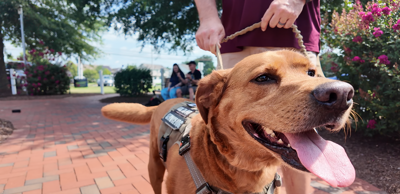

DOVER, Del. - For some Delaware veterans, a service dog is more than a companion. It's a source of independence, purpose and support.
Canines Assisting Service Heroes, or C.A.S.H., is a Delaware nonprofit that provides trained service dogs to honorably discharged Delaware veterans diagnosed with Post-Traumatic Stress Disorder (PTSD) or Traumatic Brain Injury (TBI). The organization also provides recipients with a veterinary care plan for their dogs.
The program was founded by Vietnam veterans Ray Harris and Joe Startt, who say they wanted to help veterans returning from Vietnam, Iraq and other conflicts.
"The veterans coming back from Vietnam and Iraq, they need help," Startt said. "And that's one reason why we started the program."
For Harris, the impact of the program can be seen in the relationship between veterans and their dogs.
"These guys give people a purpose," Harris said. "They get up in the morning, you know, you have to take care of them. They become your life."
Harris said the dogs can also recognize when their owners are struggling.
"They know when you're feeling bad. They can tell when you're upset," he said.
A life-changing partnership
For Air Force veteran Elizabeth Short, that connection with her service dog, Cash, has been life-changing.
"He's meant everything. He saved my life," Short said.
Short says Cash alerts her to seizures and can recognize when her blood pressure is dropping. He also wakes her from nightmares and stays close to her throughout the day.
"He doesn't leave my side normally," she said.
Short says the bond has given her a way to stay active and connected with others. She now volunteers with C.A.S.H. at events to show other veterans what a service dog can do.
Similarly, military veteran Heather Ness says her physical health relies on her service dog Freyja.
"Without her, I wouldn't be able to leave the house or drive," she said.
For Bryan Clarke, who is currently serving in the National Guard, his service dog Captain has helped him in a different way.
Clarke describes himself as an introvert. Captain, he says, is the opposite.
"He's an extrovert, so we balance each other out very well," Clarke said. "He'll help meet people, greet people, and then it kind of breaks the ice."
Clarke says Captain helps him promote the program and connect veterans and their families with resources.
Ken Parte, a Navy veteran who served for 20 years and was deployed during Operation Desert Storm, says his service dog Echo has become part of his family.
"I'm blessed to have her. She's been a godsend," Parte said.
Echo has accompanied Parte on multiple flights and helps him cope with nightmares and other challenges.
"You don't know the meaning of love unless you have these animals," Parte said. "It's incredible."
Funding the mission
C.A.S.H. currently has about 30 active service dogs working with veterans in the community, with three more in training.
The dogs come from several sources, including rescue centers, donations and private purchases, before receiving professional training.
But keeping the program running comes with a significant cost.
Harris says C.A.S.H. spends about $3,000 a month to board, train and care for its animals. The organization received $62,000 from the state this year, but Harris says continued growth means the nonprofit needs additional fundraising and community support.
"We just want to get the word out that we need help," Startt said.
Harris says the organization’s mission remains simple: help veterans find a renewed sense of purpose and connection.
For veterans considering a service dog, Harris also emphasizes that the animal is not a replacement for counseling or other treatment.
"The dog is not a cure," Harris said. "It's just like any other medicine. If you don't take your medicine, you're not going to get well."
Instead, he says, the dogs are another tool to help veterans move forward.
And for veterans like Short, Ness, Clarke and Parte, that four-legged support has become an important part of their lives.
"He's your best friend," Short said of Cash. "I don't know what I would do without him."
If you or someone you know is eligible and would like to apply, click here.
To learn more about ways to volunteer or donate, click here.