
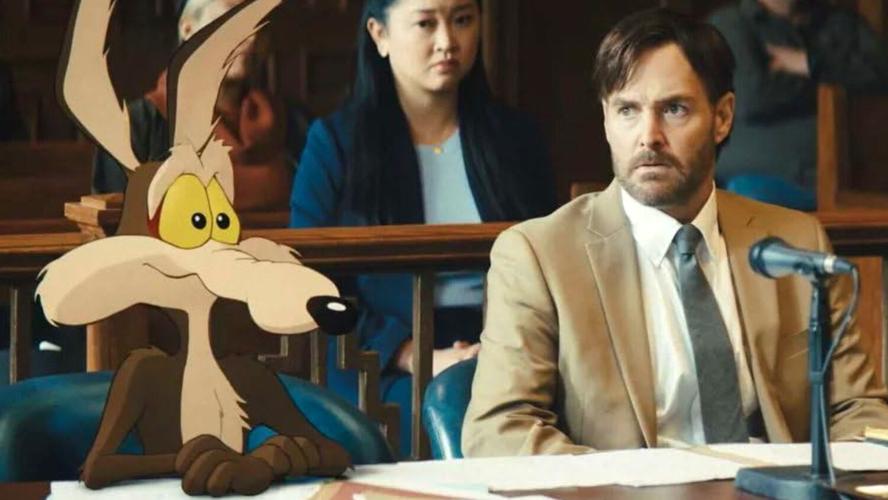
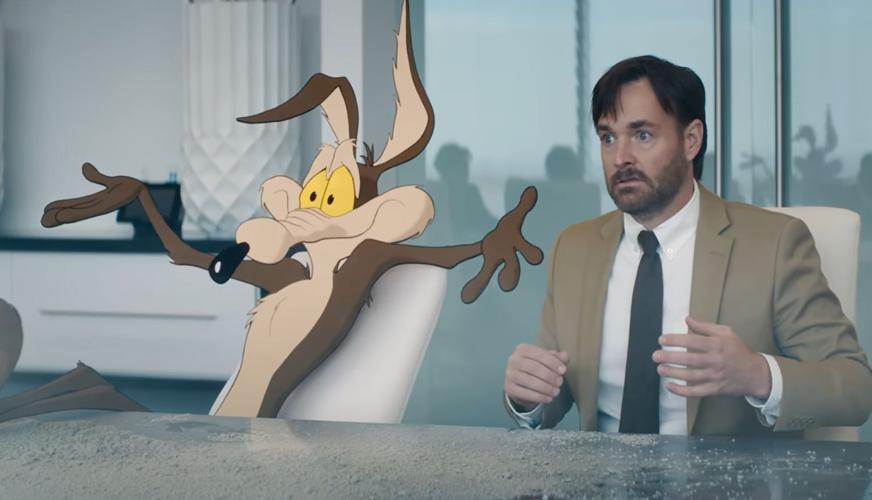
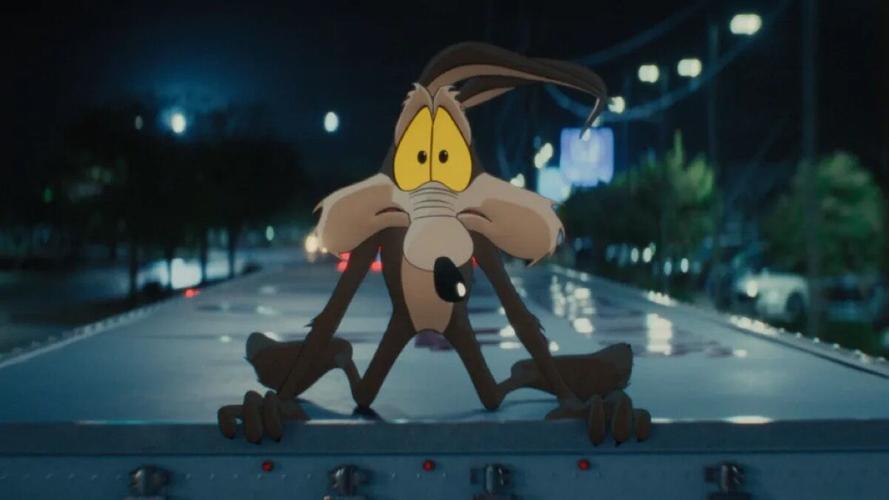

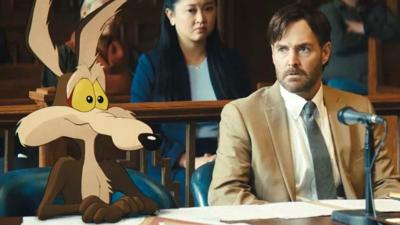
Wile E. Coyote is an animated character that was first introduced in 1949 in a short film, released by Warner Bros. He went on to be centered in about 50 short films over the course of nearly 80 years. Each of his short films had the same plot line. Wile E. Coyote chased after a fast land bird named "Road Runner." Wile E. Coyote used devices and inventions from the Acme Corporation to try to trap Road Runner, so he could eat the bird. Yet, each time, the Acme devices would backfire and cause harm to Wile E. Coyote and not the Road Runner. Directed by Dave Green (Teenage Mutant Ninja Turtles: Out of the Shadows and Earth to Echo), and written by Samy Burch with Jeremy Slater and James Gunn, this film starts as a retrospective of those 80 years, but it later goes into an exploration of issues that go a little deeper or go beyond the cartoon slapstick and pratfalls, while still embracing the slapstick and pratfalls. The conceit here is what if Wile E. Coyote sued the Acme Corporation, taking them to court.
Watching this film, one can't help but think of Who Framed Roger Rabbit (1988), which is probably the best example of blending live-action with animation. Yes, there are plenty of films of the past 30 years where live-action characters interact with CGI like Paddington (2014) or Sonic the Hedgehog (2020). Those films want the CGI or animated characters to be perceived or treated as if they aren't animated but as flesh-based, organic creatures. However, that 1988 classic, or Space Jam (1996), which utilized the same Looney Tunes characters, wanted its live-action characters to see its animated characters as such. It's the same dynamic here. Wile E. Coyote isn't perceived as an actual, flesh-based, organic animal. He's perceived as the cartoon that he is.

A lot of the jokes become seeing those obvious animated characters doing whatever shtick they normally do but in a live-action, 3D setting, interacting with live-action people as normal, even though their presence is absolutely abnormal, if not impossible. Bob Hoskins in Who Framed Roger Rabbit stood as a strong contrast and such an unlikely person to interact with cartoons, which was the running gag of that narrative. Here, Will Forte (Saturday Night Live and The Last Man on Earth) stars as Kevin Avery, the lawyer who represents reluctantly Wile E. Coyote in his lawsuit against Acme. Forte isn't a strong contrast. He comes across as a person who would absolutely interact with cartoons. He's not like Jim Carrey in Sonic the Hedgehog, but Forte can come across as a bit of a cartoon himself, which him identifying with cartoons becomes a kind of plot point.
When Warner Bros. canceled the release of this film, a lot of people were upset at the company and its CEO, David Zaslav. The film is about a little guy going against a giant corporation. Many wanted to ascribe the themes inherent in that to what Warner Bros. did. Some wanted to compare Warner Bros. to the Acme Corporation. However, as depicted, the Acme Corporation isn't comparable to Warner Bros. If anything, Acme is more like Amazon or Sony rather than Warner Bros. Given that most of the animated characters are animals, this film is more about animal rights or the ethical treatment of such. This film could have been instead distributed by PETA and not Ketchup Entertainment.

What we have here is a character study of Wile E. Coyote. It's an analysis of his behavior, which is critiqued and also praised. One could consider this to be wishy-washy or having its cake and eating it too. Wile E. Coyote is obsessed with catching Road Runner. This obsession is depicted as being toxic. Wile E. Coyote is seemingly addicted to using Acme products, which is depicted as being problematic. Yet, the film ends in a place where we're supposed to feel as if those toxic and problematic things are actually good. It's confusing as to what the takeaway should be, other than co-dependence is okay.
Yes, the film is clear that we're not supposed to like the Acme Corporation, or at least the people running it. Yet, it doesn't really come down on how we're supposed to feel about Wile E. Coyote pursuing Road Runner, which has only resulted in him starving and being hurt over and over. That being said, the film doesn't really critique Road Runner much at all. Kevin wants Road Runner to testify to all the hurt and pain that Wile E. Coyote has experienced. Road Runner knows that Wile E. Coyote is suffering and its only reaction is for that suffering to continue. The film unwittingly depicts the fast-moving bird as either a sociopath or a sadist.

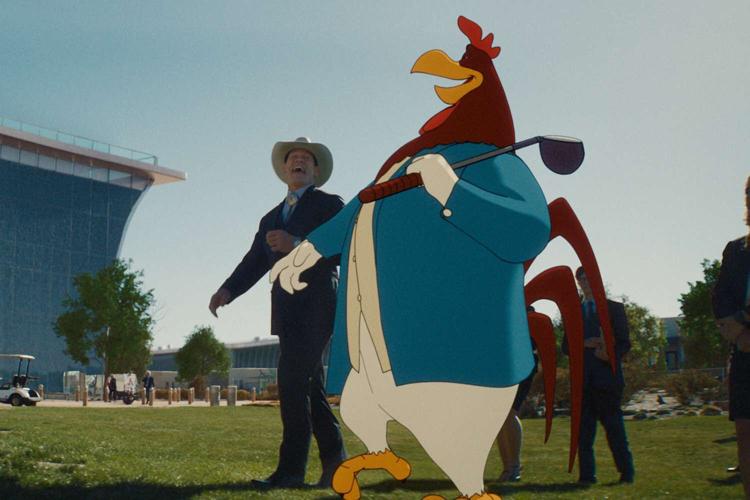
John Cena (Fast X and The Suicide Squad) co-stars as Buddy Crane, the defense attorney for Acme who at times felt like he was doing a live-action interpretation of Foghorn Leghorn, which is ironic because he has a lot of scenes opposite, the tall, talking, southern-fried bird. Opposite Forte, he's akin to the opposing lawyer in My Cousin Vinny (1992), and he certainly does his part to hold up the comedy here.
Rated PG for cartoon violence and some language.
Running Time: 1 hr. and 43 mins.
In theaters.