
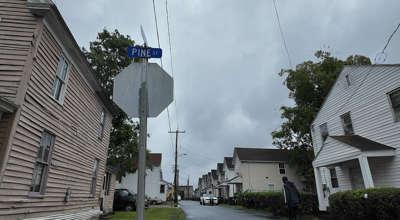

CAMBRIDGE, Md. — A local nonprofit has released a new plan aimed at reducing childhood poverty in Cambridge's Pine Street corridor, an area where more than a quarter of children live below the poverty line.
Moving Dorchester Forward, a nonprofit that serves as the county's "community quarterback" for Gov. Wes Moore's ENOUGH Initiative, published its Cambridge Neighborhood Action Plan in August. The initiative, one of Moore's signature policies, targets specific communities across the state where childhood poverty rates are highest.
In the identified area surrounding Pine Street — which includes Mace's Lane Middle School and its feeder schools — the childhood poverty rate stands at 26%, more than double the statewide average, according to Nancy Shockley, executive director of Moving Dorchester Forward.
"The child poverty rate in the given community that we've identified is at 26%, which is significantly higher than that of the state," Shockley said. "And that rate has not changed. It's stayed relatively the same."
At Mace's Lane Middle School specifically, Shockley said 80% of students meet the state's definition of poverty.
The new plan is not county-wide. Instead, it focuses specifically on the ENOUGH-designated community.
Of the ENOUGH Initiative's four core pillars — high-quality education and child care, healthy families, economically secure families and safe and thriving families — the new neighborhood plan highlights two: child care and education, and workforce development. Shockley said the remaining two pillars, safety and healthy families, will be built out over the next year.
Community input narrowed the plan down to three main pillars: workforce development (training residents for new job skills and opportunities), affordable childcare (including expanding hours to cover nontraditional and shift-work schedules for parents who don't work traditional hours), and positive youth development (sustaining and strengthening existing after-school programs in the community).
The plan was shaped by 18 months of community outreach, including door-knocking, community dinners and both in-person and virtual conversations. Much of that work was carried out by five community ambassadors — residents of the Pine Street corridor hired specifically to gather input from their neighbors.
"So the whole idea is that we are meeting with individuals that live in the community, are experiencing poverty," Shockley said, "and how do we engage them in looking forward to see what their community will look like or may look like?"
Shockley said the ambassador model, believed to be the first of its kind among the state's ENOUGH communities, emerged after the nonprofit found more general community meetings and virtual outreach produced only "superficial data."
Xavier Spencer, one of the community ambassadors and a Pine Street corridor resident, said he regularly asks neighbors a simple question.
"Most of the times I ask them, like, if their community, if Dorchester County, your community was a perfect community, what would it look like? What would be placed here in order for us to succeed?" Spencer said. "And most of the time they respond with, fixing our homelessness problems, our child care problems, the violence, stop the violence."
Veronica Taylor, the nonprofit's community engagement coordinator, said that kind of direct dialogue is essential to making sure change reflects what locals actually want.
"When you ask the question, how would you like to see your community change? We need to ask them, what does change look like?" Taylor said. "And you have to have a conversation because other than that, you're going to have people who are the people who have the money to change the community without the input of the people."
Shockley said building that trust has taken time — and persistence.
"Trust is key to this work," she said. "I've been doing this work for 30 years, so, again, you know, people know me, they know Veronica, and they know these five ambassadors. And that has been huge."
Moving Dorchester Forward is now awaiting word on the next round of ENOUGH Initiative funding, which Shockley said could arrive within days. If awarded, the nonprofit plans to issue a request for proposals inviting other Dorchester County nonprofits to apply for money to expand youth programming and workforce development training.
Shockley said the work extends beyond the neighborhood level.
"In order for us to change the level of child poverty in a community, it isn't just about the work that we do at the local level with our children and our families," she said. "It's also about breaking the barriers down within our state systems, because if we don't change the systems, we are not going to be able to change the poverty rate in the state."
She pointed to transportation, child care access and the design of state systems as some of the biggest barriers families face — issues she said are difficult, but not insurmountable.
Shockley said her message to locals extends beyond the immediate ENOUGH community to Dorchester County as a whole.
"We're here, and we are committed to improving the lives of children and families in this community," she said. "And it takes a village."