
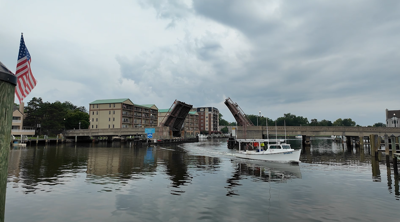

CHESAPEAKE BAY – Maryland is celebrating a milestone in Chesapeake Bay restoration after Gov. Wes Moore announced the state has achieved nearly all of its 2025 Chesapeake Bay restoration goals. But some watermen say the pollution reduction target numbers don't reflect the conditions they're experiencing on the water.
The Maryland Department of the Environment says the state has hit 100% of its sediment reduction goal, 100% of its phosphorus goal, and 99% of its nitrogen reduction goal.
According to the state agency, nitrogen and phosphorus in waterways feed algal blooms. As those blooms die and break down, they deplete oxygen from the surrounding water faster than it can be restored, creating "dead zones" — areas so low in dissolved oxygen that marine life struggles to survive there.
The targets stem from the 2014 Chesapeake Bay Watershed Agreement, which set 2025 as the deadline for Maryland, Delaware, Virginia and three other states to cut down on pollution flowing into the bay.
“Preserving the Chesapeake Bay is crucial to the long-term success of our state’s economy, culture, and identity,” said Gov. Moore. “The Bay’s rivers and streams support our local environment, seafood, tourism, and recreational businesses, and our administration is committed to improving its water quality and protecting the Bay as a precious heirloom to pass down to future generations in a better condition than we received it.”
Lee Currey, director of the Water and Science Administration at the Maryland Department of the Environment says the results reflect years of work.
“Meeting the 2025 goals is a point to celebrate, those are meeting pollution reduction goals,” Currey said. “The reason they matter to people and the reason they matter to our residents [is because] it shows that we put in the hard work. We've planted trees, we've helped farmers, we've made communities more resilient. All of those things matter. And all of those pieces are what we do to meet the 2025 targets. So there's a lot of work that goes behind that. And what people get out of that is cleaner water, more swimming days, more ability to recreate in and around the water. There's a tremendous amount of economic value in the Chesapeake Bay.”
Currey says one of the biggest drivers of progress has been upgrading wastewater treatment plants — infrastructure he says is easy to overlook but critical to removing pollution before it reaches the bay. Moving forward, he says the state needs to maintain those investments while also focusing on creating greener communities, planting more trees, restoring streams and building more living shorelines.
He also says the state relies on the Chesapeake Bay Program's computer model, combined with water sampling, to track pollution reductions across the watershed.
But Captain Robert Newberry, president of the Delmarva Fisheries Association, says the pollution reduction target numbers published don't line up with conditions that watermen are reporting.
"It's not my opinion, I'm taking up a conglomerate of what everybody's saying. We have problems with the numbers. They're not right," Newberry said.
Newberry says he spoke with watermen from Cecil, Kent, Queen Anne's, Talbot, Dorchester, Somerset, Baltimore, Anne Arundel, St. Mary's, Calvert and Charles counties while researching the issue, and says the consensus among them was skepticism.
“The upper bay, the guys have been seeing, dead zones, benthic zones, bad water all summer long. And they saw it in the south too, they’re seeing extremely turbid water, which is non-visible,” said Newberry. "Nothing was getting done in one year. All of a sudden, boom, we hit 100% phosphorus reduction, 99% nitrogen and 100% sediment. That's not the consensus I'm getting bay wide.”
Beyond the numbers, Newberry says a big concern for him is what he describes as a lack of communication between the governor and the watermen who work the bay daily.
"When someone is out there and sees what goes on every single day, they ought to have a seat at the table," Newberry said. “We have no seat at the table. You know, the saying is that the governor said ‘no one left behind.’ Oh, we haven't been left behind. We've been abandoned.”
Currey says MDE is committed to including public input in the state's restoration plans. He says the department has engaged with watermen through meetings, conversations in the main part of the bay, on-the-water discussions, and direct outreach to communities — and that it's through those engagements that officials have gathered feedback.
“As an administration, we will work together to make sure everyone is heard, thoughts are considered, feedback is considered because it's really hearing that feedback [that] shapes a plan and what makes a plan a great plan. And that's what's going to put us on a path to get us to 2040,” Currey said.
Allison Colden, Maryland executive director of the Chesapeake Bay Foundation, says the numbers released this week are based on bay-wide modeling and show Maryland has met or is on track to meet its reduction goals. But she cautions that models don’t tell the whole story.
"Models are always inherently an abstract of what we are seeing in reality," Colden said. "It's a necessity to simplify what we're seeing in order to produce a model. And because of that simplification, there's always a chance that there is, you know, some sort of gap between what the model would predict and what we are seeing. That doesn't necessarily mean the model is wrong.”
She adds that models are still helpful tools.
“The model is extremely useful in understanding progress, making sure the trends in nitrogen, phosphorus and sediment are going in the right direction,” Colden said. “But you also have to understand, proceed with caution when interpreting it down to the individual pound's level, and assuming that what the model is putting forward would be consistent everywhere, all the time.”
Colden also says while the progress is commendable, there is still more work to be done.
“So once you start to lift the hood on these numbers, you see that there's still some work to do,” Colden said. “We have several sectors of bay restoration, particularly non-point source pollution, which is more diffuse, that happen to be moving in the wrong direction and increasing their pollution loads over time. So while we applaud the administration and others for their leadership here, we know that there's more work to do.
Colden says agencies still need to increase their investment in stormwater pollution, urban and suburban runoff, as well as continue to improve agricultural pollution reduction.
Last year, Maryland, Delaware, Virginia and the other watershed states entered into a new agreement pushing pollution reduction goals out to 2040.
Currey says while this milestone is worth celebrating, the state still has more work to do.
“So setting our sights on 2040 means maintaining the infrastructure,” Currey said. “ It means thinking about the changing rainfall patterns. How do we best protect communities? How do we factor that into our bay restoration so we continue to deliver meaningful results and cleaner water for residents?”