

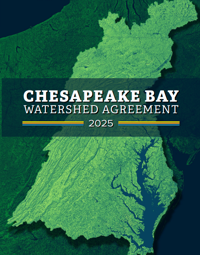
BALTIMORE, Md. - Multiple state leaders including Governors Wes Moore, Matt Meyer, Glenn Youngkin, and Josh Shapiro met in Baltimore on Tuesday to approve a revised Chesapeake Bay Watershed Agreement to guide a multi-state and federal effort to restore and protect the Chesapeake Bay.
The new agreement, according to the Chesapeake Bay Program, focuses on achieving four goals: Thriving Habitats, Fisheries, & Wildlife; Clean Water; Healthy Landscapes, and Engaged Communities.
"The reason it's important to keep on revitalizing the health of the bay, is because it's connected to everything about our society," said Maryland's Governor Wes Moore. "It's connected to our economy, it's connected to our food and making sure that people have adequate resources. It's connected to people who rely on the bay in their livelihood."
During their annual meeting, the Chesapeake Executive Council reviewed recommendations for how to continue to meet restoration goals after it had become evident the goals set forth in the 2014 agreement would not be met by the suggested 2025 deadline.
Under the new agreement, restoration goals now have a target date of 2040, at which point the partnership will reconvene to assess the agreement.
Virginia's Governor Glenn Youngkin said during Tuesday's meeting he believes the revised plan is more realistic and more attainable.
"We have to demand outcomes and then we must make decisions based on data and results," said Youngkin. "When we do this, we then can set and achieve realistic and demonstrable achievements."
Established in 1983 through the Chesapeake Bay Agreement, the Chesapeake Executive Council consists of six watershed states, the mayor of Washington D.C., the chair of the Chesapeake Bay Commission, and the U.S. EPA administrator.
“Through the Chesapeake Bay Watershed Agreement, the partnership remains committed to restoring, protecting and conserving the Bay and its watershed through efforts based in and guided by science, and responsive to the lessons learned from our past and shared experiences,” the revised agreement reads.

Chesapeake Bay Program
“Today we made a commitment to the Chesapeake Bay and a commitment to the people of Maryland and our neighboring states,” said Maryland Governor Wes Moore. “The revised Chesapeake Bay Watershed Agreement will make our rivers and streams cleaner. It will bolster Maryland’s seafood, tourism and recreational businesses. Most importantly, it will ensure we protect the precious heirloom that is the Chesapeake Bay so we can pass it down to the next generations in a better condition than we received it.”
In a unanimous vote, Pennsylvania Governor Josh Shapiro was elected to succeed Governor Moore as the chair of the Executive Council. Moore has served in the role for the past two years.
“My Administration has accelerated Pennsylvania’s progress in restoring local waterways across the Commonwealth and reduced our share of pollution to the Bay, ensuring every Pennsylvanian has access to clean air and water while supporting our farmers and our agriculture industry,” said Pennsylvania Governor Josh Shapiro. “I’m honored to be elected as the next chair of the Chesapeake Executive Council by my fellow governors and I’m looking forward to continuing this work to get stuff done together for the people we serve.”
During the meeting, the Executive Council also called for recommendations to be developed over the next year on how best to include tribal nations of the Chesapeake Bay watershed in the partnership going forward.
The full revised agreement, approved on Tuesday, can be read here.
WBOC went to Cambridge Tuesday to speak with people living and working around the water about the agreement. Mason Little, the co-owner of Choptank River Crab and Oyster Company, said it's vital to protect the bay's health.
"It's our bloodline, we've got to take care of it," Little said. "Some areas some years have a lot of bad water areas where the guys can't work. Whether it be from, the waste management plant or anything, You can definitely tell it effects all the species around here."
Little also said he hopes officials target predatory species like the Blue Catfish when creating agreements like this one. Little said they are a large threat to the ecosystem.
"The biggest problem we see is an abundance of blue catfish. They're so predatory, and they're eating up all the native species the guys are catching," Little said. "They eat blue crabs, rockfish, just about everything. We're looking for the state's help to get them out of the water."
Cambridge's City Manager, Glenn Steckman, told WBOC city officials are looking to do their part as a bayside city.
"The city is in the process of making a new pump station on Trenton Street. This is not a repair, it's a replacement of a pump station that can handle between 1.5 and 2 million gallons of wastewater a day," Steckman said. "Making sure this pump station is replaced protects our bay, protects the watershed that we're in, and also protects the Choptank River."
However, Steckman said he wishes there was more funding available for projects like that one, which look to keep the bay clean.
"That is a $7.1 million dollar project, which is quite a lift for a community our size," Steckman said.
Robert Brown, the president of the Maryland Watermen's Association, said officials are funneling too many resources into creating new oyster sanctuaries, rather than supporting existing areas.
"Over the years, they've had 52 sanctuaries set aside. It's been millions of dollars. In all the money they've spent, they've neglected the 47 sanctuaries they've had," Brown said.
Brown told WBOC that those existing areas could have been repurposed to better serve the bay and those working on the water.
"It's a waste. These bottoms are tilting over. It should have been put over to the commercial fisheries to have some of this bottom back to work on, help develop it, and make it fruitful," Brown said.