
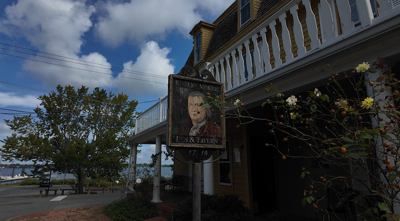

OXFORD, Md. — The Robert Morris Inn, a fixture on Maryland's Eastern Shore for more than 300 years, has sat closed for nearly a year, and a group of local residents is now pushing the town of Oxford to get more directly involved in the fight to save it.
The inn, parts of which date to 1710, was condemned by the town in January after months of unanswered property maintenance notices. Inspectors cited water damage, a deteriorating ceiling and other signs of long-term neglect as posing risks to public health and safety. At the same time, the property has been tied up in federal bankruptcy court since January, after its lender moved to foreclose and the owner filed for bankruptcy protection, staying that foreclosure.
Cameron Mactavish, an architect with about 40 years of historic preservation experience who has lived in Oxford for two decades, helped form a group called Friends of the Robert Morris Inn earlier this year with four other residents. The group recently sent an open letter to the town's Board of Commissioners asking Oxford to formally enter the bankruptcy proceeding.
Mactavish said the request is aimed at making sure the town has a voice as the case moves through federal court in Washington.
"To get involved in the bankruptcy proceeding that's taking place, and Washington, DC, and to advocate for the building and to make sure they get notices, they receive notices and communications as that works its way through the court proceeding, it's bound to be a long, slow process," Mactavish said.
Mactavish described the inn as central to the town's identity, tracing its roots to Robert Morris Sr., a colonial-era trading agent, and his son, Robert Morris Jr., who helped finance the Continental Army before the battles of Trenton and Yorktown.
He said the building itself is in better condition than its condemned status might suggest — dining tables are still set with linens and silverware, and upstairs bedrooms still have sheets on the beds — with the most serious damage confined to a leaking roof over the tavern that caused part of a ceiling to collapse.
He said the bankruptcy court has since authorized a roof repair that a local contractor could complete this fall, which the group hopes will make the property more attractive to a buyer once it clears bankruptcy.
Mactavish pointed to two other successful historic rehabilitations in town — the Oxford Community Center and the building now home to the Scottish Highland Creamery — as evidence the town has a track record of pulling off similar projects. He said the group is not asking the town to buy the inn, but to act as an advocate that keeps pressure on the process so the building doesn't deteriorate through another winter without heat.
Commissioner Dave Donovan said the town has heard plenty of opinions but is still looking for a concrete, actionable request.
"If anybody's got something that we think actually might work, I think we would jump on that. The letter we got didn't say for what purpose they were advocating that we might intervene. And I think that's really the question that we're going to be looking for them to answer," Donovan said.
Donovan, a retired attorney, said the town would need to identify a specific legal interest to justify intervening as a party in a federal bankruptcy case, and that simply showing up without one could backfire. He noted the asking price for the property is north of $3 million — well beyond what the town, which operates on a roughly $2 million annual budget, could afford.
Donovan said he doesn't believe the condemnation status is actually slowing down a potential sale, since any serious buyer would be aware of the building's problems regardless.
He added that the town has consulted its attorney about options over the past year but declined to discuss specifics, and stressed that his comments reflected only his personal views, not an official commission position.
A separate letter was sent to commissioners by Karen Wayland on Friday, who lives two doors from the inn. Rather than town ownership or a bankruptcy intervention, she is urging commissioners to formally commit to clearing regulatory hurdles for whoever ultimately buys the property.
"I want the town to commit to reducing the cost of doing business in town by pledging to smooth through all the regulatory and approval hurdles that any buyer would have to go through to do the work that needs to be done on that building," Wayland said.
Wayland said she’d like to work on getting more people active in this effort to get a buyer.
“No one's going to put money on the table while the property's in bankruptcy proceeding,” Wayland said. “ It's just not going to happen. So we could form a Friends of the Robert Morris Inn together and we could look for ways to market the property. We can look for ways to highlight the financing stack that could be put together, and how the town would help access those funds by lending its support to a prospective buyer. And we, you know, there's a lot we can do as a group. Just the presence of a really active Friends of the Robert Morris Inn group would actually help.”
Donovan said he found Wayland's proposal promising and said formalizing the town's willingness to assist a future buyer — through a resolution or similar document — is something he wants to explore, though he cautioned it hadn't yet been discussed publicly by the full board, as required under Maryland's open meetings law.
Commissioners are scheduled to meet Tuesday to discuss next steps, with both letters part of the public record for that meeting. Donovan said town intervention in the bankruptcy case remains a possibility, but what form that would take is still undetermined.