
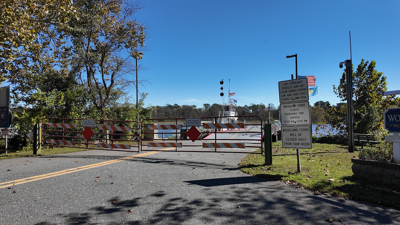

SUSSEX COUNTY, Del. – A historic crossing along the Nanticoke River could soon see some major changes as a Delaware transportation task force considers charging fares for the Woodland Ferry or transferring its operations to another entity.
The proposals are drawing opposition from State Rep. Danny Short and local historian Jim Bowden, who argue the ferry should remain a free public service despite years of mechanical problems and staffing shortages.
The Woodland Ferry, which connects communities near Seaford and Laurel, has operated since colonial times. It currently allows vehicles and passengers to cross the river free of charge.
But that tradition could change as the Delaware Task Force on Sustainable Transportation Funding searches for ways to address financial challenges facing the state's transportation system.
In a statement to WBOC, the Delaware Department of Transportation said the ferry is among 37 draft recommendations being considered by the task force.
DelDOT said the ferry costs approximately $755,000 annually to operate and carries an average of 87 vehicles per day. According to the department, that amounts to $33.40 to transport one vehicle across the river.
Short, whose district includes the ferry, believes charging passengers could make an already struggling service less popular.
"Since the ridership is down, to actually put a fare on, will continue to push the ridership down so it doesn't solve the problem as far as we're concerned," Short said.
However, Short argues the ferry's declining ridership cannot be separated from its history of unreliable service.
The current vessel, the Tina Fallon, entered service in 2008 but experienced mechanical problems almost immediately.
Short said the ferry was operational for only six of its first 14 months, causing some drivers to abandon the crossing as a reliable transportation option.
The ferry's size has also created staffing challenges.
According to Short, operating the current vessel requires a captain with a 100-ton license, significantly limiting the pool of qualified applicants.
He said the state currently has just one captain available to operate the ferry.
Short believes a smaller replacement vessel could help address both issues by reducing mechanical complexity and potentially lowering licensing requirements.
"I think we ought to study that to see if it's economically feasible to have a smaller ferry that solves those two problems," Short said.
Bowden, who has extensively researched the ferry's history, agrees that a smaller vessel deserves consideration.
He said the crossing dates back to at least the mid-1700s, when the Cannon family operated it as a paid service.
Sussex County eventually took over operations, and Bowden said state legislation in the 1880s established the crossing as a free public service.
"We have to look at the historic factor into it. The intrinsic value of history. This is the only one left in Delaware, and I think we need to keep that alive," Bowden said.
Bowden also questioned whether the task force's ridership figures accurately reflect the demand for the service, considering how frequently the ferry has been unavailable.
He believes the state should focus on improving reliability before considering major changes to its operations.
Both men argue the Woodland Ferry provides more than a transportation connection.
Short said the crossing can save drivers traveling between parts of Sussex County and Salisbury approximately 20 minutes compared with alternative routes.
Bowden emphasized its historical significance, explaining that visitors from outside Delaware and even outside the country travel to the area specifically to see the ferry.
He worries that converting the crossing into a tourism-focused operation could undermine its longstanding role as public transportation.
Meanwhile, Short questioned whether the ferry's annual operating costs justify considering such significant changes when compared with the state's broader transportation spending.
He argues that improving the ferry's reliability could help increase ridership without requiring fares.
The task force was established by Gov. Matt Meyer to evaluate Delaware's Transportation Trust Fund, which supports roads, bridges, public transit and other transportation projects.
According to DelDOT, the task force will submit its recommendations to the governor by the end of the year.
No final decision has been made regarding the Woodland Ferry.
In the meantime, members of the public can provide feedback through the task force's online survey or by emailing dotpr@delaware.gov.
Bowden is also encouraging people to join a Facebook group called "Keep the Woodland Ferry Free," where supporters are sharing information about the proposals and the crossing's history.
For Bowden, preserving the ferry means protecting a piece of Sussex County's identity.
"We think that the quaintness of the woodland area and the ferry itself would diminish because of the fact that it's lost," Bowden said. "And we don't want to see that happen."