February is Black History Month and throughout the month WBOC is sharing the stories of 10 men who were lynched on the Eastern Shore of Maryland during the 19th and 20th centuries.
In our multi-part series: Shameful Past: Lynchings on Delmarva, what follows is a profile of one of those men executed by mob justice.
On March 9 or March 10, 1889, Magruder Fletcher allegedly broke into the house of Mrs. Mary McCready in Accomac, Virginia.
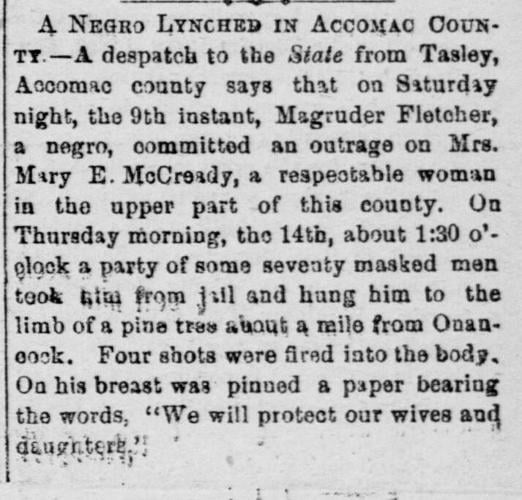
In an article published a few days after the lynching, the Alexandria Gazette, reported, "Magruder Fletcher, a negro, committed an outrage on Mrs. Mary McCready, a respectable woman in the upper part of this county."
Local historian Linda Duyer said Fletcher was probably around the age of 35, and the type of assault he was accused of committing was likely rape.
Duyer said these accusations were common at the time, especially for African Americans who worked closely with white families.
"He had a job where he was hired to cut the wood of an oyster man who was out and away often and away from home," Duyer said.
The Morning News in Wilmington, Del., and The Evening Star in Washington D.C., report this as well.
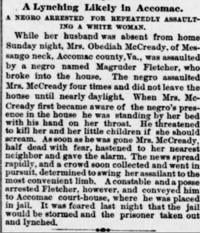
According to the Evening Star, "When Mrs. McCready first became aware of the negro's presence in the house, he was standing by her bed with his hand on her throat. He threatened to kill her and her little children if she should scream."

Magruder Fletcher Alexandria Gazette 2 1889
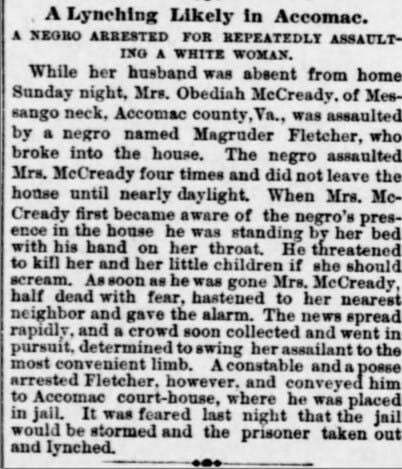
Magruder Fletcher Evening Star 1889
Magruder Fletcher Evening Star 1889
The paper said McCready reported the rape to a nearby neighbor and the police were soon alerted.
The paper further added that Fletcher fled, but was later taken into custody by police and taken to the Accomack County Courthouse. The Shenandoah Herald released an article shortly after the lynching that said after Fletcher was caught, there were rumors circulating for several days that a lynch mob was forming.
Duyer said that in fact, on the way to the jail, lynch mobs stopped police and demanded they hand over Fletcher, but officers refused to do so. It's unclear if additional law enforcement was ordered to protect Fletcher after the mobs made their demands.
A couple of days later, on what is believed to be a Wednesday, nearly 100 masked men poured into the village of Accomac, where the Accomack County Courthouse is located, and headed to the home of the jailer, demanding the keys to the jail.
The Shenandoah Herald reported, "The demand was refused, whereupon they threatened to burn the jailer's house down, tear down the walls of the jail and break open the doors."
The paper added that all of the men were armed, and the jailer eventually handed over the keys.
The paper said the mob went to the jail, took Fletcher from his cell, placed him in a cart and dragged him nearly a mile away to be lynched.
"They mutilated him, and then suspended him from the limb of a pine tree, where he was allowed to hang until he was dead," the Staunton Spectator reported. "Four shots fired into the body. On his breast was pinned a paper bearing the words, 'We will protect our wives and daughters.'"
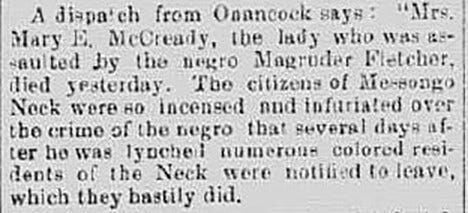
Magruder Fletcher Alexandria Gazette 1889
A few weeks after Fletcher's lynching, the Alexandria Gazette reported that Mrs. Mary E. McCready died, though it is unclear what officially caused her death.
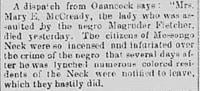
The paper said, "The citizens of Messongo Neck were so incensed and infuriated over the crime of the negro that several days after he was lynched, numerous colored residents of the Neck were notified to leave, which they did."
It was suggested in news clippings that she died from complications of the rape.
There are no recorded accounts indicating anyone was ever charged with or convicted of Fletcher's murder. He was never taken to trial or formally determined to be guilty.
To this day, historians say these lynchings still negatively affect race relations.
"It took very little for a black man to be lynched. They had to be very careful of what they did or said," Duyer said.
"It affects how you move through life. I mean there are descendants that are known to be a part of these mobs--the actual killers, not just people standing by, that are still here. So it affects people, it affects us to this day," Duyer said.