
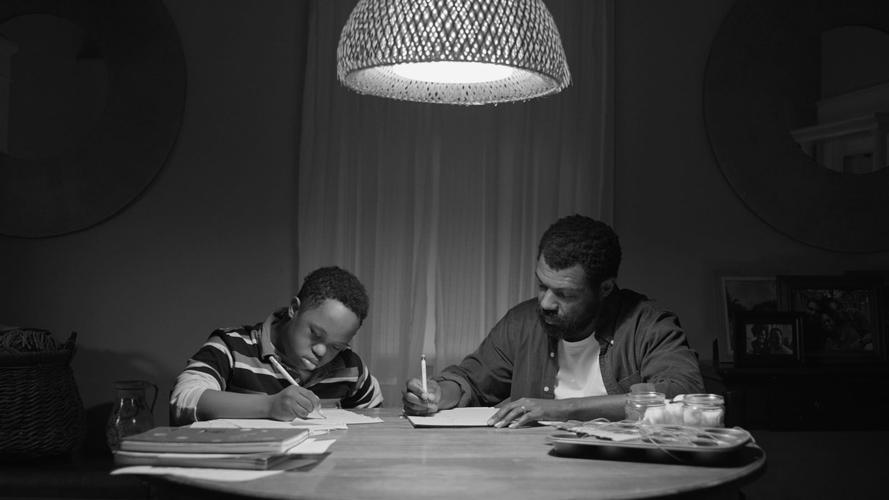
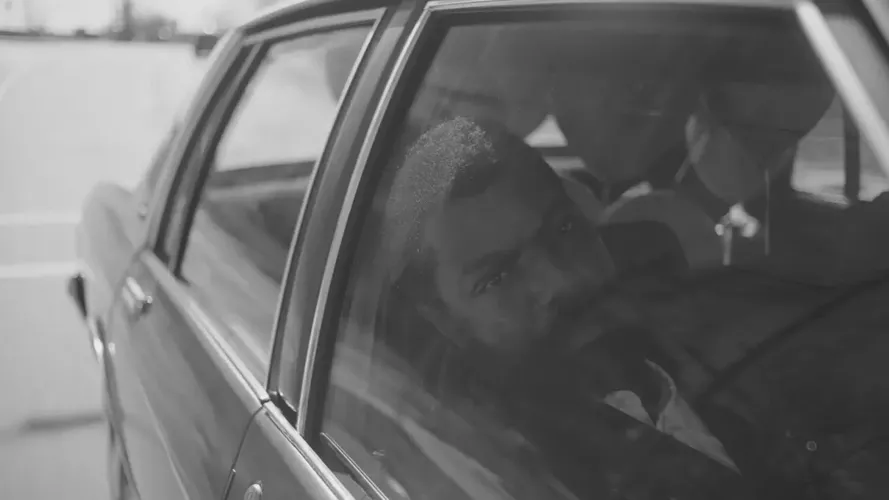
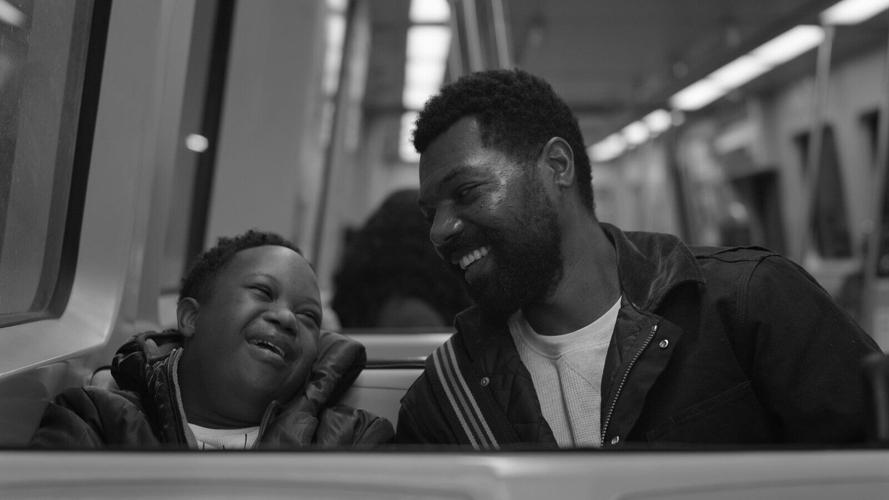

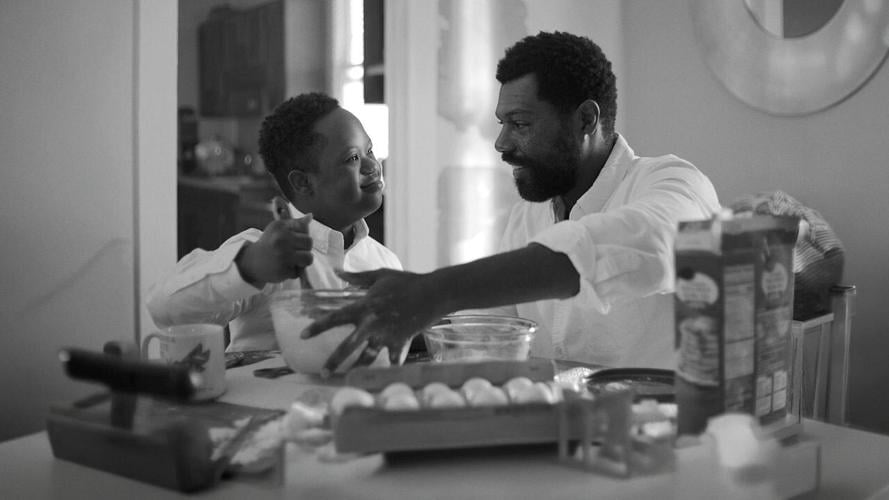


The subject of this film is a man dealing with a family member who has Down Syndrome, which is not the same as autism or being on the spectrum. It could be put under the same umbrella as neurodivergent. One of the Hollywood productions that put neurodivergent people on the map was Rain Man (1988), which was about a man dealing with a family member who has autism, as they go on a long, road trip. Writer-director David Fritz Fortune, in his feature debut, does his version of Rain Man but it's all about the African American experience. Instead of centering on two, adult brothers, it's about a father and son. Instead of a road trip by car, the road trip here is via the public transit system of Atlanta, Georgia.
So much of this narrative is a father taking care of his son. Yet, the depiction of a Black parent, particularly a Black male, being the primary caregiver for his child, is rare. Will Smith was nominated for an Oscar for The Pursuit of Happyness (2006), which focused on a father in transit with his prepubescent son. That film hit upon a man trying to pursue an economic dream with his kid in tow and the struggles of Black poverty and upward mobility. This year, a film in this rare depiction was gifted from the UK and Nigeria called My Father's Shadow (2026), which narrows on the single task of a parent taking his sons into the city for that same struggle of poverty. This film comes to have a narrow focus too, mostly taking place in the span of one day.

Will Catlett (A Thousand and One and Black Lightning) stars as Lucky, a widower whose wife just died in a car accident. He's now a single dad, raising his 8-year-old son, Mason, played by Jeremiah Daniels, in his feature debut. Taking care of Mason seems like a full-time job because Mason has Down Syndrome and requires round-the-clock care. He probably goes to school, but this film likely occurs in the summer when school is out. Lucky doesn't seem like he has the money to afford to put Mason in summer school or any kind of program. We don't see what Lucky does for work or income. He might be on leave in order to bury his wife and mourn with his son. As such, this film is as much about grief, as it is about fatherhood, or even raising a child with Down Syndrome. Actually, it's a perfect intersection of all those things.
It's revealed that Mason is a fan of baseball. He watches games with Lucky on television. Lucky can't afford to take Mason to a baseball game in person, but, one day, he gets the opportunity to get into a game for free at Truist Park. The problem is that Truist Park isn't located in downtown Atlanta. It's located outside the city, just northwest of Atlanta's limits. Lucky and Mason don't have a car and they also live outside the city, but all the way on the opposite side, southeast of Atlanta's limits. In order to get from where they live to the baseball field, they have to traverse the entire length of the metropolitan area. With a car, it would be a half-hour or more, depending on traffic. Lucky and Mason have to take public transit, which takes a couple of hours, to go from one end of Atlanta to the other. The film documents this hours-long journey, which becomes even longer due to issues that pop up along the way.

We do get time to see the relationship between Lucky and Mason, between father and son. We see that Lucky can get frustrated with some behaviors of Mason, including his obsession with balloons. We also see Lucky taking time to teach Mason how to read. We also see that Mason has an artistic side to him, or artistic things help to focus the boy. He likes to make bead necklaces, which is something his mom taught him do, but Mason really enjoys making drawings in crayon. In his backpack, he has a coloring book, which he frequently uses.
It's ironic because we see Mason drawing in his coloring book. Yet, Fortune presents this film in black-and-white and in 4:3, which is close to the Academy ratio. We don't actually see the various colors that Mason sees. All we see are the black and white, the light and dark, with perhaps some shades of gray. The look of the film could be a reflection of the simplistic ways that a child either like Mason or any kind of child might see the world. The contrasts might also help to underscore the emotions of the film, especially those coming from Lucky as he navigates the world and this one day. The colors of Mason's coloring book might be used to focus him, but the lack of color in this film's look might also be a way of focusing Fortune's audience here. The 4:3 makes the images more box-like than rectangular, which could be a metaphor for how boxed in Lucky might feel in this situation. Whatever the effect, I was affected by Fortune's tale here.

Rated R for language.
Running Time: 1 hr. and 39 mins.
Available on Netflix.