

There are a lot of complicated thoughts going into and coming out of this film. It's about a historical incident that happened in Saudi Arabia in 604 AD. The project is reportedly the most expensive film to be produced in that peninsula country and a lot, if not most of that funding came from the government of Saudi Arabia. MBC Studios financed or helped to finance the picture. MBC Studios is a subsidiary of the MBC Group, which is co-owned by the Saudi state. From what I understand, the MBC Group didn't start out that way. The Saudi Arabian government bought shares of the company over time until it owned a majority percentage.
This is not the first film that MBC Studios has produced. The company was behind Kandahar (2023), starring Gerard Butler. MBC Studios also co-produced The Voice of Hind Rajab (2025), which was nominated for an Academy Award. The Voice of Hind Rajab was a film that was submitted to the Academy from Tunisia, but there have been films submitted from Saudi Arabia itself. None of those films have ever been shortlisted, but there might be somewhat of a conversation, if a Saudi Arabian film ever were shortlisted or even nominated. The conversation would likely be about the fact that the Crown Prince of Saudi Arabia, the kingdom's ruler, is a man named Mohammed bin Salman aka "MbS," a man whose government has been accused of numerous human rights violations. It was reported that Mbs allegedly ordered the assassination of journal Jamal Khashoggi who worked for an American newspaper.

Last year, Saudi Arabia hosted an event called the Riyadh Comedy Festival, which invited a bunch of performers from the United States and Great Britain. Some comedians declined the invitation and spoke out against it, mainly due to Saudi Arabia's record on human rights violations, as well as their national policies, which discriminate harshly against certain populations or that denies certain freedoms that most people in the USA or Britain have. The event was a part of what's been dubbed "Saudi Vision 2030," which has several objectives. One of which is improving Saudi Arabia's image around the world by using entertainment. Going to see this film might be seen as the equivalent of participating in that Riyadh Comedy Festival. Vertical Entertainment is the distributor of this film. Vertical is an American company. I'm not sure what arrangements where made with MBC Studios or the other producers, but it's likely any money that is paid to see this film in the United States would mostly, if not exclusively benefit the distributor and the theaters in the United States. It's not as if anyone buying a ticket in the USA is putting money in the hands of the Crown Prince.
David Self is the screenwriter here. Reportedly, Self has written a lot of scripts that were bought by major film studios but were never made. One of the earliest was a screenplay in the early 90's about Kuwait, a country that borders Saudi Arabia. Another screenplay he did in 1998 that never made it to the big screen was a film about the Battle of Thermopylae, which is about a fight against the Persian empire in 480 BC. A film about that fight would later be made by Zack Snyder called 300 (2006). Early in his career, Self definitely had an interest in topics in the Middle East. Unfortunately, those films never got made. Yet, with this film, he finally got his wish, as it tells the story of the Battle of Ze Qar, a fight where the people of what's now Saudi Arabia went up against the people who were then the Persian Empire.

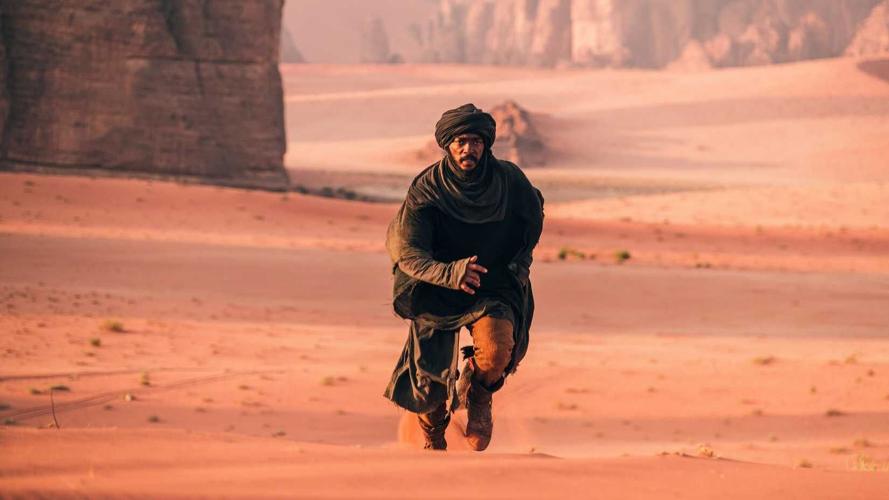
Director Rupert Wyatt (Captive State and Rise of the Planet of the Apes) doesn't make this film to be anything like 300. Wyatt's direction and cinematography are no where near being stylized or mimicking comic book panels. Snyder was adapting a graphic novel, so it made sense for him to lean into those over-the-top visuals. Here, Wyatt's camerawork is pretty much straightforward. If the film-making is noticeable or noteworthy here for any reason, it's for the editing at play. Almost immediately, the editing jumps out at you. It's really great for kick-starting the narrative and getting the first act of this film in gear. Shooting in Saudi Arabia, Wyatt and his crew were able to capture actual desert and mountain vistas that were pretty gorgeous and well used in a One Battle After Another (2025) way. In fact, there are two really amazing action sequences, which make great use of the real locations where they were filmed. One involves horses. The other involves elephants versus camels. Some of which were likely CGI.
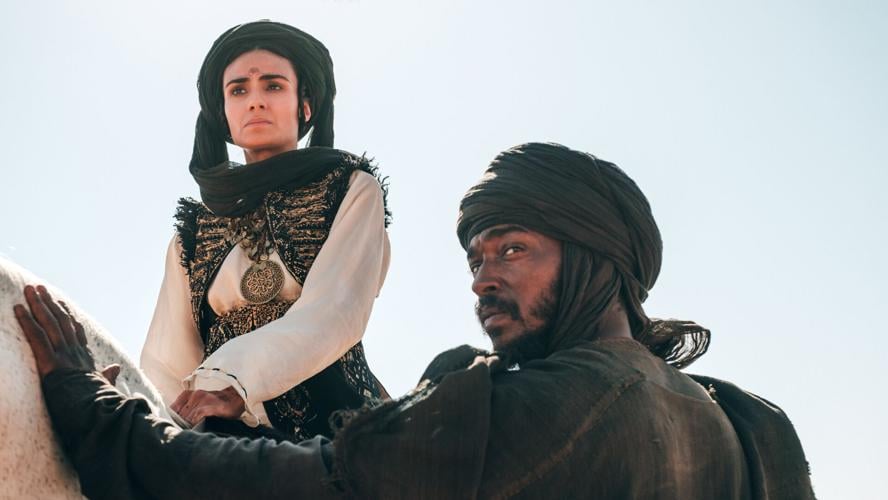
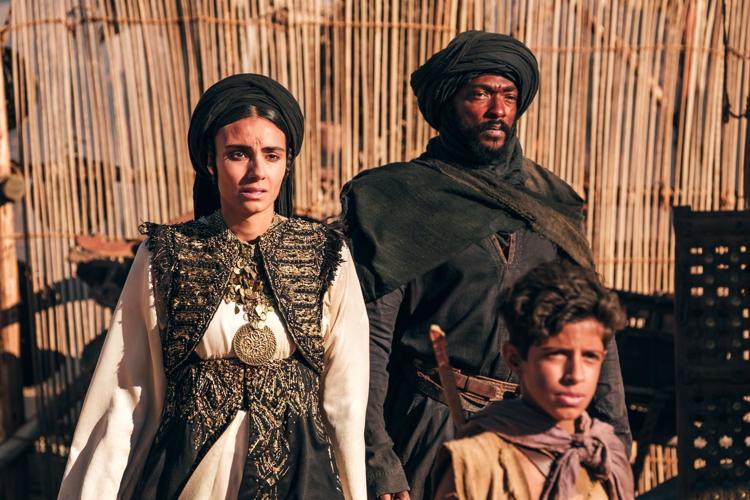
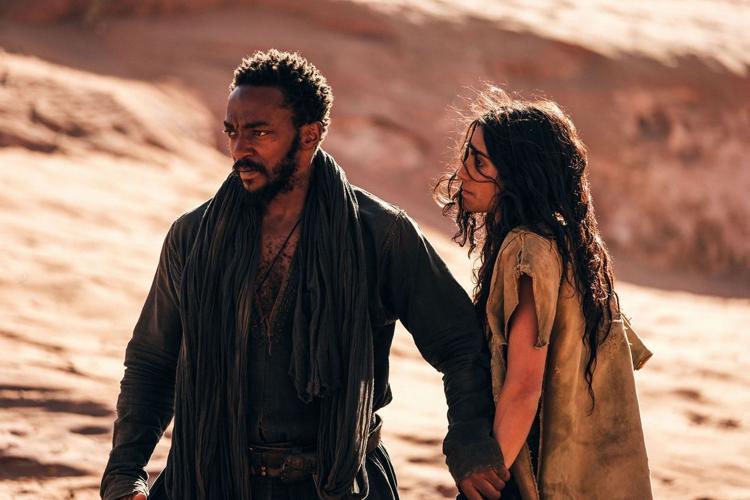
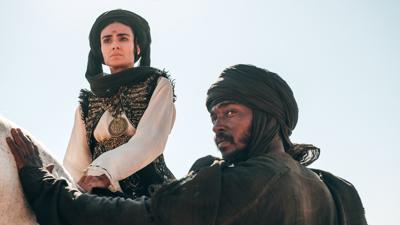
Reportedly, Lawrence of Arabia (1962) was an inspiration, a rather obvious one. If I had to compare this film to anything, my comparison would be to Dune (2021) or Star Wars (1977), minus all the science fiction elements. There's an evil emperor, played by Ben Kingsley (Schindler's List and Gandhi). The emperor is doing horrendous things, taking land, killing men and kidnapping women. The tribes or various people who are being affected and oppressed decide to fight back, or form a rebellion, taking on the emperor's army. Aiysha Hart (Mogul Mowgli and Colette) co-stars as Princess Hind, the daughter of a king of a certain tribe. She's like the Princess Leia who rises up to fight against the empire.

The film introduces us to the various leaders of the various tribes. In fact, the film spends most of its time with a tribe called "Shaybani." Princess Hind is on the run, much like Princess Leia, and the Shaybani take her in and protect her, much like the Fremen protect the main characters in Dune. Princess Hind stays with the Shaybani from pretty much the entire film. Hani, the chief of the Shaybani, is played by Sami Bouajila (Outside the Law and Days of Glory). He has a brother, and I wish that I could tell you more about this character because he's offered up as an important character, but by the end there was not much feeling toward him that would make me miss him if he were gone. The film wants you to feel something for him in the final moments, but it barely does the work to further characterize him other than being a honor-filled man.
Anthony Mackie (Captain America: The Winter Soldier and The Hurt Locker) stars as Hanzala, a bandit who fulfills that "man with no name" trope that comes from a lot of Westerns. He could also be classified as a "Han Solo" type, if we're maintaining the Star Wars comparisons. His character really kicks off the film and as such made me think this film would play out like a Western, which could be argued that it does. Strangely, Mackie's character is sidelined for large chunks of the film. He's literally sidelined. It makes sense to some degree because Mackie isn't of Middle Eastern descent. Hart, for example, has a father who is Saudi Arabian, so centering characters who are more representative is a good move, but it's almost to the point that Mackie might as well have not been in the narrative at all.

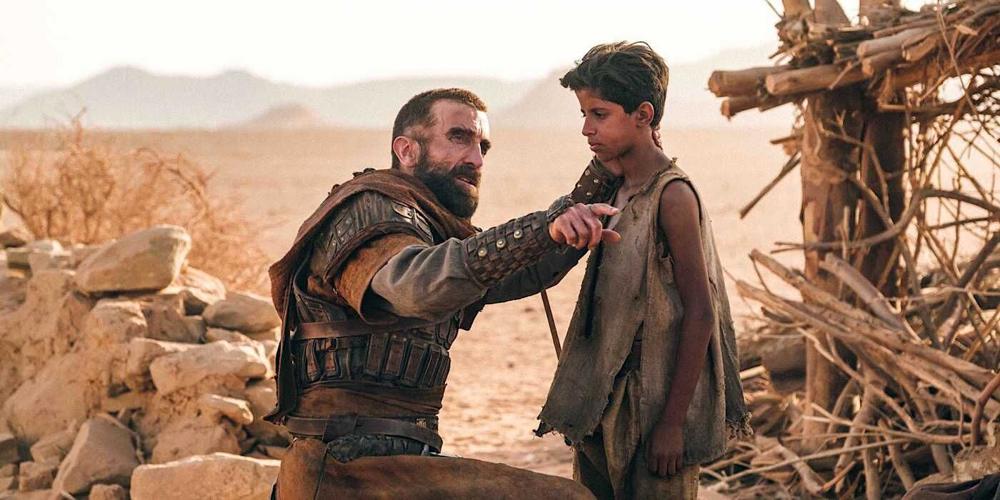
Sharlto Copley (Maleficent and District 9) rounds out the cast as Jalabzeen, a gladiator-like general who the emperor sends to kidnap Princess Hind and bring her back to the emperor. He's the Darth Vader equivalent. Yet, if one has a problem with Mackie being in this narrative, then you'd probably have a problem with Copley who as far as I know isn't of Middle Eastern descent at all.
Rated R for violence and bloody images.
Running Time: 2 hrs. and 6 mins.
In theaters.