

VIRGINIA – The Associated Press has called Virginia’s constitutional amendment on redistricting in favor of passage at 8:49 p.m. Tuesday, with voters narrowly approving a change to how the state draws its legislative and congressional districts.
As of 9 p.m. Tuesday, the measure had 1,310,397 votes in favor, or 50.3%, and 1,296,227 votes against, or 49.7% – a razor-thin margin marking approval of the overhaul of Virginia’s redistricting system following the next census.
Congresswoman Jen Kiggans currently represents Accomack County in District 2. She said in a statement Wednesday, "Under these newly drawn districts and the partisan leadership of Abigail Spanberger, conservative voices and values have been eliminated. That's not leadership, it's a disservice to the principles of fair representation that define our country."
The statewide special election, held April 21, asked voters whether Virginia should temporarily allow lawmakers to redraw congressional districts under limited circumstances before the next census cycle, with polls open from 6 a.m. to 7 p.m. in Accomack County and across the commonwealth.
A yes vote allows the General Assembly to temporarily adopt new congressional districts for upcoming elections under those conditions, while the state’s standard redistricting process would resume after the 2030 census.
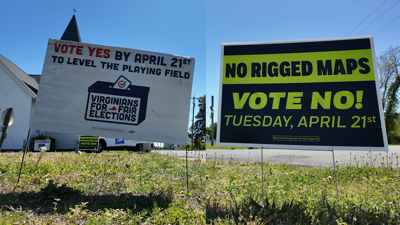
Outside polling places on Virginia’s Eastern Shore, voters framed their choices around competing ideas of fairness. Supporters said Virginia should not remain static while other states pursue mid-decade redistricting efforts, while opponents warned the change could open the door to gerrymandering and weaken the once-a-decade system previously approved by voters.
The proposed change drew statewide and national attention because of its potential impact on Virginia’s 11 congressional districts and, by extension, control of the U.S. House.
In a statement Tuesday night, Governor Abigail Spanberger weighed in on the outcome and its broader implications.
“Virginia voters have spoken, and tonight they approved a temporary measure to push back against a President who claims he is ‘entitled’ to more Republican seats in Congress. Virginians watched other states go along with those demands without voter input — and we refused to let that stand. We responded the right way: at the ballot box.”
Former Governor Glenn Youngkin also reacted to the result on social media.
“Thank you to all the voters who turned out to vote against this egregious power grab. The race was much closer than the left expected because Virginians know a 10-1 map is not Virginia. I urge the Virginia Supreme Court to rule against this unconstitutional process that will disenfranchise millions of Virginians,” Youngkin posted on X.
David A. Felt, who said he voted yes, described his reasoning in political terms.
“I’m voting yes, because I don’t believe in unilateral disarmament,” Felt said, arguing that Virginia should not fall behind if other states are redrawing maps for partisan advantage.
Paula Felt, another yes voter, said she still supports Virginia’s bipartisan redistricting commission but viewed the measure as an exception.
“We’ve got to level the playing field here,” she said. “This is our way of fighting back.”
Under current law, Virginia’s congressional districts are drawn once every 10 years by the Virginia Redistricting Commission. The maps were last redrawn in 2021 and are next scheduled for revision in 2031. Supporters of the amendment described the proposal as a temporary response to aggressive redistricting in other states, while opponents said changing the rules mid-decade undermines the existing system.
Robert McCarthy, who voted no in Greenbackville, said he viewed the issue through a fairness lens but reached the opposite conclusion.
“Well, all I could say to that is that if you believe in fairness, to vote no,” McCarthy said, adding that he and other opponents want to keep politicians from having greater influence over congressional maps.
Some no voters expressed concern about the Eastern Shore’s representation under any revised map.
John Schneider, also a no voter, said the proposal could weaken rural voices in Virginia’s political map.
“It would result in representation not being fair to the Eastern Shore,” Schneider said. He also said the amendment’s wording was confusing and that he spent time outside the polls trying to explain what he believed was at stake.
Despite the close divide, voters on both sides described strong turnout for a special election. Felt said participation was “very heavy,” while no voter Ron McIntire said poll watchers told him turnout appeared stronger than in some presidential and midterm elections.
The new redistricting system is expected to be in place ahead of the next round of map drawing following the 2030 census, potentially reshaping Virginia’s political landscape for years to come.