
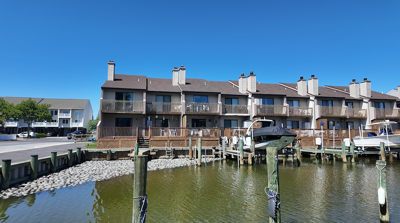

OCEAN CITY, Md. — A familiar summertime problem has returned to a canal on 94th Street in Ocean City — and some neighbors say it's worse than in years past.
Hundreds of dead horseshoe crabs have piled up in the water, creating a smell some say is impossible not to notice.
Andreas Visilias has owned his home on 94th Street for about eight years, and said the smell has kept his family off their own back deck.
"It's not good at all, you know? It definitely, you know, sways our day into not a good direction. We can't hang out with the family, back here on the deck…[We] find ourselves leaving the house versus hanging out of the house," Visilias said.
Joseph Taylor, who also has property on the canal, said the town has stepped up its response compared to past years — but the smell hasn't let up.
"It's disappointing when we try to come and enjoy our vacation home and we really can't be outside. It smells so bad…you want to throw up, and [we] really can't be outside enjoying our boat and all of our things that we want to do outside," Taylor said.
Ocean City Manager Terry McGean said the die-off has become a pattern, but this year the problem has intensified.
"So, this has been kind of a recurring issue that we've had the last few years. This year seems a little bit worse. We've already removed the crabs on three different occasions. They appear to keep coming back. At this point, we're going to be reaching out to the state. These are waters of the state of Maryland. We're sort of at the end of what we can do with our resources," McGean said.
The contractor the town has relied on for cleanup is no longer willing to continue the work, McGean said, and the canal's unusual layout may be part of the problem.
"This is really the only place we've ever seen this happen. Within the town of Ocean City, the canal is sort of, uniquely situated. It's at the end of sort of a complex of canals. And it's oriented in a different direction. So it appears…what happens is when there is this die off, there's no real way there's no kind of adequate flushing in the canal, to remove the crabs," McGean said.
The town has also brought in outside experts, including a University of Maryland Eastern Shore professor, though McGean said even he has been stumped by the cause.
Renee Thompson, a graduate student who is studying the canal, said although a certain amount of horseshoe crabs die every spawning season, they wouldn’t normally collect in one area. According to Thompson, this problem has occurred on and off since 2016.
"It's not really a natural event. It is more, the culmination of a bunch of causes. We've been researching it on and off and trying different things. We feel like it's happening in this one area. You know, we haven't had any reports of it being anywhere else," Thompson said.
She said this year's die-off is starting earlier and hitting harder than usual — and appears isolated to just one species.
"This year, it seems to be more intense than most. Usually it starts in July...And we've seen more crowds than we've seen probably in the whole spawning time die in a shorter amount of time," she said. "It's also interesting that it doesn't seem like a lot of the other wildlife in the canal is being affected the way the horseshoe crabs are."
Thompson estimated roughly 2,000 crabs have already been removed by the town's contractor, with another 400 to 500 still on the surface and more that have sunk below.
McGean said he doesn’t have a timeline for a fix, but said the town plans to lean on state agencies including the Maryland Department of the Environment, since the canal is state-owned water.
Beyond cleanup, McGean said the town is exploring longer-term fixes to keep these crabs from entering the canal — though any changes would need state approval first.
"We've actually already been talking, with our engineering department, and reaching out to some others, [to see] what others have done, that maybe can prevent the crabs from getting in there to begin with... The immediate thing is to get the crabs out of there. And then the longer term is to try to look first for something so that this doesn't continue to keep happening," he said.