
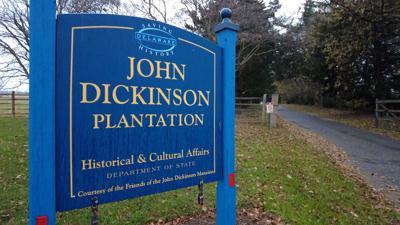

KENT COUNTY, Del.- Delaware's Division of Historical and Cultural Affairs (DHCA) is looking for help in revealing the lesser-known history of the John Dickinson Plantation.
The plantation has been open to the public since 1956 and DHCA provides tours of the Dickinson mansion Thursdays through Saturdays.
Gloria Henry, DHCA's site supervisor, stresses the collective effort in shaping history: "We talk about John Dickinson as an important founding father, but he didn't do it alone."
The agency is in the process of establishing a 'Descendant Community Engagement Group,' with the goal of shaping a more accurate historical narrative.
"There were a variety of people working, living and dying here on this plantation," Henry said. "They are just as important as Mr. Dickinson."
All interested parties are welcome to join the group, not only those whose ancestors may have been enslaved at the Kent County location.
Using guidelines from James Madison’s Montpelier and the National Trust for Historic Preservation, a new approach to involving descendant communities is evolving.
Previously, being a descendant meant proving lineage to enslaved individuals, but this was challenging due to scarce or non-existent records for many descendants.
"It is not just for the descendants, it can be descendants of [people who were enslaved] in the general area or the state of Delaware," Henry explained. "Anyone who has a passion and wants to help us create a better future."
The group will help in making various decisions, including one related to an African burial ground that was recently identified in March 2021.
Daniel Citron, DHCA's Historic Sites team manager, elaborates on the recent discovery, highlighting the challenge: "We knew it was somewhere on the site; however, the current site is about 450 acres, whereas the plantation at one point was about 5,000 acres. The reason we didn't know where it was is because this is a lost part of history."
He emphasized the need to proceed with caution following the discovery.
"There was some discussion about whether to open up any of the graves and confirm that they are indeed graves," he said. "However, we felt that wasn't our decision to make alone, there is a lot of emotion and feelings there and we want to take that into account."
While DHCA holds strong evidence indicating the presence of graves, Henry reveres the site as a sacred space.
The agency is also developing a website to display information about the lives of enslaved individuals, indentured servants, and freed African Americans at the John Dickinson Plantation. They're currently compiling content for the website on a spreadsheet.
Those interested in joining the Descendant Community Engagement Group can find more information here.