

DELMARVA PENINSULA - While the 2023 Atlantic Hurricane Season officially began on June 1, you might say that "hurricane fatigue" has long set in across much of the United States, Caribbean and Central America, and even Canada.
Recent Atlantic hurricane seasons have set several records. We had so many named tropical storms and hurricanes in 2020 and 2021 that the National Hurricane Center scrapped using the Greek alphabet to name storms beyond the primary list of names.
In 2020, southwestern Louisiana got clobbered with a 1-2 punch in 2020 as Category 4 hurricanes "Laura" and "Delta" struck less than two months apart. And in a rare November event, northeastern Nicaragua got hammered by "Eta" and "Iota", both Category 4 hurricanes that struck only two weeks apart.
And even Canada has not been spared, with the Canadian Maritimes seeing the likes of hurricanes "Dorian" and "Fiona" in recent years
Delmarva usually gets spared the worst of tropical storms along the East Coast, but such storms are no stranger to our pleasant peninsula, and storms like "Isaias" and "Sandy" have had devastating effects.
"We tend to see more inland flooding impacts throughout the Delmarva, especially with a storm that tracks close to the Chesapeake Bay, compared to additional winds with a storm that tracks along the Atlantic Coast," said James Hamilton of the Worcester County Department of Emergency Services.
For 2023, tropical forecasters are predicting a "near normal" hurricane season, with the National Oceanic and Atmospheric Administration predicting 12-17 named tropical storms, 5-9 hurricanes, and 1-4 major hurricanes (hurricanes of category 3 or greater).
El Niño may also develop in the Pacific Basin, which typically limits the ability of storms to form in the Atlantic Basin.
However, Hamilton says it's not the quantity of tropical storms we need to be ready for - it's the strength.
"It's also important to remember that one of the lowest hurricane forecasts was in 1992, where Hurricane Andrew, as a Category 5, significantly impacted Florida, and it only takes one storm to cause serious damage," Hamilton recalled.
Hamilton also cautions that the start of hurricane season should be one of several times folks should review their storm preparedness.
"Along the Delmarva, we are regularly experiencing outside of hurricane season, nor'easters and other storms that can impact us at any time," Hamilton said.
Hamilton said folks should review their insurance coverage, noting that most homeowner's insurance does not cover flood damage, which often occurs on Delmarva. They should also have family or friends away from the coast and bay who will be willing to take them in on short notice if they have to evacuate. And important documents and medications should be kept together in places where they can be quickly grabbed should evacuation become necessary.
Be sure to also have a plan for your pets whenever dangerous weather strikes.
More About El Niño
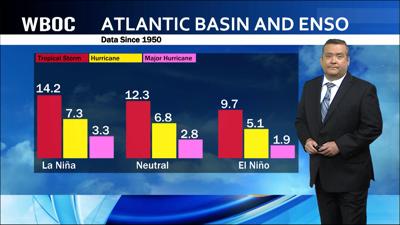
Normally winds in the tropical Pacific blow from east to west, pushing warm water at the ocean surface westward toward Asia. But in an El Niño year, the winds are weaker, so that warm water spreads east, causing warmer sea surface temperatures near Central America. That changes our atmospheric flow pattern and it pushes the jet stream down to the south and allows for storms to track south into the Caribbean. That creates some unfavorable upper-level winds which strengthen the trade winds in the tropical Atlantic, which rip apart tropical storms before they can really get a chance to organize themselves. Looking at some statistics for the Atlantic Basin and ENSO ("El Nino-Southern Oscillation", the proper term for El Niño). In a La Nina year, when those trade winds are stronger out in the Pacific, we tend to see more tropical storm activity in the Atlantic. But in an El Nino year, we see those numbers lower. Fewer than ten storms on average, and fewer than two major hurricanes on average.