
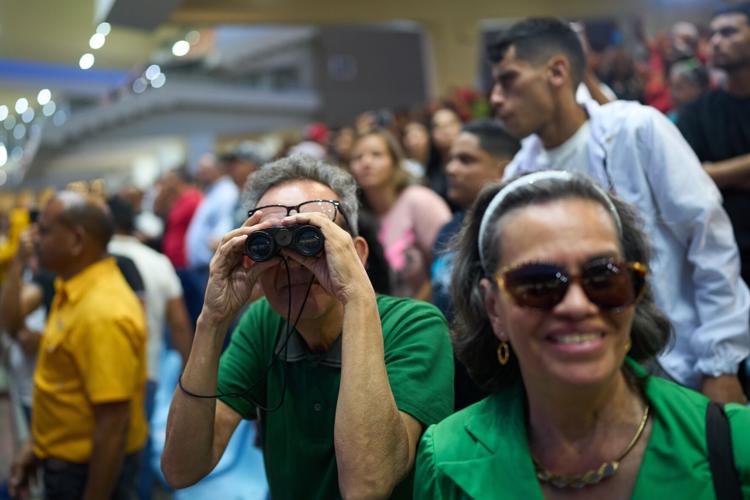
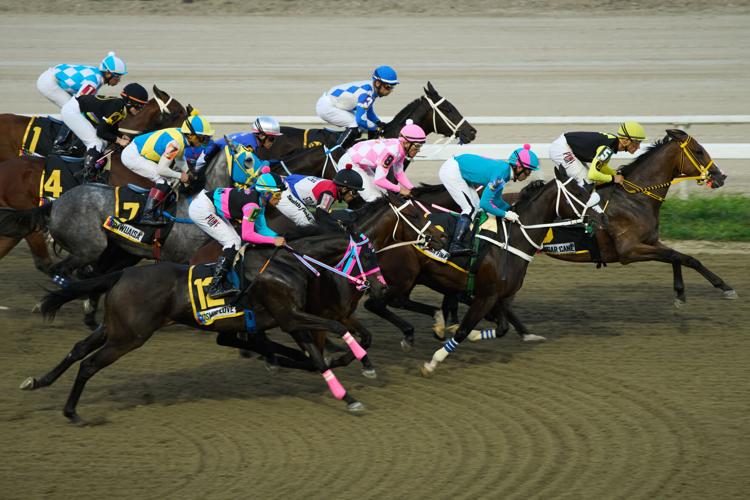
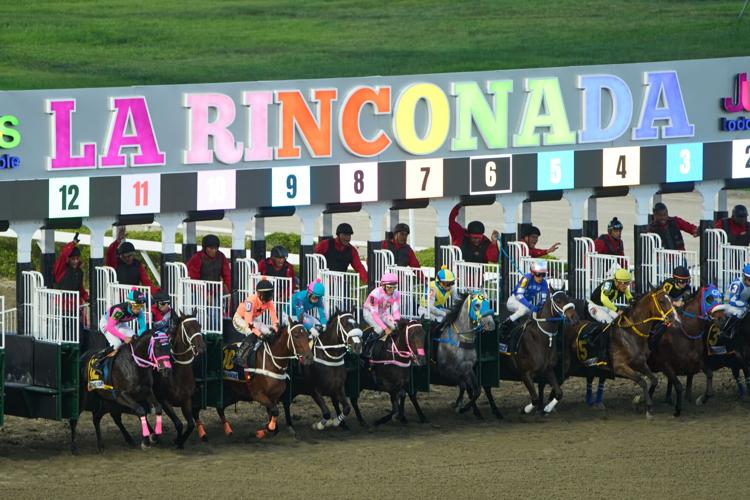
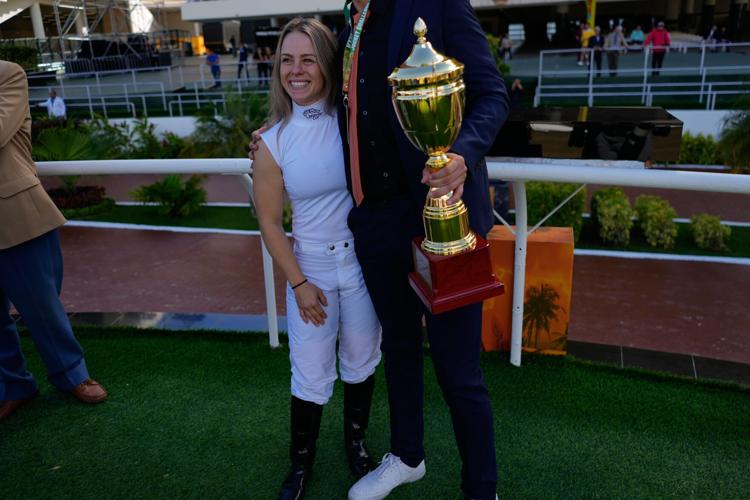

CARACAS, Venezuela (AP) — The stands roared as Silk Eyes galloped past Mr. Thunder at the top of the stretch. Adults and children, some rushing to reach the barriers to get a better look, snapped their fingers as if willing the colt to go faster. They erupted in cheers when it crossed the finish line.
On Sunday, the crowd of mostly lower-income people at the racetrack in Venezuela’s capital enjoyed a day of races that drew jockeys from the United States and elsewhere, despite the increasingly tense political climate around them. Their country’s protracted crisis has accustomed them to unpredictability. Years of political promises or threats — even of a possible U.S. military attack on Venezuelan soil — now hardly move them.
“Given the circumstances and the situation in Venezuela, we all have that uncertainty and anguish,” fan Mari Alegría said Sunday after Silk Eyes won the seventh of 13 races. “But we move forward, and just as one works, one also has to have fun.”
Tense political climate
The South American country is wrapping up another year marked by a complex social, political and economic crisis that began when Nicolás Maduro became president in 2013. He, again, is vowing to remain Venezuela’s president for years to come. His opponents, once more, pledge to end his rule soon. But unlike other years, U.S. military assets are deployed off the country’s Caribbean coast and U.S. President Donald Trump is consistently threatening to strike land.
The threats are part of the Trump administration’s strategy to pressure Maduro, who was charged with narcoterrorism in the U.S. in 2020, during Trump’s first term.
The White House has said the military operation, which began in the Caribbean and later expanded to the eastern Pacific Ocean, is meant to stop the flow of drugs into the U.S. The operation has killed more than 80 people, with Venezuelans among them.
Maduro, who denies the drug-related accusations, and his allies have repeatedly said that the operation’s true purpose is to force a government change in Venezuela.
Just days before the race, Trump escalated his campaign against Maduro, when U.S. commandos fast-roping from helicopters seized a tanker carrying tens of millions of dollars’ worth of illicit crude oil near the coast of Venezuela. Oil is the backbone of Venezuela’s economy.
Opposition leader and Nobel Peace Prize winner María Corina Machado in an interview aired Sunday on news program “Face the Nation” expressed support for the seizure. She argued that as a “criminal structure,” Maduro’s government will suffer “when the inflows from their criminal activities are cut.” The inflows, she said, include oil, drug, gold, arm and human smuggling and trafficking.
“So that’s what we believe, it was so important to apply law enforcement (pressure), and we have been asking this for years, so it’s finally happening,” Machado said from Norway, where she appeared in public for the first time last week after hiding in an undisclosed location in Venezuela for 11 months. “That’s why I believe the regime has its days numbered.”
Day at the track
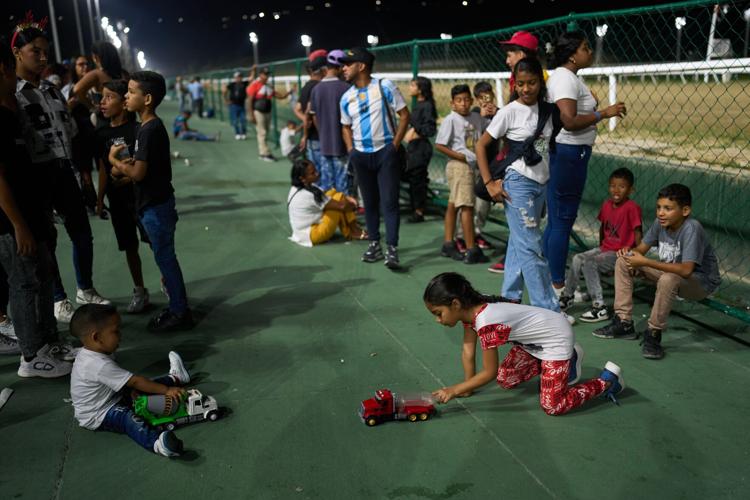
None of this seemed to matter at the racetrack.
“It’s true that all Venezuelans are anxious (wondering) what’s going to happen and all that,” Luigi Achique, who visits the track regularly, said holding a racing magazine he had marked with his bets. “But I come here on Sundays to unwind. You never know what’s going to happen.”
Nearby, a section of the stands was dedicated to government workers and uniformed members of a pro-Maduro civilian militia.
As the races took place, children formed long lines to use a variety of bouncy castles set up next to the track. But in many families, children were the ones interested in the races, not the adults.
“The children love horse racing; they’re fascinated by it,” Roxany Hernández said as her 10-year-old son and other children tried to get pictures of the jockeys. “Despite the difficulties, we’re working, we’re enjoying ourselves.”
Among the jockeys the crowd cheered on was American Katie Davis, who rode Silk Eyes to victory, despite a U.S. travel alert warning citizens against visiting the country sent before the military operation began earlier this year.
Davis said she arrived to Venezuela hours before the event. She explained she “was a little nervous being” in Venezuela but also “felt very safe.”
“Everybody has their opinion on it,” Davis said of her visit. “It’s like life in general, you can listen or you can do what you think is best. At the end of the day, it’s your life on the line, just like horse racing, our lives are on the line, and I come in peace.”
