
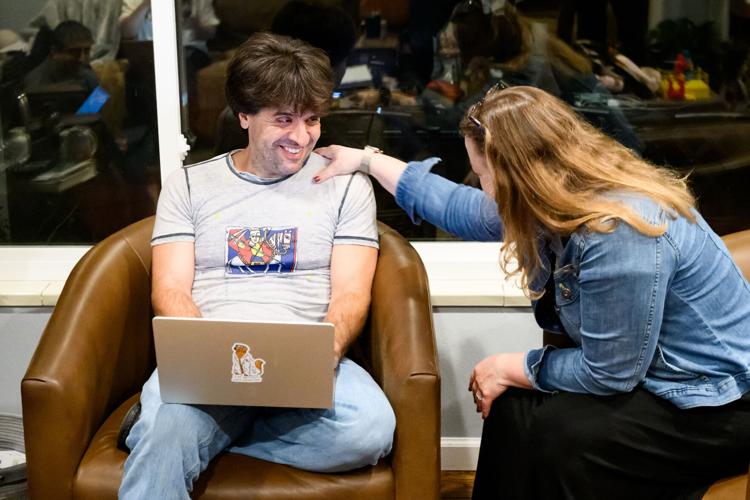
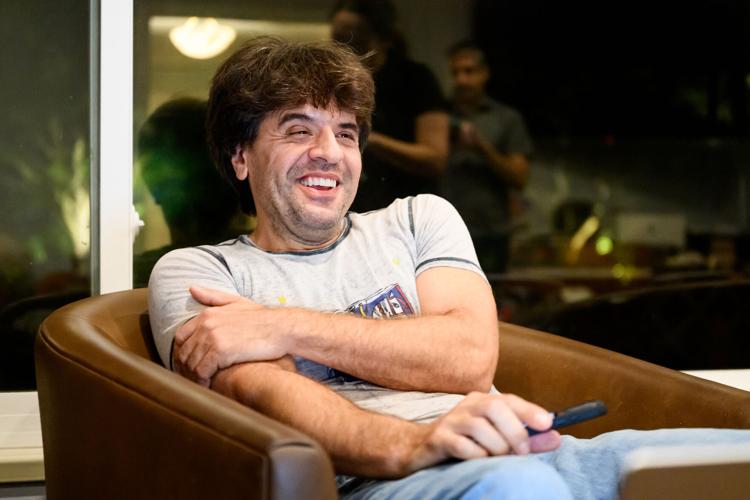

STANFORD, California (AP) — Dr. Karl Deisseroth spent hours fielding congratulatory calls after learning early Monday that he had won a Nobel Prize for medicine for helping to open a new field of brain science called optogenetics.
But it wasn't long before the California scientist asked for a break from all the attention for a more ordinary task: He needed to make school lunches for his children, who were asleep in the family home in Stanford, where their father had been speaking in the middle of the night with journalists and well-wishers.
Deisseroth, 54, shared this year’s medicine prize with two researchers in Germany for their work in optogenetics, a field that combines light with genes to switch on and off neurons in living brains.
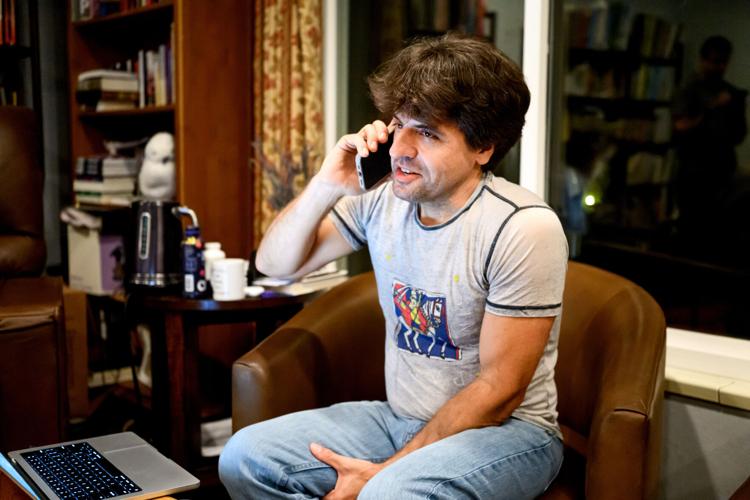
A self-described night owl, the Howard Hughes Medical Institute investigator and Stanford University professor often works past midnight. After reviewing papers and emailing his students, he said he had just gone to lie down when he got the call from the Nobel Assembly in Stockholm.
“I almost felt as if I’d lost the power of forming words,” he told The Associated Press, “but I recovered after a minute or two.”
He regained speech quickly enough for remote interviews with AP science reporters. Speedy emails with the Stanford communications staff had helped put them in touch.
“No real sleep was achieved,” he said an hour after the announcement.
As the science reporters chatted with Deisseroth over the phone and Zoom, an AP photographer and videographer raced to his home in Stanford.
The photographer arrived around 3:30 a.m. to find Halloween decorations outside the home but just one light on inside. He was worried he had the wrong house before mustering the courage to knock on the door.
Dr. Michelle Monje-Deisseroth, the scientist's wife, answered and ushered the photographer into their home, where the Nobel winner was taking calls from the couch.
Monje-Deisseroth, an HHMI investigator and Stanford pediatric neuro-oncologist, was at his side when she wasn’t making coffee for the Stanford communications staff who had joined the celebration. Deisseroth was surprised to hear his work had been honored with a Nobel Prize, he told the AP, but his wife was not.
Deisseroth recounted the research he conducted with fellow Nobel winners Peter Hegemann and Georg Nagel, and its real-world impact.
“For me, I’m a physician-scientist. I am a psychiatrist. I care about patients and my patients who have autism, who have depression,” he said. “I care about the hope that this brings. But I’m also a basic scientist, and I care about understanding this amazing organ, the brain, and how it works and how it integrates and computes and delivers all the things that make us human.”
As Deisseroth wrapped up the interviews, he told the Stanford staff he needed an hourlong break beginning at 6:30 a.m. His kids would be waking up, he said, and they would need lunches before leaving for school.
When one of the Stanford representatives wondered if the neighbors would mind all the late-night commotion, Monje-Deisseroth shrugged it off.
They live in faculty housing, she said. There are a lot of Nobels in the neighborhood.
Ramakrishnan reported from New York. Associated Press writers Stefanie Dazio in Berlin and Lauran Neergaard in Washington contributed to this report.
AP Nobel Prizes: https://apnews.com/hub/nobel-prizes