
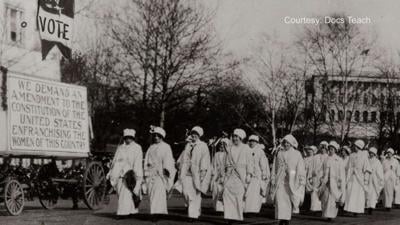
SALISBURY, Md.- 100 years after the women's right to vote was ratified, activists and feminists are looking back on the centennial and the future of the women's rights movement.
The suffrage movement on the Delmarva peninsula differed than the movement across the country, with women more independent due to the local economy.
"I think one thing you see is we have some history of women adopting non traditional roles," explains Salisbury University Women's Historian Dr. Kara French. "There's a history of water women just like watermen in the fishing industry here, and a really interesting case of Ocean City where some of the first boardwalk hotel owners were actually women. So there's a really neat history of entrepreneurship."
Dr. French says once suffrage was open, African American women were able to register to vote on the Eastern Shore, which was not the case especially in the South. Dr. French says the educational makeup of the Delmarva peninsula may also have contributed to progressive politics at the time.
"I think maybe one of the things that's unique about this community is that you have the presence of universities like Salisbury and UMES so from the very beginning you had the example of female leadership," she says. "You had women who were college presidents, women who were educators, and so young women in our community had these people to grow up and I should say look up to and aspire to these leadership positions." As the women's rights movement evolved over time, issues like equal pay and financial respect came to the forefront. Susan Buyer with the Suffrage Centennial Celebration Committee of Worcester County recalls what life was like before some of the legislative and societal changes seen after the height of the women's rights movement in the 1970s. "As a young married woman wanting to buy a house, [I was] told by a mortgage lender that my income--which was actually the major income in the family at that point--could not count toward the mortgage because I might get pregnant at some time and I might quit work," Buyer says. "That was I think routine. That's not an exceptional story. That's the way things were." Buyer's colleague on the committee, Linda Linzey says Maryland women have always inspired the movement, noting historical records from 1648 show Margaret Brent demanding the legislature give her the right to vote per colony law, as she was a landowner. "She said 'well I am a landowner and I'm also the executor of the Carroll estate, so I should be getting two votes.' Of course she was turned down," says Linzey. "In Maryland it began in 1648, and here we are in 2020 still trying to make sure that everybody has the franchise." Linzey says she attended an elementary school in Baltimore named after Brent, and no one ever explained the school's namesake. "Women have always participated but they had a hard time getting any notoriety for it because these are not things that we learned about in school," she says. "Because the history was written by the rich, white men." Linzey and Buyer say the way their group is honoring the legacy of suffragettes is by ensuring everyone has safe, easy access to the ballot box, and continuing to fight for voting rights. Activist Rosie Bean says that is critical in 2020, as is tying in the women's movement with racial justice movements. "The women's rights movement was a big stepping stone and empowered a lot of women to become politically active and engaged but now it's time to take those tools and move it into the future with current issues that are going on concerning women with the Black Lives Matter movement and health and education and so forth," she says. "It was a stepping stone and now we need to go on from there and empower other young women with knowledge to go out there." Race has always been a component in the women's rights movement. Records show parades were segregated, and sometimes women of color
were written out of suffrage records all together.Delta Sigma Theta Sussex County Chapter President Sherita Belle says her sorority's founders fought for the rights that are still being discussed today. "It was the women of Delta Sigma Theta who were resilient and just pressed forward to be noticed and get in line," Belle tells WRDE. "Even though we were in the back of the line but it was very important that we were there to stand up for the rights of us, of women of color, on issues as equal pay, freedom from discrimination even though we still face that today." Belle says we must look back in order to press forward. "I can't honestly say that I see the real change," she says. "We are striving to get there but until everyone opens up and are honest about our feelings and we confront the past [...] the past is the truth and once we confront that then we may be able to understand each other and that's when I think we will see change." Local governments have taken steps legislatively to advocate for women's rights, such as Delaware approving
the Equal Rights Amendmentand Maryland
requiring gender statistics to be reported.In Delaware, the Office of Women's Advocacy and Advancement is hosting
four free salary negotiation workshops online in October."Women in Delaware are either the primary or the co-bread winner in the majority of families," explains OWAA's Melanie Ross Levin. "So if women don't have the financial resources to take care of themselves and their families, Delaware women and Delaware communities suffer." Young women say for them, the future of women's rights is all about freedom of expression, and ensuring racial equality is on par with gender equality. "It still bothers me that people calling 2020 100 years of women's suffrage just because it was so limited in terms of which women could vote," says Zoe Michelle Bradshaw. "It wasn't women's suffrage at all, it was just white women and let's face it, probably wealthy women." "Use your voice, use your privilege," urges Fathima Rifkey. "It's not that your issues as a white woman aren't important but also that it's not just about you. We have to start looking at the community as a whole and not just have one western view of everything. We have to start looking at these issues with critical thinking, think about these other opinions and views and that's how we are going to achieve real equality and equity for women whether it's nationwide or worldwide." For more on the women's suffrage centennial,
click here.