
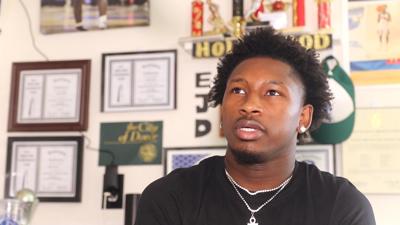
SALISBURY, Md.- Shayne Leatherbury is a Salisbury native who grew up and played football at Delmar High School. He says he felt nothing but love during his time at the home of the Wildcats. However he says he did not feel that same love everywhere he went.
"We were playing at Caravel and we were getting names called and stuff getting thrown at us and I felt like we didn't really have that many Black people on our team and we were still getting called racial slurs for that," said Leatherbury.
Despite his experiences navigating racism, Shane excelled on and off the field playing as a wide receiver at Towson and even signing to play for the Arizona Cardinals.
"He taught us at a young age that you got to be twice as good to go half as far just because you have some extra melanin," says Leatherbury, recalling a lesson taught to him by his father.
Eden Davis was a star player for Dover Senators, leading the team to an undefeated season in 2019 and a co-state championship in 2020. But off the court, Eden says that it's been difficult seeing all of the cases of police brutality involving unarmed black men.
"Why are they acting out against us like this? Not seeking justice for obvious crimes us we do something just so small we getting life sentences," says Eden.
He also says that it's discouraging hearing people trying to silence Black athletes.
"What do you mean shut up and dribble? Why can't I express my opinions do you know how I feel? Have you been in my shoes? Have you experienced the things I've experienced?" says Eden.
Darryl "Debo" Williams played for the Smyrna Eagles. Williams during his time with the Smyrna Eagles won two DIAA state football championships.
Off the field Williams has also been using his voice to point out the injustices that Black athletes face.
"Right now we trying to focus on black lives matter. We're not saying we're better than anyone else it's just that black lives are in danger right now we're trying to focus on that," says Williams.
Williams says it's important for people to understand why activists are saying, "Black lives matter," instead of of "All lives matter."
"I just feel like some people say that because they don't understand what it's like to be Black, you know just fearing for stuff that you would never have to fear for if you weren't that skin color," says Williams.
Dr. Marshall Stevenson, dean of the School of Education, Social Sciences & the Arts at the University of Maryland Eastern Shore in Princess Anne, says that Black athletes cannot remove what they have experienced when they suit up to perform on the field.
"You've got Black athletes, you've got race, you've got racial issues in this country. Those two are conjoined that's not going to come apart so it's going to continue as long as these incidents, as long as these things keep happening, boom it's going to be right back at the table again," says Stevenson.
Dr. Louis Moore, a professor of African American history and the author of We Will Win the Day: the Civil Rights Movement, the Black Athlete, and the Quest for Equality, says that it is crucial for people to allow Black athletes to speak on their experiences.
"Hear them outright. Allow these athletes to speak right and eventually it's for the betterment of society," Moore says. "This is what we know about these movements: they create change for the betterment of everybody."