

Each week a member of the WBOC and WRDE news teams will dig into an aspect of race relations or diversity on Delmarva. These stories will highlight challenges, provide inspiration and hopefully, spark conversation here on the peninsula.
By Kimberly Holmes
You've read the stories and seen the aftermath: hate bubbling up through America's veins and into the streets of cities and towns throughout the country.
Racist literature even popped up here on Delmarva several times within the last few years. Police say fliers originating from national Ku Klux Klan chapters were placed on yards of homes in Harrington, Del., St. Michaels, Md., and Berlin, Md.
Worcester County, Md., native Patrick Henry has had his share of brushes with hate.
"Sometimes you get very tired of it,” said Henry. “Very sick of it."
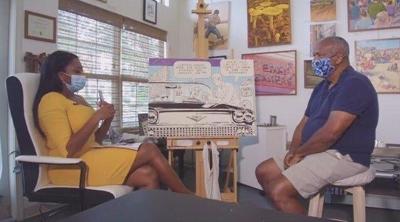
The Eastern Shore artist is currently finding the right shade for each stroke of color in his newest piece. It’s centered on a subject he says isn't just black and white: race.
His tools tell a tale with watercolors, oil paint and even snapshots of bygone moments. The renowned artist captures history while his own story is just as remarkable. Henry was among the first group of African-Americans to integrate Stephen Decatur High School.
"I could see it in my young white classmates that they were trying to figure out who these dark-skinned people were because they were taught that there was a difference,” said Henry. “Up to that point, society -- outside of the foreman and fishing industries, races stayed separate."
Yet, harsh overtones of racism mix with many of his memories.
"In Ocean City when I would hang out, you'd walk along the street and this carload of boys would come by and hurl the ‘n-word’ at you,” said Henry. “After the George Floyd incident, I was just devastated because I saw him lying there and easily it could be me."
Dr. Marshall Stevenson, who is the dean of the School of Education, Social Sciences and the Arts at the University of Maryland Eastern Shore, says racism and the hatred woven into it is an intricately ingrained problem in America.
"Whether it's against African-Americans, Native-Americans, Asian-Americans, Jews, there has always been this animosity between that which was different,” said Stevenson. “Or the other that was opposed to sitting down and viewing one another as equals in a Democratic society."
Dr. Katie Elder, a psychologist, said, "New neurobiological studies of hatred show that the hind part of the brain actually activates when we hate."
She said it is possible for certain phrases and words to elicit hate for some people.
"Words create an association for us and if again that hind part of the brain is activated in that and we go into this mode of being threatened,” said Elder. “If you hear "fire" you hear "help." If you hear words like that we go on alert, and now there is that association with certain phrases that get people fired up very, very quickly."
“I think what we can learn from history are those particular instances where blacks and whites were willing to sit down and talk about the issue of race,” said Stevenson. “Whether that was in the abolitionist movement and certainly that was a movement to abolish slavery, but within that movement, there were many abolitionists that simply want to end slavery but it did not mean they believed in racial equality. And so, I think we're at a point in time now where again whether it be on a university campus, whether it be on a corporate board room, people need to sit down – allow their raw emotions to come out and try to understand what can we do in this point in time with something that's been so engrained in this country.”
"It just shows that we haven't come too much further than we have in the 1960s,” said Dr. Stevenson. “We still have serious problems when it comes to public education."
Studies show lack of access to education is a major predictor of passing poverty from one generation to the next and receiving an education is a top way to achieve financial stability.
A 2016 "Equality and Human Rights Commission" report reveals when people feel their basic needs are threatened for things like jobs, housing- even beliefs, It can lead to hatred.
Henry agrees, and adds classism may be a bigger issue locally than racism.
"In some ways, there's not a whole lot of opportunity for blacks or whites!" Henry said.
Programs like Horizons Delmarva target children from families of all colors in financial need.
Joe Laque runs the program and says his summer students have gone from falling behind by two to three months to becoming top achievers.
"Our Horizon students have a 99-percent graduation rate,” said Laque. "It's a generational thing. They develop a livelihood. They develop their education. They can then instill that in their students or their children."
Advocates stress that education and awareness are big keys in the fight to eradicate hate, a learned behavior.
WBOC asked Elder whether hate can be unlearned.
"It does come back to overall brain health,” said Elder. “There are some theories that racism is a symptom of psychological ill health. Primarily, if someone exhibits racism, they lack self-esteem. They over identify with a group. Yes, it can be unlearned. It's gonna take work. It takes awareness. It also takes everyone to be open minded about our role in racism."
“Race is something we've avoided for a very long time in this country, but it is something that has set the framework for the United States,” said Stevenson. “And even before that in Colonial America. In fact, when you talk about race, you can actually go all the way back to antiquity where people's racial perceptions were created and traveled all the way down to this time. So, on the one hand, it's very tragic what our country is going through. It just shows that we haven't come too much further than we have in the 1960s. While we have made some progress and passed some laws, there have been an increase in various minorities in executive positions and various roles in leadership, we still have serious problems when it comes to public education and when it comes to employment -- when it comes to access to those kinds of things. Those are the things that need to be addressed at this point in time. And I think what the African-American community is particularly looking at right now, is the way that larger corporations and entities are approaching this particular issue.”
Henry adds we must learn how to work together to solve the problem.
"It's one America,” said Henry. “We've got to address this thing that we can live together in peace with one another."