


POCOMOKE CITY, Md. - Some suspicious simoleons are appearing in Pocomoke City.
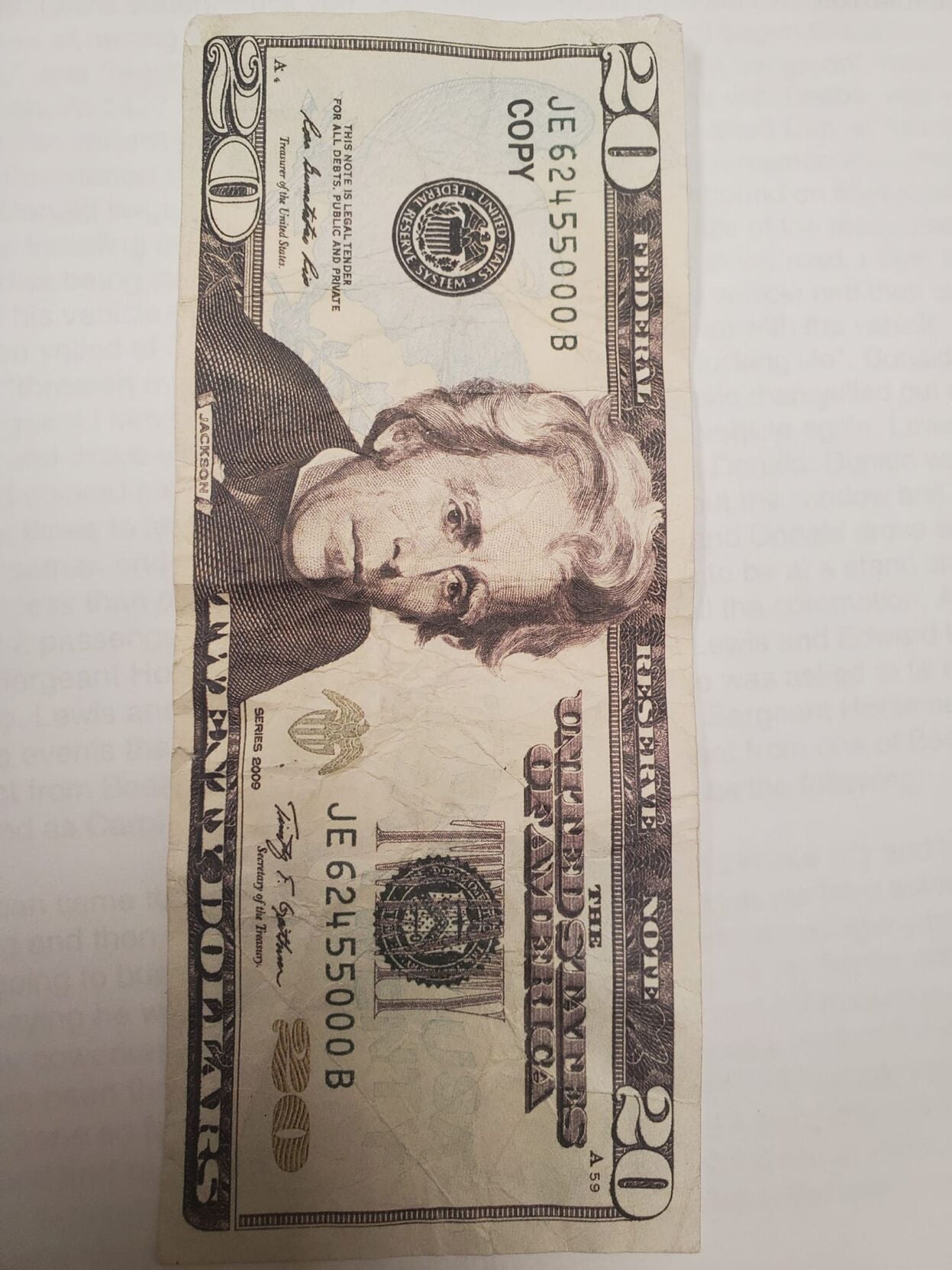
Friday morning Pocomoke City Police reported on their Facebook page that several businesses in town had received fake $20 bills.
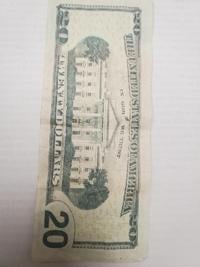
The fake $20s are all nearly identical and bear the serial number "JE62455000B" and have the word "COPY" in bold print on the upper left of the obverse (front) of the banknote.
The fakes have police warning businesses and customers to be alert.
"It diminishes trust and faith in the value of that currency, so absolutely, we need it to be authentic as much as possible," said Lt. Ian Castaneda of the Pocomoke Police Department.
Counterfeit money has been used for centuries not just to steal, but to destabilize entire nations' economies.
While the scope of this counterfeiting scheme is unlikely to cause global turmoil, even small scale counterfeiting is devastating to small businesses and their patrons.
"It saddens me because, you know, small business is really struggling as it is," said Lisa Taylor, owner of The Christmas Sweet on Market Street in Pocomoke City. "So to receive a fake bill instead of a real bill will definitely hurt many businesses in town."
According to the Federal Reserve Bank of Kansas City, the $20 bill is one of the most commonly forged banknotes in the world, and counterfeiters rely on its frequent use (unlike $50s and $100s) to trick unsuspecting consumers.
"You know, how many times do you go into a convenience store and you get change, and you don't really check?" said Marc Scher, owner of Scher's Bridal Shop. "The proprietor doesn't know it's counterfeit, and that money just gets circulated."
In the end, it's not nations or the big businesses getting hurt by this kind of counterfeiting. According to the manager of one Pocomoke business who worked retail for many years, it's the individual workers at the cash registers getting the worst of it.
"If someone had counterfeit money and it was in their till, then they would have to pay back that money to their store at the end of their shift," said Lorie Stout of Classic Collections at The Vault. "Think about how much that is, how many hours someone had to work to make that much money."
Police also remarked that the fake banknotes are printed on cheap paper that does not feel like genuine U.S. currency. They advise parents to make sure young folks, who frequently use electronic payment systems, know the feel of real money so they don't get tricked at the market.