
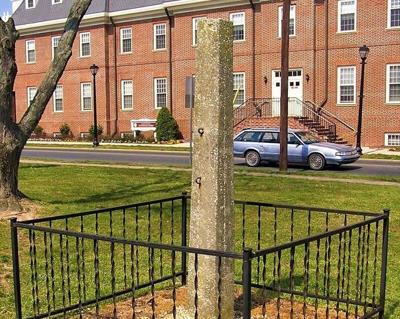

GEORGETOWN, Del.- The Delaware Division of Historical and Cultural Affairs on Wednesday will remove a whipping post from public display on the grounds of the Old Sussex County Courthouse near the Circle in Georgetown.
For some, the post outside the old Sussex County courthouse may mean nothing. But for others, it is a painful reminder of the past.
"This has been an eyesore to the community for some time," said Jane Covington.
The decision to remove the whipping post was made in response to calls from the community and in recognition of the violence and racial discrimination that its display signified to many Delawareans, according to state officials.
“Finally, Delaware is removing its last ‘Red Hannah,’ the whipping post, from the public’s view,” said Dr. Reba Hollingsworth, vice-chair of the Delaware Heritage Commission. “Such relics of the past should be placed in museums to be preserved and protected for those who want to remember the cruel, inhuman, barbarous acts perpetrated on our citizens.”
"This is representative of the atrocities that so many African Americans - and there were Caucasians that were whipped on this as well, it wasn't just black people. But the fact of the matter is it's inhumane. We continually talk about how inhumane some of the things are going on in our country - this is evidence of the treatment some people have received," explained Covington, president of the Richard Allen Coalition.
The post will be moved to a Division of Historical and Cultural Affairs storage facility with other historical objects and artifacts, including a whipping post that once stood near The Green in Dover.
“It is appropriate for an item like this to be preserved in the state’s collections, so that future generations may view it and attempt to understand the full context of its historical significance,” said HCA Director Tim Slavin. “It’s quite another thing to allow a whipping post to remain in place along a busy public street – a cold, deadpan display that does not adequately account for the traumatic legacy it represents, and that still reverberates among communities of color in our state.”
HCA intends to work with historians, educators and leaders of the African American community in Delaware to explore plans for future display of this artifact in a museum setting, where it can be properly contextualized and interpreted.
This whipping post was located on the grounds of the Sussex Correctional Institution south of Georgetown. The facility was established in 1931, but the exact date this particular post was installed is not known. In 1992, the warden donated the post to HCA. The post was installed for public display at the state-owned Old Sussex County Courthouse site in September of 1993.
The history of corporal punishment in Delaware goes back to the earliest days of colonial settlement and included the use of the whipping post and the pillory in all three counties into the 20th century. These punishments were imposed for a variety of crimes throughout history and were disproportionately applied to persons of color. Those sentenced to the whipping post could be lashed up to 40 times for a single offense.
The last use of the whipping post in Delaware took place in 1952. Delaware was the last state to abolish the whipping post, removing the penalty from state law in 1972 through an act of the General Assembly signed by Gov. Russell Peterson.
Some say the removal of the post is a move that's long overdue.
"It's liberating, we have to be honest about the oppression and the hurt and the things that people feel when they see this. And I think it's time for our community to come together and learn how to feel together," said Dr. Brittany Hazzard, who was an advocate to have the post removed.
But more importantly, she says, it shows change can happen.
"It shows that our community is trying to understand each other better. Our state is working to understand each other better and not just talk about it but make changes."
The post is set to be removed at 9:30am tomorrow in Georgetown.