
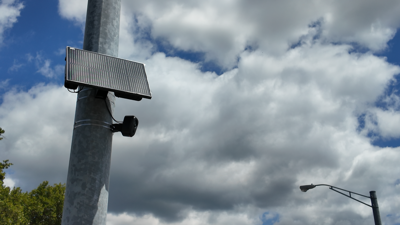


SALISBURY, Md. - Salisbury Police Chief Dave Meienschein is offering new details about how the department uses its Flock Safety camera network as questions continue about privacy, access and oversight.
Meienschein said Friday that Salisbury’s system is about 70% deployed. Once completed, it will include 40 automated license plate readers, 40 pan-tilt-zoom cameras and three mobile camera trailers.
The department also launched a new online transparency portal this week outlining its policies, frequently asked questions and examples of cases in which the technology has assisted investigators.
Meienschein said information collected through the system is retained for 30 days on a rolling basis. He said direct access is limited to authorized Salisbury Police Department personnel and described Salisbury’s network as a closed system.
Other law enforcement agencies do not have open access to Salisbury’s cameras, according to Meienschein. If another agency is investigating a major crime and believes Salisbury’s system could provide useful information, an authorized Salisbury officer can conduct a search on that agency’s behalf.
Meienschein said officers must have a legitimate criminal investigation and case number before accessing the Flock system. Searches are audited internally, and the department also reports information to the state annually.
Maryland law carries penalties for misuse of automated license plate reader systems, Meienschein said.
Police say the technology has already helped investigators identify stolen vehicles and tags and has assisted in cases involving a sexual assault, carjacking and missing persons. In one carjacking case, Meienschein said a person was taken into custody and the vehicle was recovered within about 20 minutes.
The chief stressed that Salisbury’s license plate readers are intended for serious criminal investigations and are not used to identify a driver’s race or other personal characteristics.
Still, critics say the broader concern is the amount of information that can be gathered about where vehicles travel.
Bob Arthur, of Arthur’s Shooters Supply in Berlin, said he believes the technology creates significant privacy concerns.
“There’s no reason for someone to track where I drive every day, all day long. 24 hour surveillance,” Arthur said.
The local NAACP, which raised questions about Salisbury’s camera network last week, says the department has addressed many of its original concerns.
Monica Brooks said Meienschein provided thorough answers to the group’s questions, but the organization still plans to seek additional information.
Brooks said one concern is whether safeguards limiting the technology’s use are strong enough to remain in place under future police leadership. She also raised questions about camera placement and the possibility that surveillance technology could disproportionately affect predominantly Black neighborhoods.
“We want law enforcement to have tools at their disposal,” Brooks said. “But we also recognize and understand areas, how these tools can be misused, if in the wrong hands.”
Brooks encouraged people with questions to attend Monday’s Salisbury City Council meeting, where the Flock system is expected to be discussed further.