

OCEAN CITY, Md. - The National Oceanic and Atmospheric Administration, or NOAA, has a plan to help protect endangered right whales. NOAA has proposed a speed-limit rule change that would expand upon a law that was set back in 2008.
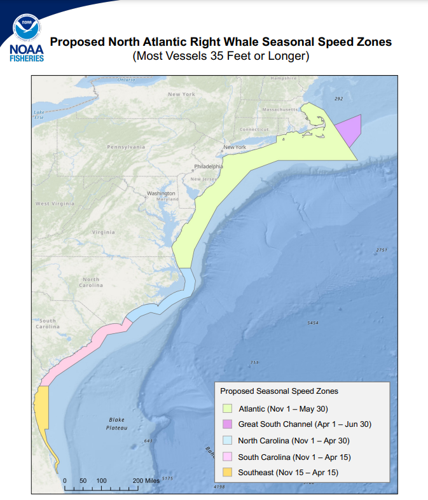
The new rule would enforce a 10-knot speed limit on more boats and expand where and when that speed limit is enforced. A map from NOAA shows the speed limit would be enforced all across the East Coast, and would be in affect from Nov. 1 through May 31.
Maryland First District Congressman Andy Harris met with watermen in Ocean City on Thursday, all of whom voiced their concerns about how this new rule would make their jobs tougher and possibly more dangerous.
"When days are longer on the water, you get fatigued and when you get fatigued, mishaps happen and when mishaps happen, people get hurt," said Jacob Wainglass.
But, the proposed rule is something Suzanne Thurman of the Marine Education, Research and Rehabilitation Institute, based out of Lewes, Del., supports.
"The speed reduction is such a simple seeming step to take to prevent some of these deaths," said Thurman.
Thurman says boat strikes and entanglement in fishing gear is the primary cause of death in right whales. She says one of the reasons it's a problem is because there are only roughly 360-380 right whales left.
Harris, however, says he needs to see more data to back up the cause of death claim before he gets on board with this new rule. Watermen we spoke with in Ocean City agree.
"There's no proof in the pudding," Wainglass said. "These guys are attempting to propose these regulations without any real data, and their data and so-called evidence is little to none."
Those watermen believe if this new rule goes into affect, they'll be spending more time out on the water and the speed limit would hamper their ability to do the fishing they need to do. Plus, watermen we spoke with say it may make it more dangerous for themselves and the whales.
"It's gonna put us more in danger because we have to travel 24 hours a day, which means we're traveling at night, which is just as dangerous for right whales because now we can't see them," said Joe Joachimowski.
Watermen also say this rule could hurt them economically.
"We all grew up hearing the saying time is money and money is time," said Wainglass. "If it's taking you longer to get out there and you have a catch and you're a commercial fisherman, you got to keep your catch fresh, you got to keep it frozen, you got to keep it right so you can sell it at the top quality."
The proposed rule is open for public comment until Oct. 31. Comments can be made via the following link: https://www.regulations.gov/docket/NOAA-NMFS-2022-0022.