
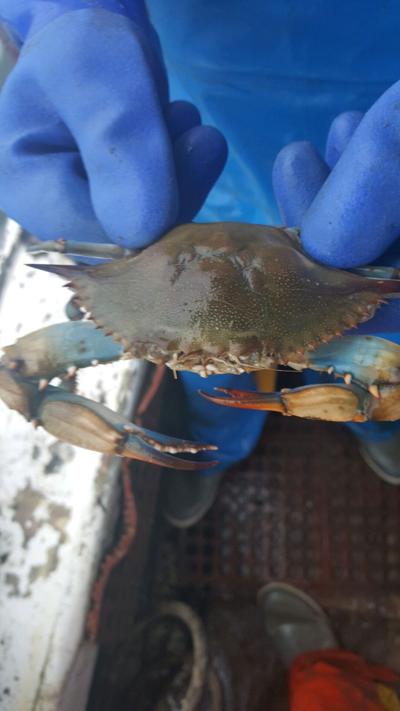
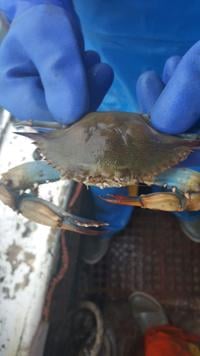
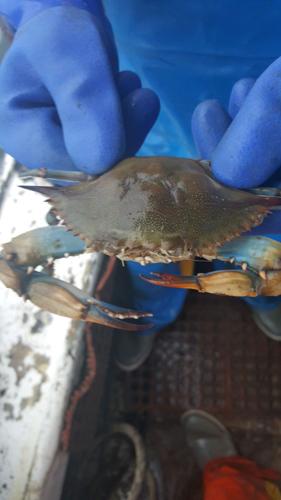
WENONA, Md.- A rare catch in the Tangier Sound left many watermen puzzled. The strange crab seemed to display both male and female characteristics. It's almost as if you drew a line down the middle, the right side of the crab female-- the left, male.
A group of watermen discovered the hermaphrodite crab Monday morning. Tom Wheatley was sorting through hundreds of crabs when he quickly spotted the unique crustacean, unsure of which pot to place it in.
"I was combing through a box of crabs and this one crab caught my eye. It threw me off for a second, and I set it off to the side. I looked at its claws and the claws looked weird... the apron threw me off. I told the captain, he slowed the boat down and we stared at it for five to 10 [minutes] to figure out what was going on," Wheatley said.
News spread quickly over the radio to other boats out in the water at first, then to neighboring islands.
But even with a lifetime worth of experience, none of the watermen had ever heard of such a thing.
"I've seen a lot of crabs, but nothing like that one," said waterman, Patrick Holland.
After a quick google search, Wheatley and others on board learned that it was indeed a hermaphrodite crab.
Dr. Thomas Miller has been studying fishery sciences for decades. He is currently a professor and director at University of Maryland Center for Environmental Science.
"The maturation process in the crab is a very complex physiological process. It involves lots of different things working and if one of those steps doesn't work appropriately, then you can get these unusual outcomes," Miller said.
Miller compares this natural phenomenon to humans who have an extra finger or whose foot didn't fully develop. According to him, hermaphrodite crabs were first spotted in the Chesapeake Bay in the 1980s.
"If in the coming weeks and months if they start finding more of them, then that would be significant, but this one by itself is probably not," he said.