

SALISBURY, Md.– If you’ve had the chance to listen while at the office, in line at the gas station or maybe while out to lunch, you may have heard rumblings of uncertainty regarding this year’s taxes.
Perhaps your friend has a friend who finished filing only to learn they would see less of a refund this year. Perhaps your friend unexpectedly owed money when all was said and done. Or maybe it wasn’t a friend of a friend, or even a friend at all. Maybe it was you!
The deadline to file your 2018 tax returns is Monday, April 15 and, as a result of the Tax Cuts and Jobs Act that was passed in 2017, this season saw tremendous changes compared to years past, according to Lynn Ebel, Director at the Tax Institute at H&R Block.
"This is the largest change to the tax code in over 30 years and it impacts virtually everybody,” says Ebel.
Understanding the nuances of our tax laws is complicated enough, which is likely the reason tax collections services was a $10 billion industry in 2018, according to research by Ibis World.
The tax code is roughly 75,000 pages. So, let’s be realistic about what we can dive into here. Here are three of the biggest changes this season.
Tax Brackets and Income Rates Changed
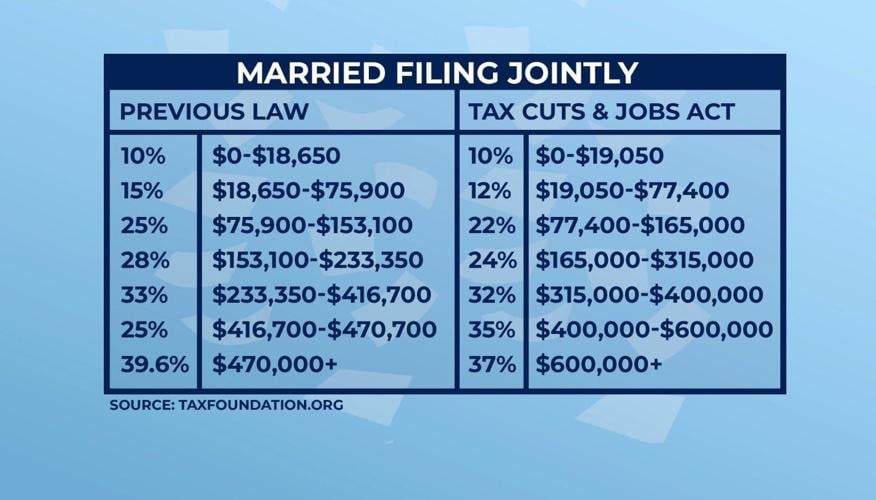
Depending on how you filed and how much you earned in 2018, you may have found yourself in a different tax bracket. The graph below shows what that change looks like for a married couple filing jointly.

Changes to the tax bracket in 2018WBOC
As you can see, income brackets changed and the rates have generally lowered for each bracket.
Standard Deductions Increased
The increase in standard deductions (the portion of income not subject to tax) increased. In 2017, the standard deduction for a person filing single was $6,350. In 2018, the standard deduction increased to $12,000. A married couple filing jointly saw their standard deduction go from $12,700 in 2017 to $24,000 in 2018.
Child Tax Credit Increased
Ebel says some of the biggest winners this tax season are parents with children or dependents under the age of 17. The reason: the child tax credit doubled from $1,000 in 2017 to $2,000 in 2018.
“If you have a dependent under the age of 17 that has a Social Security number and that lives with you”, says Ebel, “more people were able to claim a child tax credit, which actually doubled this year. So, some of those people are finding that the tax reform is a great benefit in their favor."
As a result of these and numerous other changes in the tax code, Ebel says many people were left with what she is calling a “tax surprise”. Some saw a lower refund while others learned they owed money.
"They are having expectations of a refund to look like it did when they were filling out their 2017 tax return and seeing that the changes are impacting them differently", Ebel says.
But Ebel also points out that you likely saw more money per paycheck last year. That is because less money was withheld. Essentially, says Ebel, you were getting the benefit of tax reform in little bits throughout the year. The reality, she says, is that the only real surprises happened to people who weren’t prepared. If that was you, don’t feel badly. You are not alone.
How Can I Avoid a Tax Surprise?
While it may be too late this season, there are steps you can take to better prepare yourself for next season. One of the best ways to be prepared is to use this IRS withholding calculator. The calculator walks you through a series of questions to give you a better idea of what your refund will look like.
If you don’t like what you see, the IRS has a link to something called a W-4 form. You can fill out the form to adjust your income tax withholding and submit it to your employer.
For more information on the withholding calculator and W-4 form, click here.