







Sixteen years ago, James Cameron introduced us to the world of Pandora and the alien species, known as the Na'vi. It wasn't difficult for people to figure out that the Na'vi was Cameron's metaphor for what happened to the Native American people and quite frankly all Indigenous people who were invaded by mostly European colonizers and imperialist forces. Cameron is very good at world-building or is good at hiring teams to world-build. That 2009 blockbuster focused on one part of Pandora, the forest clan. The sequel, Avatar: The Way of Water (2022) took audiences to another part of Pandora, that of the water clan. We saw a group of Na'vi that were slightly different in terms of culture and what creatures with which they interact. The first film was all about the Na'vi who interact with large flying animals. The second film was all about Na'vi who interact with large swimming animals. The aesthetic in the second film was different and it opened up the world, making things more exciting.
When the title of this film was announced, it was presumed that this third installment would take us to yet another part of Pandora that we had not yet seen where we would meet a new group of Na'vi. It was presumed that this new group would be somehow fire-based. Just as the last film had our protagonists engaging with water-based people, this film seemed primed to have our protagonists engaging with fire-based people. Essentially, this is what happens, but the narrative isn't centered on these fire-based people, as much as the last film was centered on the water-based people. In fact, a lot of this film is our protagonists continuing to engage with the water-based people again and not any other group on Pandora. In my review for that 2022 sequel, I pointed out that Cameron has always had an affinity for water. From Cameron's directorial debut, Piranha II: The Spawning (1982) to The Abyss (1989) to Titanic (1997), the Oscar-winning filmmaker has always had some fascination or obsession with the water and telling stories that take place on or inside of it. That affinity fails him here because it feels as if he's just spinning his wheels and returning to familiar ground or familiar fluids. It mostly feels like he's just repeating himself.

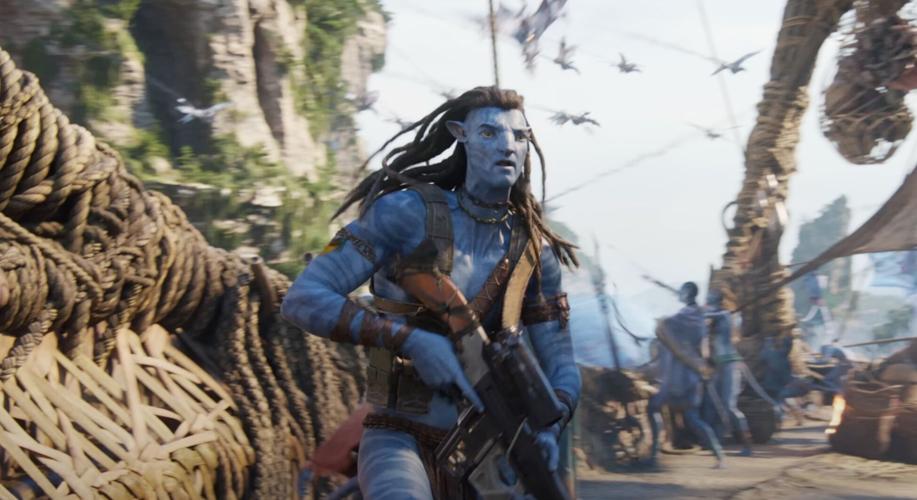
Sam Worthington (Clash of the Titans and Terminator Salvation) stars as Jake Sully, a U.S. Marine whose mind is placed inside the body of a Na'vi. Humans can't breathe the air on the planet of Pandora. They need gas masks, but humans can inhabit the bodies of Na'vi clones. This is what Jake does, but, instead of helping the military forces to colonize Pandora, Jake decides to join with the Na'vi to fight against the human military and their advanced technology, even though the Na'vi have very primitive weapons, exclusively bow-and-arrow weapons made out of wood and sticks. The Na'vi that we've encountered are content with using these weapons and thinking they can face any challenge, even the human forces. They are guided mostly by their religious beliefs and their faith in a god-like or goddess-like figure called "Eywa," or Great Mother. Jake doesn't really believe in Eywa and he'd rather scavenge for human weapons like machine guns in order to help in the fight.
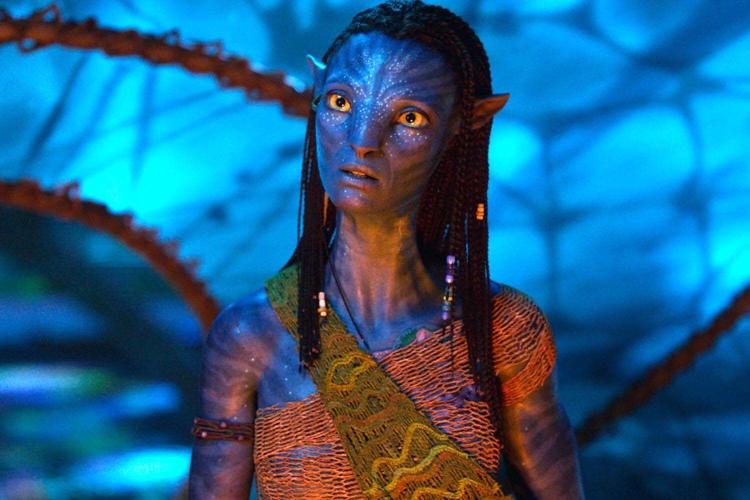
Zoë Saldaña (Guardians of the Galaxy and Star Trek) co-stars as Neytiri, a naturally-born Na'vi who is a part of the forest clan. She was technically a princess, but she is more a warrior who is highly trained and skilled in combat and bow-and-arrow work. She became a mother herself in the last film. She was matriarch to five children overall. Two of which were not her biological children. Of those two, one wasn't even a Na'vi. She and Jake basically adopted a human boy, a boy whose biological father was killed by Neytiri at the end of the 2009 film. However, Neytiri has a lot of hatred toward humans because they're trying to colonize her home and destroy everything that she's known. A part of her wants to get rid of this human boy, but Jake sees that as her hating or rejecting Jake because inside he's human and that humanity has also been passed along to their other children.

The humans are the enemies here and basically remain so. There are obviously some humans who aide the Na'vi here and there, but the two groups, humans and Na'vi, remain hostile to each other. Cameron has announced that the possibility for more sequels after this one are planned. I can see that he is perhaps building to an ending where we see peaceful co-existence or an ending that includes assimilation where humans integrate themselves and join the Na'vi way of life. There are strong attempts to get the villain of this film to do so. Several scenes consist of Jake trying to convince the villain to assimilate or accept the Na'vi way of life. There's also one prime example of that assimilation happening in figurative and literal ways.
Jack Champion (Freaky Tales and Scream VI) reprises his role of Spider, the aforementioned human boy that Jake and Neytiri adopt as their own. The best description I can give for Spider is that he's very much reminiscent of Mowgli, the character from The Jungle Book (1967). Mowgli was a human boy who was raised in the forest by animals. It's not to compare the Na'vi to wild animals, although the animals in the Rudyard Kipling adaptation were just as civilized as the humans, if not more so. Yet, the struggle of that 1967 Disney classic was whether or not Mowgli would stay in the wild with the native creatures or if he would rejoin the humans. It's the same for Spider. It's a struggle over whether he'll stay with his adopted family in the Na'vi or if he'll return to living with the humans.

Just like in Avatar: The Way of Water, a lot of this film is simply about the back-and-forth of the military forces pursuing Spider and trying to capture him and bring him back to the side of the humans. The Way of Water was mainly about pursuing Jake with a similar motive as to the one in Cameron's The Terminator (1984) where it was about stopping the leader of a rebellion, in order to quell that rebellion. Here, the motive for pursuing Spider is a bit more complicated. Without spoiling it, Spider becomes special in that he can bridge the gap between the colonizers being able to colonize more easily, as well as those who wish for assimilation and peaceful co-existence, which for some is a reason to capture him and for others a reason to kill him.
Stephen Lang (Don't Breathe and Conan the Barbarian) also reprises his role of Colonel Quaritch, a fellow Marine who was too transferred into the body of a Na'vi. He's similar to Jake in more ways than one. Quaritch is the actual, biological father to Spider, or at least he was before Neytiri killed his human body. Quaritch wants to be Spider's father, which is exactly what Jake wants as well. These two dads are battling over that role and over possession of Spider. Unfortunately, despite being inside a Na'vi body, Quaritch doesn't like the Na'vi and is fully on board with the military wanting to colonize and possibly destroy them. This runs counter to what Spider wants. Spider loves the Na'vi and wants to assimilate and fully integrate into their culture. It's ironic in that father and son are polar opposites.

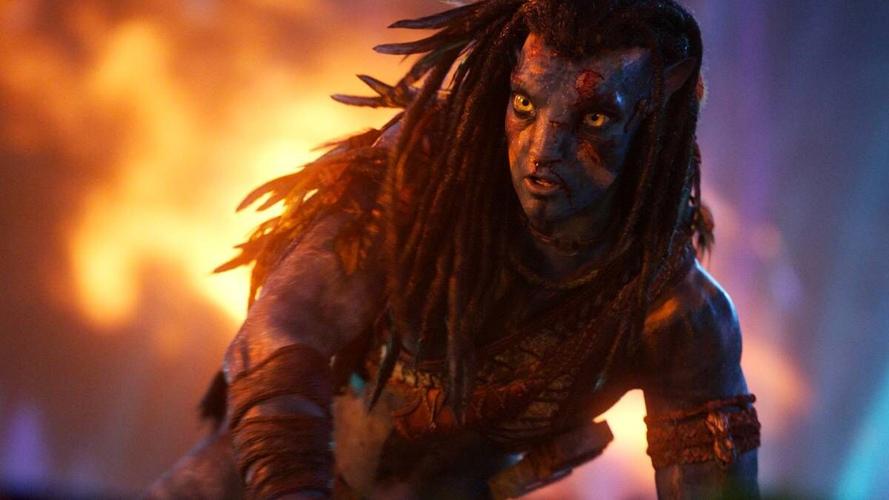
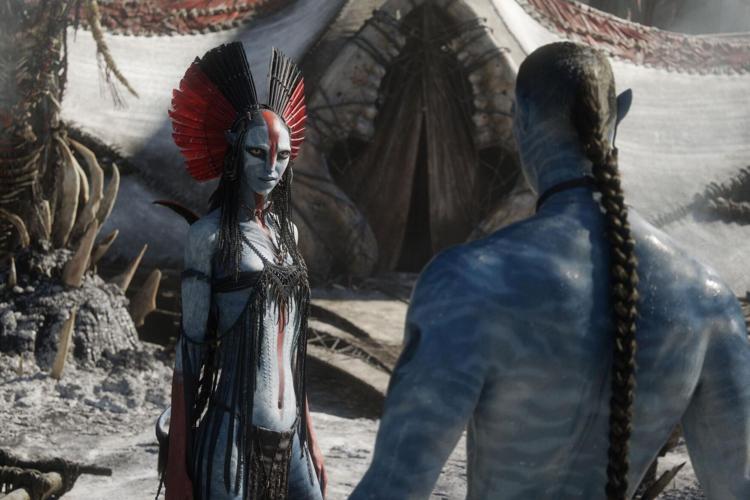
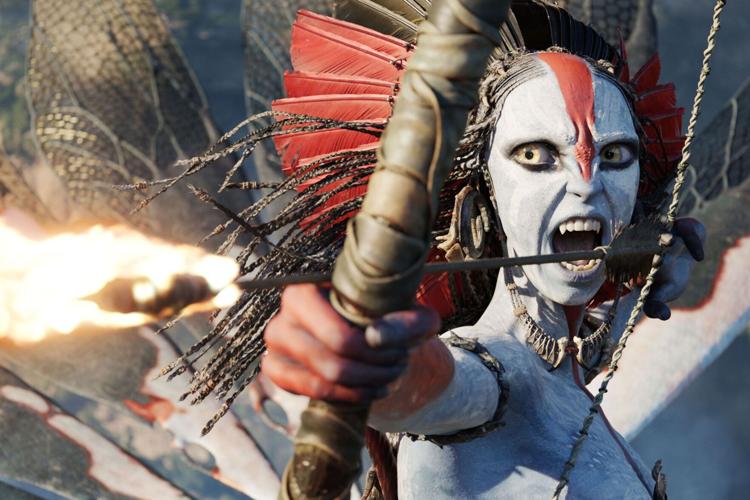
Oona Chaplin (Taboo and Game of Thrones) is the other notable actor here who plays Varang, the Na'vi leader of what's called the "ash people." She's in charge of those who could be considered fire-based. They live near a volcano and have learned to utilize fire in almost everything they do. I imagine that all Na'vi know how to make fire in order to cook food, but what sets Varang and her people apart is that they use fire in their weapons. They also use bow-and-arrows but the tips of their arrows are usually burning with flames. Varang also has other abilities that she can do with fire. She can cast spells to make people tell the truth, for starters.
The problem is that we don't spend enough time with Varang and her people to get a full sense of who they are. At one point, a character refers to Varang and her people as "savages" or "hostiles," which is a derogatory term used against Native American or Indigenous people. I imagine that Cameron's whole point is that we're supposed to see Varang and her clan, as well as all Na'vi as more than just savages or hostiles. The way to do that is by spending time with them and getting to know them. However, Cameron doesn't do that for Varang and her people. They're simply seen as this wayward threat. Because this film is meant to be yet another stepping stone to what will likely be a fourth installment, I imagine that Cameron has plans to investigate Varang and her people in the next film. Yet, that makes the title of this film even more baffling. It felt like this film was going to be a delving into Varang and her clan, but instead they feel more like accessories to what is a repeat of the fight between Jake and Quaritch.

Literally, the final battle scene is almost a beat-for-beat repetition of the final battle in The Way of Water. Cameron knows how to put together great action scenes. Unfortunately, with such repetition, I felt a bit bored once it finally got to the end. Varang and her tribe intrigued me and upped my interest, but so much was simply hitting the same beats as the previous film without advancing things at all. The ending of this film essentially leaves the characters in the same place where they were at the end of that 2022 flick. We didn't learn anything new and we didn't go anywhere new, so it felt like Cameron really was just spinning his wheels.
Rated PG-13 for action, violence, bloody images, and some strong language.
Running Time: 3 hrs. and 17 mins.
In theaters.