


This year marks the 50th anniversary of Rocky (1976). That film was the highest-grossing motion picture of the year of its release. It went on to be nominated for 10 Oscars at the 49th Academy Awards. It won three, including Best Director and Best Picture. Sylvester Stallone was nominated for Best Actor and Best Writing, which is the first time that a person was nominated in both those categories in the same year since Orson Welles' Citizen Kane (1941) did it at the 14th Academy Awards. Rocky spawned eight sequels, five direct continuations with Stallone as the lead and three spin-offs, starting with Creed (2015). All of which have made nearly $2 billion in the box office. The franchise has been very successful and has become an institution onto itself. It's now an American icon and a cultural phenomenon. Much like Saturday Night Live (1975) had its 50th anniversary, which included a feature film about the making of that show's first episode, this is also about the making of that first installment in the Rocky franchise.
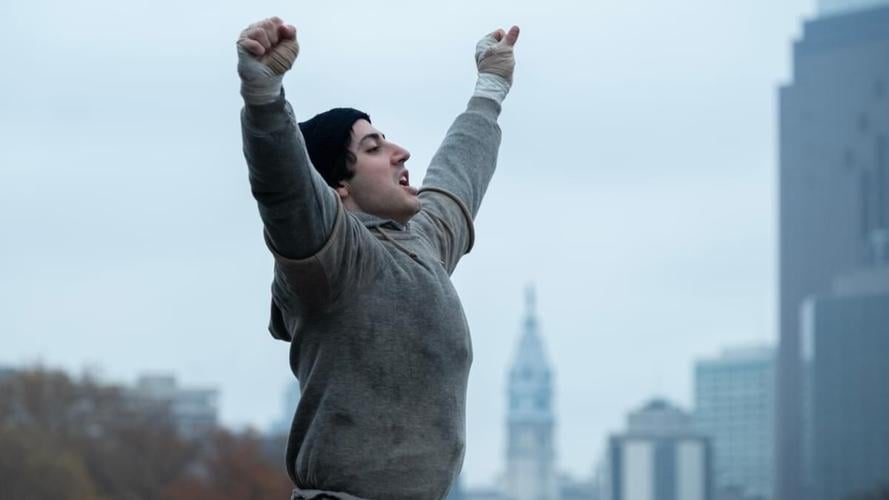
Anthony Ippolito (The Offer and Grand Army) stars as Sylvester Stallone, a struggling actor in New York City. He hasn't had much luck and he eventually becomes homeless because he isn't really booking gigs or if he does, they're small roles that don't afford him much. He's forced to do desperate things in order to survive. This includes taking a role in an adult film, which doesn't care if he can do any emotional acting. All adult films care about is if the person is sexually attractive. Sylvester works out, doing calisthenics in the park and bulking up like a bodybuilder would. Yet, he's not just all muscle. After demonstrating some literary aptitude, he turns to writing because he doesn't believe that he will ever get a lead role unless he gives one to himself. This idea becomes his motivating force. The message of the film becomes betting on oneself, maintaining artistic integrity, creative control and never giving up on your dream.

What happens is that Sylvester writes the screenplay for Rocky and he manages to get it to two producers. The producers like the script. The producers take the script to a studio executive at United Artists who also likes the script, so much that he's willing to finance the project, but the only condition is that the studio executive wants a celebrity or a well-known movie star to be the lead. Yet, Sylvester insists that he wrote this script so that he can star in it himself. The studio executive offers lots of money to Sylvester to buy the script, but Sylvester refuses to sell unless he can be the lead. A large chunk of the film is about this back-and-forth negotiation, which underscores the point that money isn't as important as one's artistic passion and determination, as well as one's dream.
At the same time, this film is trying to mimic the theme of Rocky, which is widely considered to be the ultimate underdog story. There had been numerous underdog stories that came before Rocky, but Rocky became emblematic and the poster child for underdog characters moving forward. Rocky Balboa was the guy who was considered a "bum," or someone who was a waste and isn't likely to win or succeed. However, Rocky's determination, passion, and sheer will-power keep him going and give him the power to go further than he ever thought in order to accomplish what is his dream. It's a thing to which everyone can relate because for a lot of people, even when things are bleak or they're struggling, the only reason that they get up and keep fighting is because they have a dream and it's tied to their happiness. Rocky is literally someone fighting for his dream. It's a powerful theme and the power of that 1976's film was very resonant. It's a resonance that director Peter Farrelly, and writer Peter Gamble, certainly try to capture in this behind-the-scenes romp.

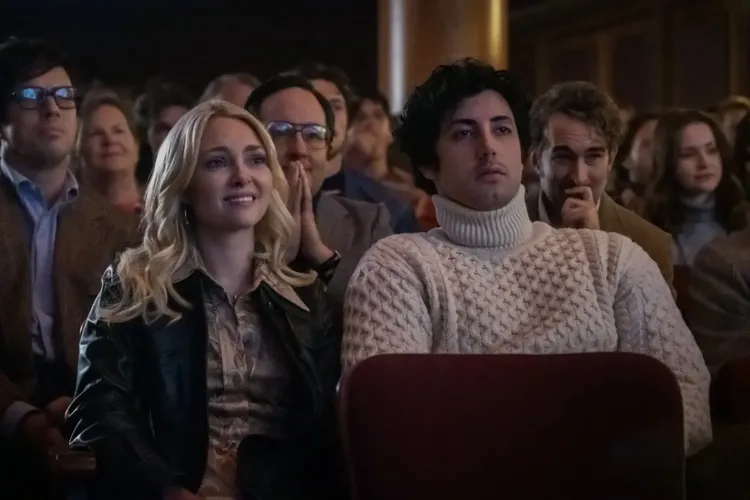
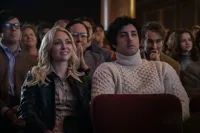
AnnaSophia Robb (The Carrie Diaries and Rebel Ridge) plays Sasha Czack, the wife of Sylvester whom he meets working at a Manhattan movie theater. She has a better role than the wife in Farrelly's Green Book (2018). This is in large part due to the structure of this film, as opposed to that 2018 Oscar-winner. Sasha gets to be more involved in Sylvester's work. We see her helping him to write his script. Using his left hand, he scribbles his ideas onto legal pad. She's the one who literally types it up on a typewriter. She even gives him notes. Later, she's on set and assisting or being somewhat more than a sounding board. Their initial dialogue is charming and engaging banter that always made me like them as a couple more than the easily dismissed "wife character" that we get in most, male biopics.
The producers of the film are Irwin Winkler, played by P. J. Byrne (Green Book and The Wolf of Wall Street), and Robert Chartoff, played by Toby Kebbell (Ben-Hur and Dawn of the Planet of the Apes). They have an integral role in this narrative and in Sylvester's life, given that they were the ones who helped him make a lot of the decisions all along the way. In terms of memorable performances though, Pulitzer Prize-winner and Tony Award-winner, Tracy Letts (Saturday Night and Lady Bird) eclipses all of them as Sandy Maddox, the aforementioned studio executive at United Artists who is financing Sylvester's project. He likely gets most, if not a lot of the laughs in this film, as this overbearing and no-filter, Hollywood wheel-and-dealer.

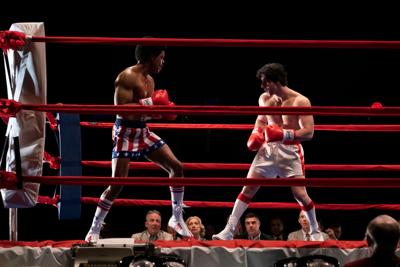
Jay Duplass (Other Mommy and Transparent) plays John G. Avildsen, the director of Rocky. He was chosen because Sandy won't give them any more than a million-dollars to make the film, which is incredibly low-budget, even in the 1970's. John has experience with low-budget filmmaking. His main contribution to the vision of the project is that he states early that Rocky isn't a boxing film, but a film that just happens to have boxing in it. As such the focus isn't on boxing, plus neither John nor Sylvester know much about the sport, beyond watching some matches on television, which doesn't really qualify either to make a boxing film. As such, this film touches upon the idea of eschewing conventions when it comes to making a certain thing.
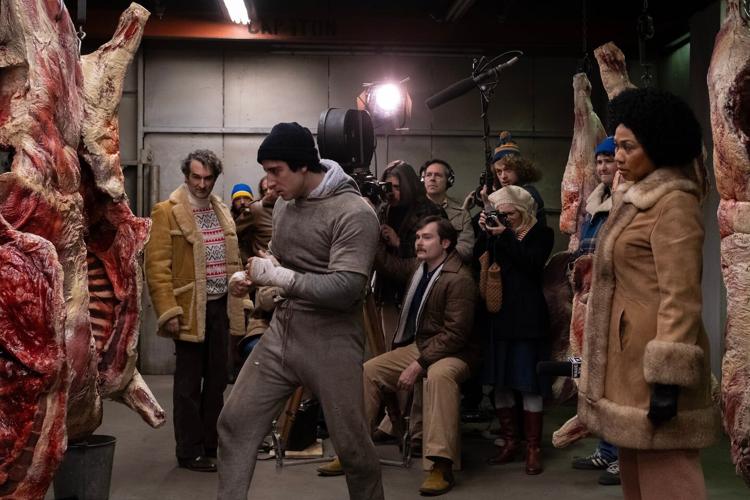
Unfortunately, this film only touches upon it, skimming the surface of how unconventional this film was. One of the ways this film skims is by reinforcing how having little money forced the makers of this project to make sacrifices or changes to what was originally in the script. The main battle comes at first with Sylvester being upset by the fact that because they have such a tight schedule, the project only has time to give him one take for every shot. Often, actors are allowed multiple opportunities to do a shot or deliver certain lines. Sylvester doesn't get multiple opportunities. He doesn't even get two. He has to do each shot only once. While it's not the convention, it forces Sylvester to draw upon the things that inspired him to write the project in the first place and basically be himself or be natural, which could be a negative or a positive to being an actor, which is Sylvester's ultimate dream.

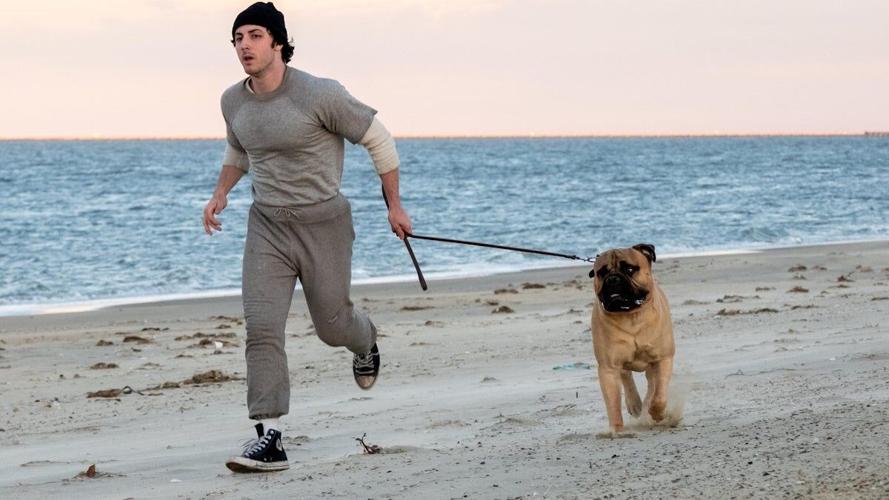
Farrelly's film is entertaining in how it breezes through the making of this Oscar-winning classic. So much goes wrong and it's funny to see everyone involved power through it. There's a lot here that could've gotten explored more deeply. For example, Rocky was one of the first films to use Steadicam, which was a kind of big deal. This film really gives it the superficial treatment. This is fine because Farrelly isn't that concerned about the technical process. It's more about the emotional process and how Sylvester is feeling. There is a connection that the film makes about Sylvester's father, Frank Stallone Sr, played by Matt Dillon (Crash and There's Something About Mary). Every scene with Dillon and Ippolito are very well done and well acted, but whatever connection between father-and-son and the making of Rocky feels lost in the weeds. For example, I feel like there's more of an emotional connection between Sylvester and his dog, than Sylvester and his father. More scenes should've been devoted to that dynamic if we're really meant to care about it.
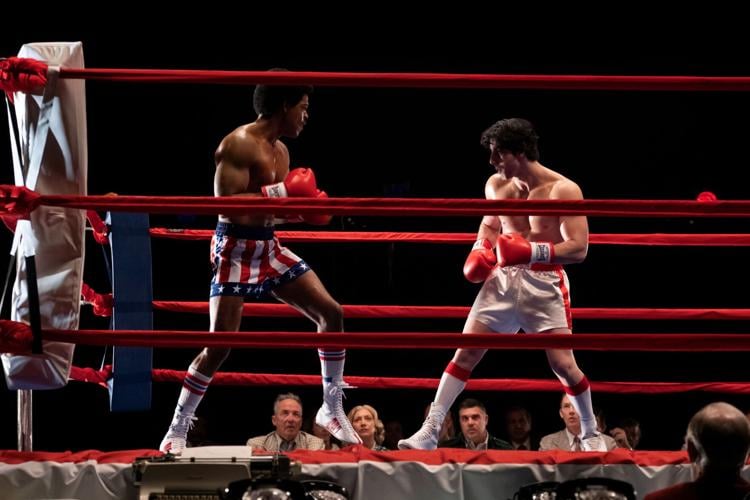
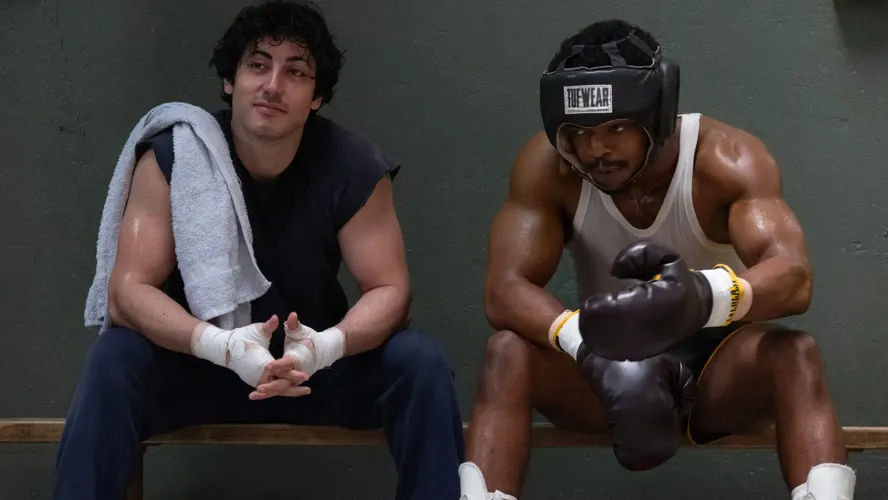
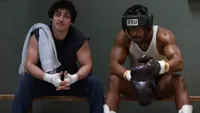
Stephan James (If Beale Street Could Talk and Race) rounds out the cast as Carl Weathers, the actor who co-stars with Sylvester Stallone in Rocky, as his boxing rival. He has probably the best introductory scene of any character here. He's a bold, in-your-face, very confident actor, if not overly confident and cocky. Arguably, the character of Apollo Creed whom Carl is cast to play was inspired by Muhammad Ali, a very specific and well-known personality. Carl walks into the audition room very much exuding Ali's same energy and vibe. Carl might as well be playing Ali as much as he nails that persona. My wish is that he could've been in the film more, but, as stated, the film isn't about boxing, so there was perhaps no room. Given that three actors from Rocky were nominated for Oscars, that of Talia Shire, Burgess Meredith and Burt Young, it's a bit of wonder why they are so shunted or sidelined in this narrative.

Rocky was also nominated for Best Editing and Best Sound. Yet, Farrelly's film doesn't devote any time to the post-production process. Based on the final scene in this film, Sylvester didn't have much or any input in the post-production process. He has no idea how the film will turn out, not until he attends the premiere and see it on the big screen for seemingly the first time. As such, I get that Farrelly's film wouldn't include any post-production stuff. As a fan of Rocky, it would have been interesting to see that part. Yet, there's likely a documentary or special feature on a DVD somewhere that perhaps covers that process.
Rated PG-13 for strong language, brief sexual material, and smoking.
Running Time: 2 hrs. and 8 mins.
In theaters.