



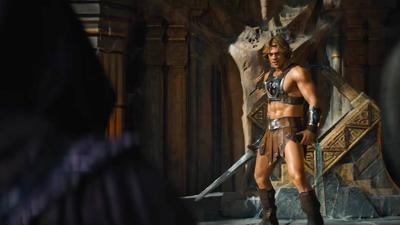
Mattel, the toy company, created this franchise in 1982. It started with action figures and comic books. Eventually, it turned into an animated series in 1983. That cartoon went into syndication and ran for a decade or more. A live-action film, starring Dolph Lundgren in his first leading role, was made in 1987. Unfortunately, it got mixed-to-negative reviews and was a commercial failure, which in part led to the sinking of that film's production company, Cannon Group. Following that, the franchise was limited to additional animated shows that have appeared in every decade since the original. There was a series in the 90's, one in the 2000's, one in the 2010's, and etc. There have also been a variety of video games. Reportedly, this film was in development in 2009 and has bounced around from studio-to-studio, director-to-director, and actor-to-actor for over a decade. According to certain articles, there have been creative and budgetary reasons for all the punting that's been done. It's interesting because Amazon MGM Studios purchased the rights to this feature in the fall of 2023, following the mega success of Barbie (2023), which was also an adaptation of a Mattel toy.
Capitalizing off the success of Greta Gerwig's Barbie would seem like a no-brainer. Gerwig's film was a meta-comedy that was about the titular character going from her own world into what could be considered the real world or the human world where she encounters commentary about her, her identity, those she knows and the environment in which she normally lives. This premise or framework is pretty much copied in this film. Aaron and Adam Nee are credited writers on this film. They could've set up the framework that's here presently, or it could be the work of Chris Butler, the frequent collaborator of Travis Knight, the CEO of Laika, the stop-motion company, and current director of this Mattel feature. Stop-motion characters are not that far flung from action-figures, so it makes some kind of sense to get Knight as the director here. However, if the Nee brothers did establish this film's framework, they couldn't have been copying what Gerwig did because they were reportedly working on this film a year or so before Barbie was released. As I watched the film, what its creators under Knight or under the Nee brothers could have been copying is Marvel Studios' Thor (2011) or specifically its second sequel, Thor: Ragnarok (2017).

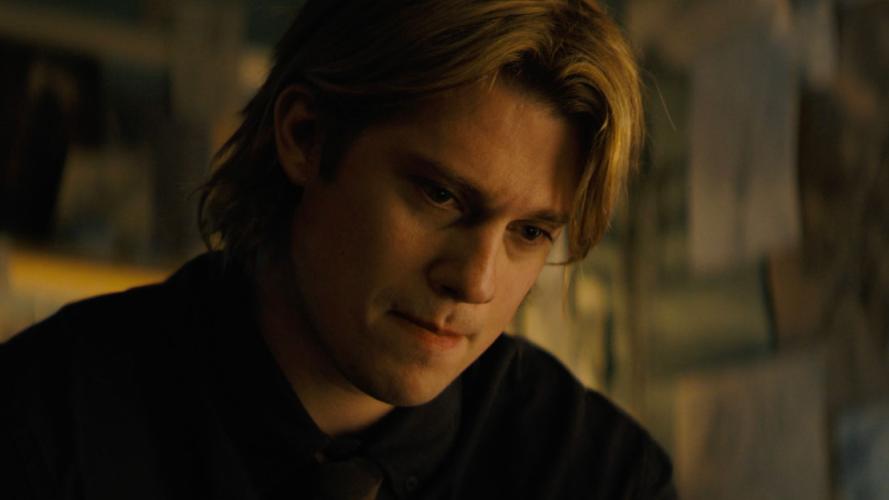
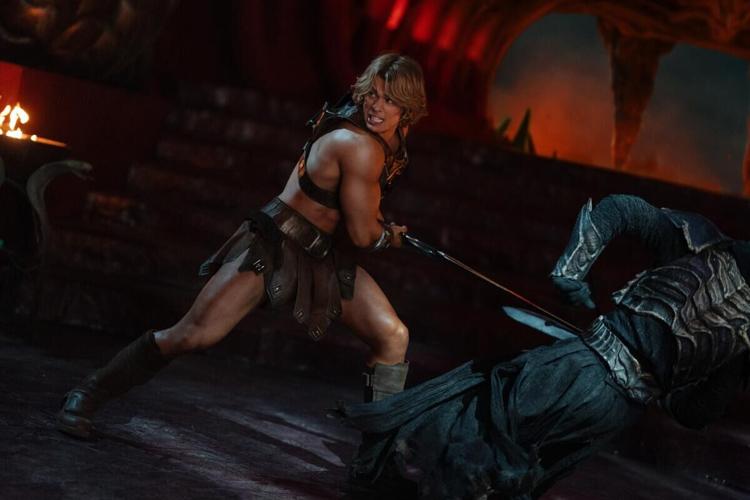
Nicholas Galitzine (The Sheep Detectives and Red, White & Royal Blue) stars as Adam Glenn, a young man who lives in Oklahoma City. He's 25. He works at a human resources company where his job is to help people to find employment. He's described as the best because he's very compassionate and very honest. He's probably too honest. He's so honest that he'll tell anybody that he meets, including the guy who is his roommate and random women whom he dates, that he's actually a prince from another planet and the thing that will help him return is a magical sword. Of course, his roommate and date look at him like he's crazy. The bulk of the humor in this mostly comedy-filled, action flick comes from Adam's insistence that he's from another planet and he needs to find this magical sword.
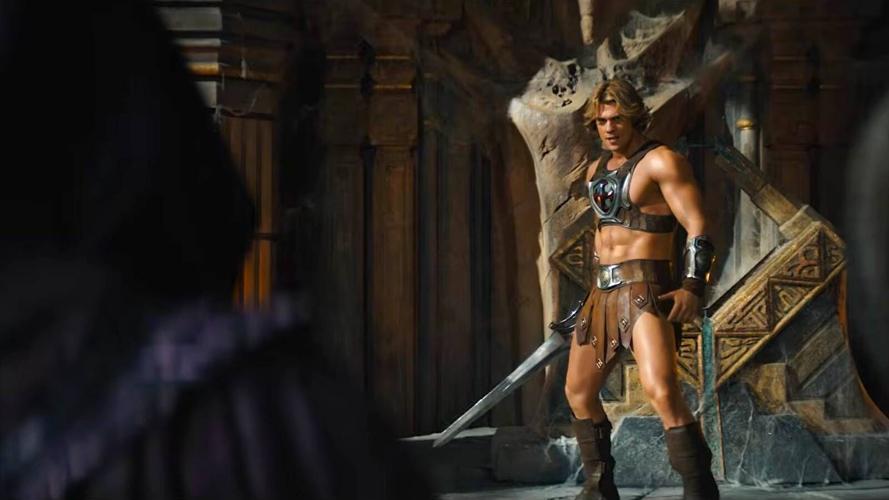
However, it's no mystery what Adam's backstory is. Having him on Earth feels like an excuse to allow for the same dynamic that exists in Barbie. It allows for the filmmakers to make meta-commentary on the Mattel franchise, specifically the iconography of the character known as He-Man, spoofing that iconography and everything around it. They even go as far as making fun of the name "He-Man" and how ridiculous it is. Yet, in Masters of the Universe (1987), Lundgren was essentially playing the same character as Galitzine and Lundgren's He-Man, aka Prince Adam, was never spoofed or made to be the butt of the joke, not really. His character was taken seriously. Yes, there was humor around him and in the narrative, but Lundgren's character and the iconography around him was treated very seriously.

This is why I compare this film to Thor, which was directed by Kenneth Branagh and Thor: Ragnarok by Taika Waititi. Branagh's film took the protagonist, this super buff, super muscular, blonde man from another planet, dropped on Earth, and treated him and the things on his home planet with almost Shakespearean reverence. It wasn't exactly that serious, but it approached that level, injecting humor by sheer contrast but never really mocking or deriding it. This is opposed to Waititi who basically mocked and derided the whole thing, almost from the very beginning of his 2017 film. Under Branagh, Thor was an almost Shakespearean character from one of the Bard's tragedies. Under Waititi, Thor became a standup comic or a character from a sitcom. The 1987 film with Lundgren felt like it leaned more toward Branagh's vision, whereas this film feels like it leans way more toward Waititi's vision.
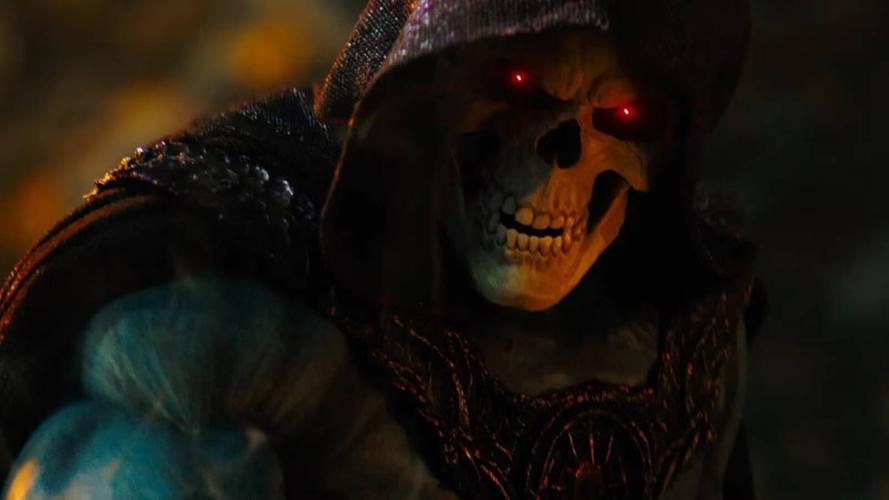
Jared Leto (Suicide Squad and Dallas Buyers Club) co-stars as Skeletor, the warlock whose body is almost as muscular as Adam, but he wears a cloak over his shoulders and head to partially cover the fact that his head is nothing but a bare skull. His head has no flesh. It's simply talking bone. The 1983 animated series made light of the fact that the man had a skeleton head and sometimes made silly jokes about it. The 1987 live-action film, starred Frank Langella, and the character was treated with a bit more gravitas, even though Langella arguably imbued some camp into it, much in the way Heath Ledger would do in The Dark Knight (2008). Where Langella and Ledger sprinkled a little camp, Leto puts large scoops of camp into his performance here. It's not as annoying as his Joker in Suicide Squad, but instead scoops of fun. As I watched him, I got a sassy and whiny guy, not unlike Jafar in Aladdin (1992) or Scar in The Lion King (1994).

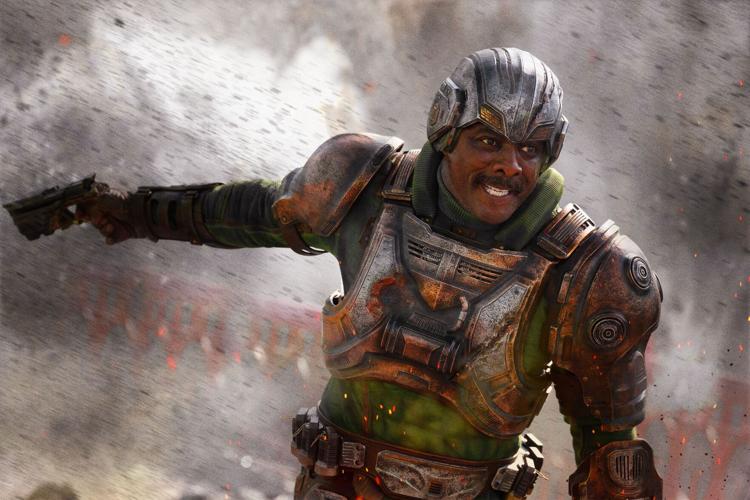
Idris Elba (Beasts of No Nation and Mandela: Long Walk to Freedom) also co-stars as Duncan, aka Man-At-Arms. Elba was also in Thor, which further underscores the comparisons here to those Marvel Studios films. This film makes better use of him than in any of those Thor films. He gets to a play a bad-ass warrior, a dutiful bodyguard, a loving father and even a drunk, later in the film. His drinking is even what puts him somewhat at odds with his daughter Teela, played by Camila Mendes (Riverdale), a young female warrior. It's odd because Teela could be seen as a love interest for Adam, but the film does shut down the avenue, literally putting Adam in the friend zone, and also by making Duncan a de facto father to Adam, thus making Teela his de facto sister. There's not much more to her, aside from being mad at her dad. Otherwise, she could've been taken out of the narrative with not much lost.
Alison Brie (Glow and Community) plays Evil-Lyn, a sorceress who is the right-hand of Skeletor. She gives funny looks occasionally. She's supposed to sell how bad Skeletor is at times, but she doesn't really contribute much. Meg Foster plays the same role in the 1987 film and she's extremely better and memorable. Brie is totally forgettable here. There's a bunch of people in the supporting cast who seem to only exist for certain gags that are mostly rudimentary. Most are rather forgettable too.

Some might think that Lundgren in the 1987 film was forgettable. This is mainly due to Lundgren's He-Man not having much of an arc or really much of a personality. Lundgren was mostly just an action-figure. Galitzine's Adam or his eventual He-Man does get a personality. Despite being fated as becoming this muscle-bound hero who wields a sword and fights like a champion, Adam is a more sensitive guy who at first doesn't want to fight but prefers talking out conflicts. The film tries to reckon with this personality trait and reckon with this idea that masculinity and leadership is built around being physically strong and violent. The film doesn't go the way of Wonder Woman 1984 (2020) and not end with a fight sequence, but having one does betray the initial themes of Adam learning that violence isn't necessarily the answer. There is a way to end an action film or superhero film like this without using violence and it was done in Christopher Nolan's The Dark Knight (2008).
In that vein, the 1987 film didn't really portray He-Man as this god-like being. He was mortal and could be killed or scarred. This film does the opposite and gets to a point where Adam is this god-like being, again not unlike Thor, which rather eliminates the stakes. At least in Thor, the premise was that the titular character had his powers taken away, so he could be killed. We come to learn that that's not really the case here. Adam is god-like, so there are no stakes. That would be fine, but the final fight isn't even interestingly shot. The final fight in 1987 had such great lighting and cinematography that made it a bold spectacle in itself. Here, the final fight is fun and cartoon-like, but I wasn't that impressed.
Rated PG-13 for action, violence, suggestive material, and language.
Running Time: 2 hrs. and 20 mins.
In theaters.