











Just over a decade ago, author Andy Weir had his debut novel adapted into a blockbuster film, The Martian (2015), which made two-thirds of a billion in the box office and was nominated for seven prizes at the 88th Academy Awards. Weir's work was clearly a huge success. It makes sense that Hollywood would be interested in Weir's next book and the one after that, and so on. Weir's second novel is still in development. This film is based on Weir's third novel. The Martian was about an astronaut stranded on the planet Mars. It's about him having to figure out how to survive using the resources he has with his major problem being starvation. It's also about the crew of another spaceship also trying to figure out a way to rescue the astronaut, which puts them in danger as well. Those familiar with those details will also find a lot of similarities in this narrative. Drew Goddard was the screenwriter of The Martian for which he was nominated for an Oscar at that 88th Academy Awards. He's also been nominated for Emmy Awards for his work on Lost (2004) and The Good Place (2016), which are two shows I love, so Goddard is a good writer. It's ironic that Goddard is so attracted to space stories, given that one of the pioneers of space travel was Robert H. Goddard whose name is on a NASA facility outside DC.
The Martian was directed by Ridley Scott, which had some comedic elements, but this film is directed by Phil Lord and Christopher Miller, collectively known as Lord and Miller. They've directed films like 21 Jump Street (2012) and The Lego Movie (2014), which are comedies. The latter is a manic, fast-paced, animated feature, which has come to exemplify their style of film-making. This film isn't as manic or as fast-paced as Lord and Miller are capable of doing, but it leans that way and leans more in the comedy realm. The Martian was nominated in the comedy category at the Golden Globes, and supposedly an argument could be made, but most people didn't see that film as an outright comedy. This film won't have that problem. It is intended to be a funny film.

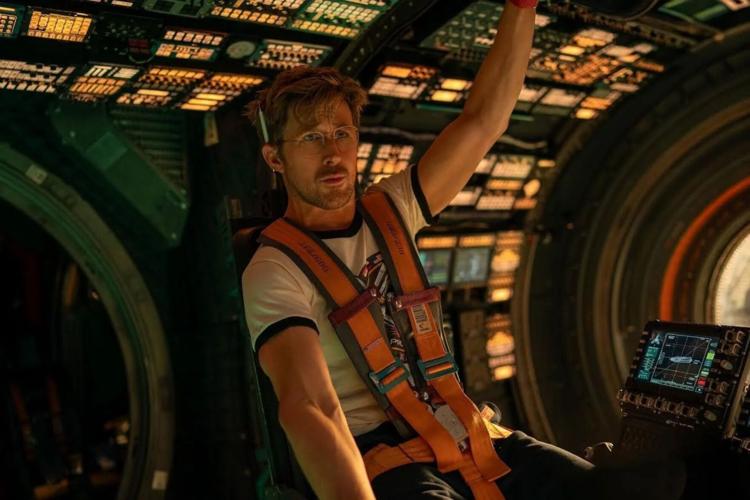
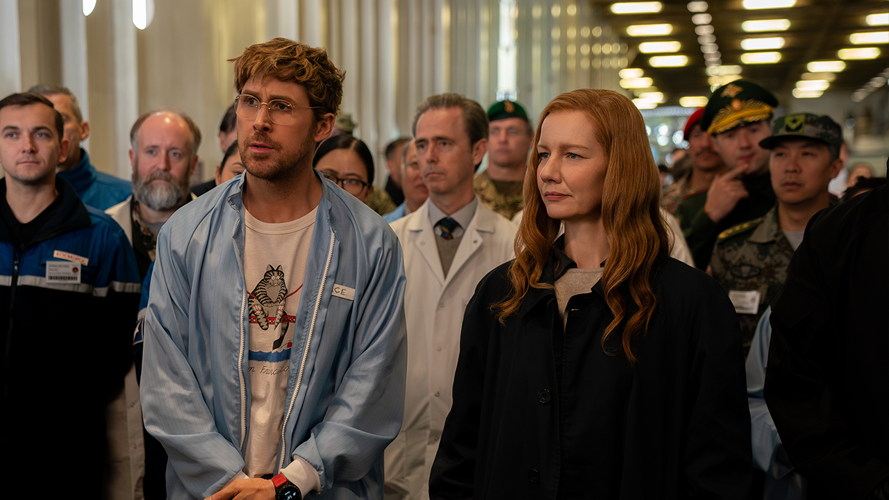
Ryan Gosling (Barbie and La La Land) stars as Ryland Grace, a science teacher at a middle school. He has a degree in molecular biology and tried to work in the bigger science community for a laboratory or some government organization, but he got kicked out of that community because he had ideas that were contrarian or that were perhaps too different for most people. Despite being a funny, charming and good-looking guy, he's not in a relationship. He doesn't seem to have family or friends. This perhaps makes the choice he has to make easier because he's approached to be involved in a mission that involves going into space on a one-way trip where he will ultimately die. There's an aspect about that choice that I want to criticize, but doing so will involve spoilers, which I will delve below.
The film starts with Ryland waking up on board his spaceship on route to Tau Ceti, which is a star, similar to the Earth's Sun, that is about 11 light-years away. He's going to Tau Ceti because the Earth's Sun is dying or essentially it has a virus, which is killing it or dimming it. Scientists project that in 30 years, the Sun will be so dimmed that the Earth will start to freeze, plunging the planet into a permanent ice age, wiping out half of the population. This phenomena is not only happening to the Sun, but it's also happening to other stars within the galaxy. The one exception is Tau Ceti. Tau Ceti isn't dying. It's perfectly fine. Ryland's job is to figure out why Tau Ceti is fine.

Sandra Hüller (The Zone of Interest and Anatomy of a Fall) co-stars as Eva Stratt, a German scientist who has identified what the virus is. She's even identified that Tau Ceti is the one star that isn't dying. She simply needs a scientist who can put the pieces together, as well as a scientist who is brave enough to go on this suicide mission into space. She has a stereotypical, German disposition or way about her. She's stoic, straightforward and no-nonsense in her personality. She should be this way because she's working to stop an apocalyptic and extinction-level event. If she has a sense of humor, it's very deadpan. She's of course the straight man bouncing off Gosling's Ryland who is not totally manic and fast-paced but anxious and awkward. They become a rather subtle comedic duo.
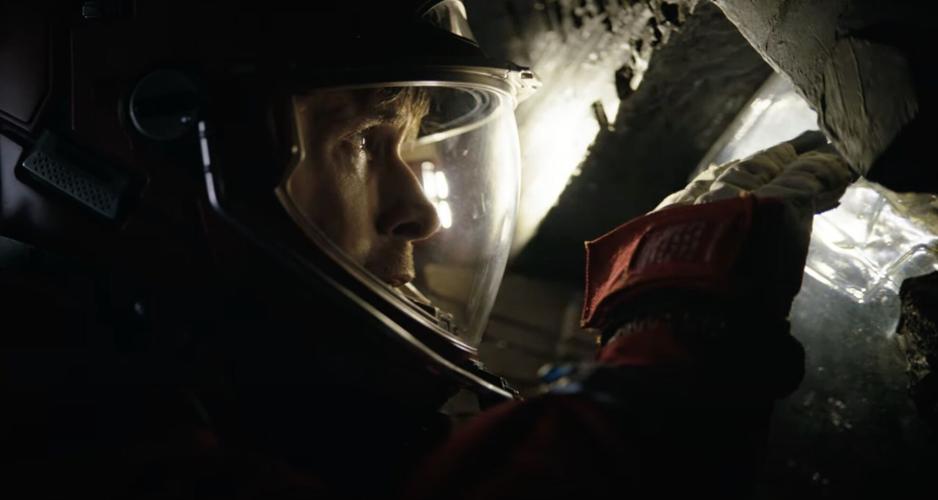
Her role in the film is minimal though. This film is mostly Gosling by himself on screen. Again, structurally, it's like The Martian, which is mostly Matt Damon alone, except for when the film cuts back to what's happening on Earth simultaneously. Here, it's mostly Gosling alone, except for when the film shows flashbacks to before Ryland left, so we see how he got to be up in space and how he and Eva prepared for the mission on which he embarks. A large chunk, if not the majority of this film, is Ryland traveling to Tau Ceti and discovering alien life. As such, reminders of other space films come to mind. When Gosling hosted Saturday Night Live for its Season 51, Episode 14, other than mentioning Harry Styles' music being in this film, he also referenced Interstellar (2014) and E.T. the Extra-Terrestrial (1982). Most people of a certain age might think of Danny Boyle's Sunshine (2007), which probably is the most obvious comparison.

Another comparison that immediately jumped up was Denis Villeneuve's Arrival (2016), which a lot of that film is not only discovering new alien life but also it's about the protagonist learning how to communicate with that new alien life. There's also a specific scene in Project Hail Mary that invokes imagery or one image from Stanley Kubrick's 2001: A Space Odyssey (1968). Villeneuve and Kubrick's films had a slower pace or more contemplative or almost meditative mood to them. The pace here is instead much quicker. It's certainly quicker than The Martian, which seemed like it had time to dwell and allow people to absorb the scientific information being presented. As such, The Martian felt like it cared more about the science. Yes, the dramatic aspects were important, but it felt like it gave equal weight of importance to the science. Project Hail Mary treats the science as if its lessons for elementary school children and it feels like it cares more about the comedy and the silly jokes, which can be entertaining, if not hollow.
James Ortiz is the voice and the puppeteer for the alien called "Rocky," a stone-like and spider-like creature from a star system called Eridani. The relationship between Ryland and Rocky is supposed to be the emotional core or the heart of this narrative. It actually is comparable to E.T. the Extra-Terrestrial in that both Ryland and Rocky behave like children, particularly Rocky. What becomes obvious is that Rocky has more advanced technology than Ryland and humans. Yet, Rocky behaves more like a child than even Ryland. As such, children and families can be safely entertained. Unfortunately, for those looking for more mature and more complex depictions, that's not really at hand here. Some might argue differently, but a look at the politics of Rocky or how aliens deal with things like bigotry, religion, war or anything thorny is strongly avoided.

Spoiler alert! Spoiler alert! Spoiler alert!
Despite the fast-pace and quick editing, this film still felt too long. This is in part due to this film having not one, not two, but three endings. The second ending feels very repetitive. The third ending basically undermines the first two endings, which were supposed to be poignant and tear-jerking. This third ending, as it were, is faithful to what happens in Weir's book, but, in the context of this film, it feels too long and it feels as though a studio executive or focus group deemed this film needed a sappier stinger or an even more upbeat ending. Despite the second ending being rousing and imparting a note of friendship and sacrifice, that sacrifice seems to come off as perhaps too depressing because the third ending basically reverses the sacrifice.
Finally, there is another reveal at the end that shows us that Ryland never actually chose to go on this space mission. What we learn is that Eva drugged him, putting him into a coma, and then placed him on the ship against his will, forcing him on this suicidal mission. She did this because the scientist and the backup who was supposed to go on this mission got killed in an explosion. She claims that Ryland is the only one left alive who has enough knowledge about the mission and the virus that's killing the Sun, so he has to be the one to go. That idea feels problematic on various levels. First of all, Ryland as depicted by Gosling comes across as not as competent as one might think or hope.

Lionel Boyce (The Bear) plays Carl, a security guard who is assigned to keep watch over Ryland when he's still on Earth working with Eva to analyze the Sun's virus. At one point, Ryland is stumped and he asks Carl for advice. Carl comes up with a theory that ends up being right. When Ryland has a question about something, Carl comes up with a solution. It's not very reassuring that Ryland can't get to these answers himself and that he needs Carl who isn't a scientist to come up with fixes. Also, at another point, once Ryland figures out how to replicate the virus, he meets other scientists, gathered from all over the world, who have already figured out how to use it to create fuel. These scientists feel like they are many steps ahead of him. So, when it gets to the end and we hear Eva making this argument that Ryland is the only person and the only scientist who can go on this mission, it's ridiculous and brings the film to a screeching halt.
Based on what we see Ryland do in space and in this mission, he doesn't come across as so special that he had to be drugged and forced to do this thing. Most astronauts in NASA are scientists. For example, Buzz Aldrin had a doctorate in science. Many astronauts study aeronautics and engineering, but many astronauts are versed in other fields because many experiments are conducted in space from biological experiments to all kinds. What we see Ryland do is to me nothing beyond what any NASA scientist could accomplish. If he does do anything that is so special that no one else could, the film doesn't underscore it.
Rated PG-13 for thematic material and suggestive references.
Running Time: 2 hrs. and 36 mins.
In theaters.