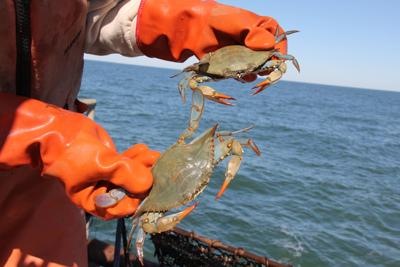
CHESAPEAKE BAY - Scientists studying the Chesapeake Bay’s iconic blue crab say the species is not currently considered overfished, but new research presented to the Chesapeake Bay Commission on Friday suggests the population may be less productive than previously believed.
Researchers unveiled the latest blue crab stock assessment to the commission during a meeting on May 8, offering one of the most comprehensive looks at the fishery in more than a decade. One of the biggest findings presented to commissioners involved recruitment, which measures how many young crabs survive long enough to enter the fishery. According to the assessment, recruitment declined by roughly 50% between 2010 and 2023.
Scientists say blue crabs are heavily dependent on strong year-to-year reproduction to sustain the population. Unlike longer-lived species that can better withstand weak spawning years, blue crabs rely on a steady flow of young crabs reaching adulthood to maintain healthy harvest levels, according to researchers.
Roy Ford, a Deal Island waterman, tells WBOC that the decline in blue crab numbers has seemed drastic in the past decade.
"That's the million dollar question among us watermen,” Ford said. “Hey what's going on here? You know, why is it that we're not seeing the amount of crabs that we're accustomed to."
Despite the potentially troubling results, researchers cautioned against drawing sweeping conclusions too early and emphasized that the findings represent an evolving scientific picture rather than a final verdict on the future of the fishery.
Researchers stressed that the report does not conclude the Chesapeake Bay blue crab population is collapsing. The assessment found that overfishing is not currently occurring, and the stock is not officially considered overfished under current management standards. Still, the numbers presented Friday raised concerns about whether conditions in the Chesapeake Bay have changed enough to limit how many crabs the ecosystem can naturally support.
The assessment, headed by lead scientist Dr. Michael Wilberg with the University of Maryland Center for Environmental Science, examined several possible factors that could be contributing to the decline including habitat loss, warming water temperatures, changing environmental conditions, predation, and the growing presence of invasive blue catfish in some Bay tributaries. The assessment also notes that juvenile blue crabs face heavy mortality from cannibalism by larger crabs, which has long been considered a major factor affecting survival rates.
Out of all of these factors, the main cause for the lower recruitment numbers remains a mystery that Wilberg and fellow scientists hope to solve.
The report also suggests the Bay’s crab population may no longer rebound to the levels seen after major conservation measures were implemented in 2008 to protect female crabs and reduce harvest pressure.
Scientists used updated fishery and survey data spanning from 1994 through 2023 and rebuilt much of the assessment model from the ground up. It marks the first benchmark stock assessment for Chesapeake Bay blue crabs since 2011.
Commercial watermen, seafood industries, and regulators closely watch blue crab assessments as the species remains one of the Chesapeake Bay’s most valuable and culturally important fisheries.
Researchers say future management decisions will likely depend on whether the declining recruitment trend continues in the coming years and whether additional studies confirm the Bay is now supporting a smaller blue crab population than it once did.